

Executive Summary
Premium industrial manufacturers, particularly Germany’s Mittelstand, face escalating pressure from low-cost competitors. China’s state-backed “Little Giants” (专精特新 “Little Giants”) are rapidly migrating up the value chain, combining low cost structures with increasingly sophisticated mid-tier technical specs. This analysis explores the deployment of a Fighter Brand as a strategic weapon to absorb low-end pricing pressure, protect premium brand equity, and block market encirclement.
1. DEFINITION & STRATEGIC CONCEPT OF A FIGHTER BRAND
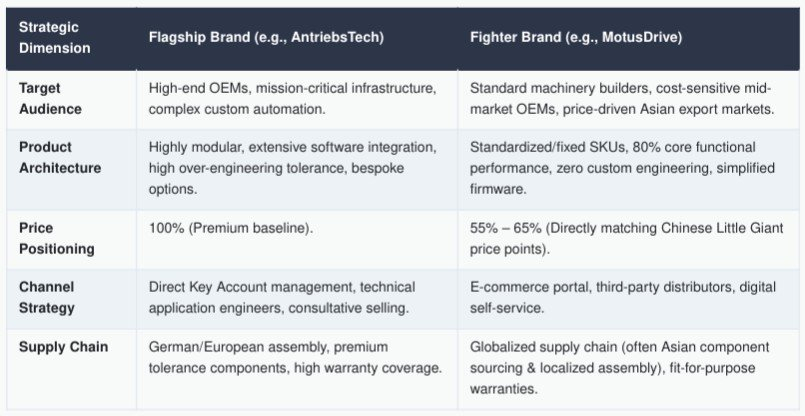
A Fighter Brand (also known as a fighting brand or combat brand) is a secondary brand introduced by a marketleading incumbent specifically to target and neutralize low-cost competitors. Unlike standard brand extensions designed to explore new revenue segments, a fighter brand’s primary objective is defensive: it exists to eliminate or restrict price-focused entrants without sacrificing the margins or premium perception of the flag-ship brand. According to Harvard Business School researchers Mark Ritson and Richard D’Aveni, a fighter brand acts as a “brand shield” or strategic buffer. In consumer markets, classic examples include 3M launching Highland tape to fight low-cost generic tapes, or Qantas launching Jetstar to counter low-cost carriers like Virgin Blue. In B2B industrial engineering, a fighter brand typically strips non-essential high-end features, offers standardized off-theshelf configurations, and utilizes alternative sales channels while maintaining acceptable core reliability.
2. COMPETITIVE CONTEXT: THE GERMAN MITTELSTAND VS. CHINA’S “LITTLE GIANTS”
For decades, the German Mittelstand (medium-sized, specialized B2B industrial leaders, often classified as “Hidden Champions”) dominated niche global markets through extreme quality, deep customization, and high-touch customer engineering. However, the competitive dynamics have shifted dramatically due to the emergence of China’s Little Giants.
The Emerging Clash: German Engineering vs. Chinese Specialization China’s
“Little Giants” Policy: Initiated by China’s Ministry of Industry and Information Technology (MIIT), this program incentivizes thousands of highly specialized SME manufacturers focusing on niche industrial technologies (e.g., precision robotics, sensors, hydraulic valves, CNC components). Supported by state subsidies and rapid domestic scaling, these firms achieve 70–80% of German performance at 30–50% of the price.
When Little Giants enter European, North American, or Asian growth markets, Mittelstand firms face a strategic dilemma: dropping prices on flagship products destroys profitability and brand equity, while ignoring low-cost entrants leads to market encirclement—where competitors dominate lower-tier applications, gain scale, and eventually erode the incumbent’s core premium market.
3. STRATEGIC EXECUTION: MITTELSTAND FIGHTER BRAND ARCHITECTURE
To illustrate how a B2B Mittelstand firm utilizes a fighter brand against Little Giants, consider a hypothetical leading German industrial automation & drive firm, AntriebsTech AG (or real-world strategic playbooks from firms like Siemens with Inovance counter-strategies, or Danfoss with VLT vs. Holip):
4. STRATEGIC RISKS: SUCCESSES AND PITFALLS (THE “FIVE HAZARDS”)
Deploying a fighter brand is fraught with execution risks. In their seminal HBR analysis, Mark Ritson identified five critical traps that firms must navigate when executing a fighter brand strategy:
Key Danger: Cannibalization vs. Combat
If existing premium customers discover they can buy a “good enough” solution from the same parent company at 40% less, sales shift from the high-margin flagship to the low-margin fighter brand, destroying net enterprise value.
Hazard 1 Cannibalization: Failing to hard-fence product capabilities and sales channels, causing existing flagship customers to downgrade.
Hazard 2 Failure to Match Value/Price: Producing a fighter brand that is still too expensive compared to Chinese Little Giants, or so stripped of quality that it fails basic operational requirements. Hazard 3 Financial Bleed: Underestimating overhead costs, resulting in a low-margin brand that burns cash without achieving sufficient volume.
Hazard 4 Management Distraction: Diverting executive attention and engineering talent away from innovating the core flagship products toward managing a low-margin price war.
Hazard 5 Tarnishing Core Equity: Customer confusion over parentage, leading to reputation damage if the fighter brand experiences quality failures in the field
5. PROMINENT B2B & INDUSTRIAL EXAMPLES
While fighter brands are frequently analyzed in B2C (e.g., Intel’s Celeron launched to fight AMD, or Ted by United), B2B industrial technology offers powerful case studies:
- Intel (Celeron vs. AMD): One of the most famous fighter brand successes. When AMD threatened Intel’s lowerend PC market with cheaper processors, Intel created Celeron—a downgraded chip that successfully contained AMD while preserving the premium positioning and margins of the Intel Pentium line.
- Danfoss (Holip Acquisition/Brand): Danish drive manufacturer Danfoss acquired Chinese manufacturer Holip to run it as a distinct fighter brand in emerging markets. This allowed Danfoss to offer low-cost frequency converters in Asia without discounting the core Danfoss VLT series.
- Daimler / Mercedes-Benz Trucks (BharatBenz): Developed specifically for cost-sensitive emerging markets like India to counter low-cost regional players, keeping the core Mercedes-Benz commercial vehicle brand untarnished.
- Siemens (Smart Infrastructure / Low-Voltage Protection): Introduced dedicated “Standard/Basic” lines alongside “Advanced” lines, utilizing separate sales networks in China to compete with local aggressive players like Chint Electric.
6. STRATEGIC RECOMMENDATIONS FOR MITTELSTAND EXECUTIVES
When defending against China’s Little Giants, a Fighter Brand should not be the default response, but a carefully isolated tactical option. Mittelstand firms should evaluate the following governance rules:
- Enforce Strict Product Fencing: Remove advanced software features, IoT telematics, or custom bus protocols from the fighter brand to ensure high-end application clients cannot utilize it.
- Isolate Sales & Brand Communications: Do not co-brand. The fighter brand should operate with a separate identity or “powered by” quiet endorsement to prevent brand dilution.
- Cost-Structure Alignment: The fighter brand must be backed by an actual low-cost operating model (e.g., Asian manufacturing or automated standardized lines). Attempting to build a “cheap” product on a high-cost German overhead structure guarantees failure.
- Focus on Blockade, Not Profit Maximization: The goal of the fighter brand is to deny market share and cash flow to the low-cost competitor, preventing them from funding R&D to attack your core.
Referenced Sources & Literature:
- Ritson, M. (2009). Should You Launch a Fighter Brand? Harvard Business Review, 87(11), 86-94.
- D’Aveni, R. A. (2002). The Empire Strikes Back: Counterstrategies for Market Leaders Facing Low-Cost Competitors. Harvard Business Review.
- Hidden Champions / Simon, H. (2012). Hidden Champions of the Twenty-First Century: The Success Strategies of Unknown World Market Leaders. Springer Science & Business Media.
- MIIT (Ministry of Industry and Information Technology of China). Guidelines on Promoting the Development of Specialized, Refined, Differential, and Innovative ‘Little Giant’ Enterprises.
- Kumar, N. (2006). Strategies to Fight Low-Cost Rivals. Harvard Business Review, 84(12), 104-112.
A pdf-Version of the above article can be downloaded here (click here: Fighter_Brand_Strategic_Analysis)
IP Lawyer Tools by Martin Schweiger
The content of this article is intended to provide a general guide to the subject matter. Specialist advice should be sought about your specific circumstances.
[View Source]