

Why this matters for legal, capital and actuarial teams
Legal teams care about recourse, attribution and enforceability; capital teams care about collateral architecture and counterparty credit; actuarial and reserving teams care where recoverability or security assumptions are being made against the wrong asset pool.
Segregated cell structures change netting and set-off analysis
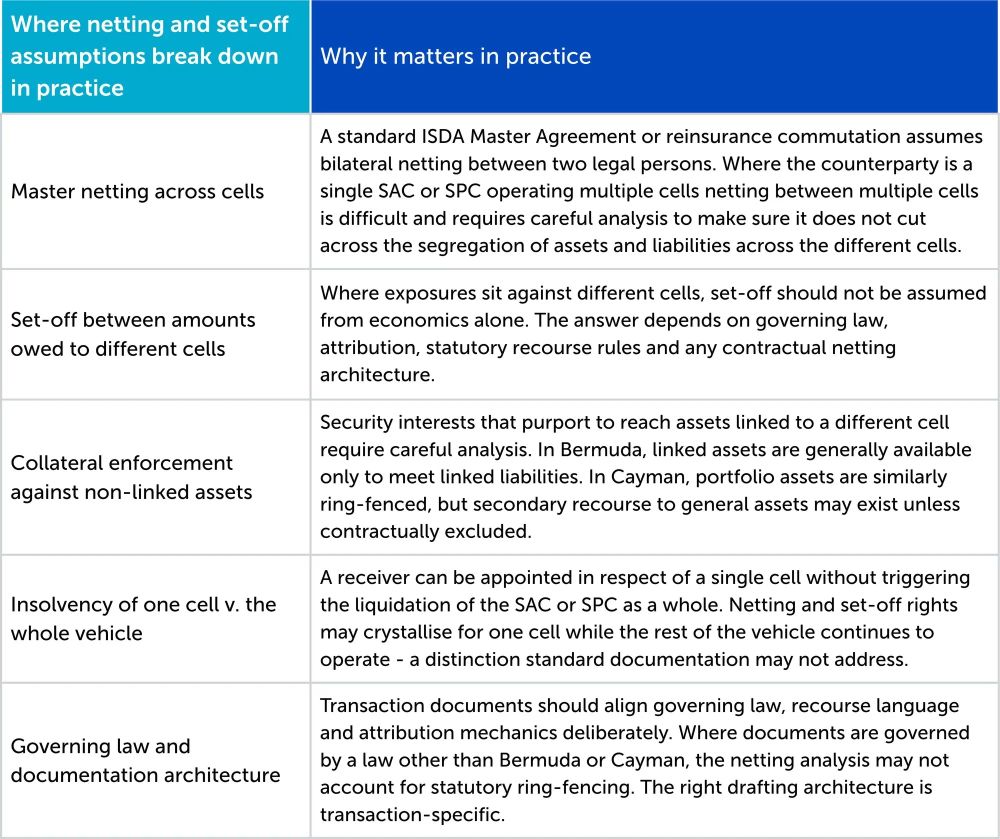
The real question is not simply whether the master agreement contains netting language. It is what obligations are attributed to the relevant account or portfolio, what assets are legally available to meet them, and whether the analysis under the governing law respects the local statutory regime.
Key legal principles for netting and set-off in cell structures
Cells are not separate legal entities (SACs and SPCs)
Under both the Bermuda Segregated Accounts Companies Act 2000 and the Cayman SPC regime, segregated accounts and portfolios (referred to herein as "cells") are not distinct legal persons. They are statutory ring-fences within a single corporate entity. The company is the legal counterparty, but the relevant cells must be properly identified and attributed in the contract, governing instrument and records.
Ring-fencing is statutory, not contractual
The segregation of assets and liabilities is imposed by statute, not by contract alone. Contractual netting provisions that purport to reach across cells may interact with the governing legislation in ways that require specialist analysis, particularly where the statute expressly limits the assets available to meet particular liabilities.
Different recourse outcomes in Bermuda and Cayman
In Cayman, portfolio creditors may have limited secondary recourse to general assets above the regulatory minimum unless excluded by the articles or by limited recourse language in the transaction documents. In Bermuda, the SAC Act contains specific provisions on set-off that require careful analysis. The differences matter for documentation and enforcement.
Bermuda – Segregated Accounts Companies Act 2000
- Creditors with claims attributable to cell generally have recourse only to assets linked to that cell
- Linked assets are not available to meet liabilities of other cells or the general account
- Documentation must clearly evidence which cell the company is contracting on behalf of
- Recent decisions underscore that outcome turns on whether linkage is adequately evidenced in policy, governing instrument and records
- The SAC Act contains an express provision on set-off as between cells; the analysis is nuanced, not categorical
Cayman – Part 14 of the Companies Act (2026 Revision)
- Liabilities attributable to a segregated portfolio have first recourse to that portfolio’s assets
- Unless excluded by the articles or by limited recourse language in the transaction documents, limited secondary recourse to general assets above regulatory minimum capital may exist
- Portfolio creditors do not have recourse to other cells
- The company must contract on behalf of identified cells and say so in execution language
- Cross-border structures or transactions add a further layer of governing law and forum/jurisdiction analysis.
Bermuda vs Cayman: recourse, attribution and netting outcomes
How Walkers advises on netting and set-off in cell structures
- Netting and set-off analysis for transactions with SACs and SPCs across both jurisdictions, including formal opinions
- Review and drafting of governing law, recourse and attribution provisions for ISDA, reinsurance and collateral documentation
- Cell-specific documentation structuring consistent with statutory segregation
- Cross-border enforceability risk assessment for netting and set-off against cell insurers
- Insolvency scenario analysis: single-cell receivership, general account exposure and secondary recourse
- Recourse and governing-law analysis for structures involving Bermuda domestic registration overlays
Key takeaway and further information: netting assumptions require jurisdiction-specific analysis
Standard netting assumptions require specialist analysis when the counterparty operates through statutory ring-fences. Counterparties dealing with segregated cell insurers should understand the cell-level constraints – and the Bermuda/ Cayman differences – before executing documentation.
For more information, please get in touch with your usual contact at Walkers or any of the individuals in your region listed below.
The content of this article is intended to provide a general guide to the subject matter. Specialist advice should be sought about your specific circumstances.
[View Source]


