
- with Finance and Tax Executives
- in Canada
- with readers working within the Accounting & Consultancy and Business & Consumer Services industries
Download a PDF copy of this Blog here.
A good part of our Tax and Trade practice involves advising Clients in the Textiles industry on matters involving Canadian customs duties and taxation on imported goods.
Recently, we have seen an increase in Canada Border Services Agency (“CBSA”) verification audits and assessments involving carpets and area rugs. One focal point seems to be the application of Tariff Chapter 57 of the Customs Tariff (“CT”), which contains many of the Harmonized System (“HS”) Classification codes for carpets and similar textile floor coverings. Improper tariff classification can lead to significant duty assessments and penalties, even for importers who have “always used” a particular tariff code without issue.
CBSA Verification Audits & What Can Happen?
Under section 42.1 of the Customs Act, the CBSA conducts periodic compliance verification audits, which generally conclude with one or more Statements of Adjustment (“SoA”).
The SoA documents have significant legal implications. In addition to re-determining the duties on B3/CAD transactions in error, a SoA may trigger mandatory self-correction obligations on declarations of origin, tariff classification, or value for duty reaching back four years.
Furthermore, “corrections” are generally due within 90 days of the SoA and may require immediate payment of duties owing. Moreover, failing to correct a tariff classification when an importer has “reason to believe” it is incorrect can result in Administrative Monetary Penalties (“AMPs”) on top of duties.
Tariff Chapter 57: Textile Floor Coverings
A recurring issue in recent CBSA verification audits has been the proper classification of goods under Chapter 57 of the CT.
Chapter 57 covers carpets and other textile floor coverings and distinguishes products based on their method of manufacture and constituent materials. Particular attention appears to be directed at carpets and area rugs classified under headings such as:
- Heading 5702 – Carpets and other textile floor coverings, woven, not tufted or flocked, whether or not made up, including "Kelem", "Schumacks", "Karamanie" and similar hand-woven rugs (duties ranging from 0% to 14%)
- Heading 5701 – Carpets and other textile floor coverings, knotted, whether or not made up (duties from 6.5% to 13%)
Similar goods attract widely different tariff treatment depending on whether they are hand-knotted, tufted, or otherwise constructed. Likewise, other goods, such as travelling rugs, may instead be classified under Chapter 63 which deals with other textile articles.
Current CBSA verifications appear to be taking the view that many importers or their brokers have historically misapplied classification codes related to textile floor coverings – resulting in the issuance of retroactive duty assessments and AMPs.
Takeaways
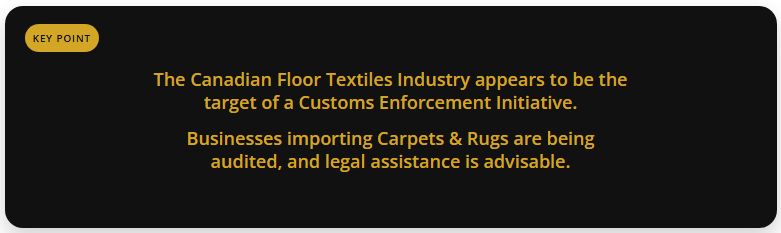
The CBSA looks to have launched a verification enforcement initiative targeting carpets, rugs and textile floor coverings.
Importers who have been contacted by CBSA to begin a tariff classification verification should get legal counsel involved at the outset. Attempting to resolve the matter at the Trade Verification stage is greatly preferred because, as we have written about before, appealing a CBSA decision requires the importer to “pay to play”, and deadlines for appeals are generally 90 days after receiving notice!
For help with tariff classification or a verification audit, click here.
The content of this article is intended to provide a general guide to the subject matter. Specialist advice should be sought about your specific circumstances.
[View Source]