
Contents Sometime this fall, the Ontario Ministry of the Environment
(MOE) is expected to release draft regulations detailing the
requirements for source protection plans under the Clean Water
Act, 2006. In the meantime, the Ministry is soliciting
information on what the plans should contain and how they should be
prepared. MOE posted a discussion paper on the Environmental
Registry on June 25, with a deadline for comments by September 23,
2008. MOE also intends to post draft guidance material on its
website, and will be organizing focus groups and workshops during
the summer and fall. Source Protection Plans are to be submitted to
the Minister in 2012. The discussion paper addresses the following topics: The preparation of source protection plans will comprise the
second phase of the implementation of the Clean Water Act.
During the first phase, local multi-stakeholder source protection
committees are overseeing the preparation of science-based
assessment reports for each of the 40 designated watershed areas in
the province. These reports are intended to identify and assess
threats to drinking water sources as listed in each committee's
terms of reference. The information assembled will be used to frame
the source protection plans that will, in turn, detail the actions
required to address the identified threats to drinking water
sources. The Conservation Ontario website (http://conservation-ontario.on.ca/index.html )
provides links to the individual terms of reference, as well as the
local drinking water source protection region or area. W+SEL
Partner, Juli Abouchar is a member of the CTC Source Protection
Committee. Ontario's new Toxics Reduction Act, 2009, which
received Royal Assent on June 5, will require designated facilities
to track the manufacture and use of designated "toxic
substances" and "substances of concern". Companies
will also have to develop toxics reduction plans and make summaries
of those plans available to the public. Implementation of the plans
will be at the discretion of the company. Over the summer, the Ministry of the Environment is consulting
with stakeholders on the regulations needed to implement the Act.
These regulations will spell out the lists of substances, the
facilities that will be subject to the Act, and the timelines for
planning and reporting. Confidentiality safeguards could also be
addressed. Once the regulations are in place, companies would have
to complete their first toxic reduction plans as early as the end
of 2011. According to a background paper posted on the Environmental
Registry, the Act will apply to manufacturers and mineral
processing companies. Facilities with more than 10 employees and
that make or use more than a threshold amount (in most cases,
10,000 kg) of a listed substance in a year must prepare a toxics
reduction plan for that substance. The reporting thresholds in the
regulation would be the same as those set under the National
Pollution Reporting Inventory (NPRI) system. The preliminary list of "toxic substances", compiled
on the advice of the Minister's Toxics Reduction Scientific
Expert Panel, is split into two groups. Phase I consists of 31
priority toxics, as well as 14 known or probable carcinogens. Phase
II includes the rest of the substances on the NPRI list, as well as
acetone. The "substances of concern" list would contain
chemicals not currently included under NPRI. Companies using more
than a minimal threshold amount (perhaps as low as 100 kg) of these
materials would be subject to a "one-time" reporting
requirement. The Ministry is proposing that prescribed companies track Phase
I substances from January 1, 2010 through December 31, 2010, submit
their first usage report by June 1, 2011, and provide a summary of
their first toxics reduction plan by December 31, 2011. While
implementation of the plans is voluntary, the province says it will
establish an electronic reporting system and website to let the
public monitor the progress that facilities make in reducing their
use of toxics. The contents of the Act are enforcement and prosecution-heavy
– more than half of the statute is devoted to detailed
entry and inspection powers, the issuance of provincial officer
orders, reviews and appeal procedures, director and officer
liability, offences, fines, administrative penalties and innovative
sentencing provisions. The Act sets fines of up to $25,000 for
individuals and $50,000 for corporations – double that
amount for repeat offenders – for every day on which an
offence occurs or continues. In addition, administrative penalties
(up to a maximum of $60,000) may be assessed if a person
contravenes a provision of the Act, its regulations, an order
issued under section 26, or a compliance agreement under subsection
29(9). Further details on the application of administrative
penalties will also be contained in the regulations. There will also be fiscal carrots to supplement those heavy
enforcement sticks. The province has earmarked $24 million, spread
over three years, to help industry "meet its requirements and
transform their processes, find green chemistry alternatives and
reduce the use of toxics in their operations." Grants will
permit small businesses to offset at least some of the costs
associated with the first round of toxics accounting and planning,
as well as support early off-toxics action by regulated facilities.
The province will underwrite the training and accreditation of
"Toxics Reduction Planners" who will assist facilities in
preparing their plans and meeting the certification requirements of
the Act. In addition to the requirements for reporting and planning, the
Act gives the Ministry the authority to prohibit or regulate the
manufacture, sale or distribution of a toxic substance. These new
powers mirror those in federal legislation and would allow the
province to take action on specific toxics if Ottawa proves
recalcitrant to do so. The Ministry says that additional
consultation with stakeholders and the public would be undertaken
before it develops any regulation to implement these new
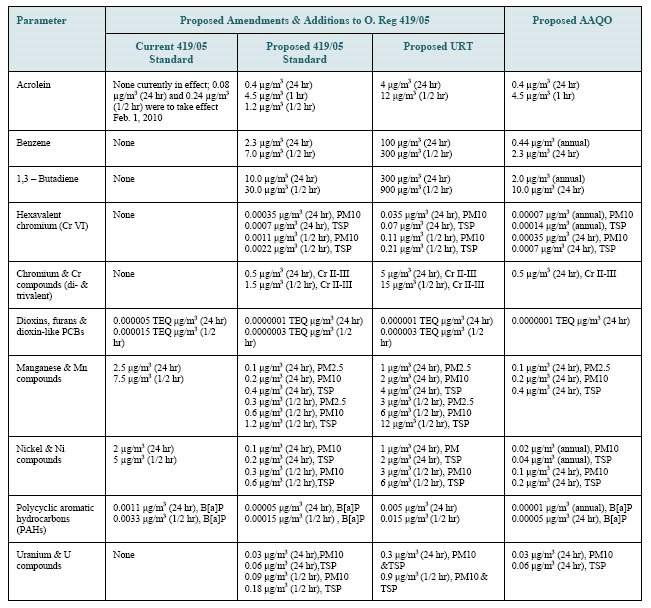
powers. The Ministry of the Environment is amending the O. Reg. 419/05
(Air Pollution – Local Air Quality) standards and ambient
air quality objectives (AAQOs) for nine high priority contaminants.
Some AAQOs will have an annual average concentration. Two novel
situations arise. For some contaminants, the new URT (upper risk
threshold) is lower than the current standard. The metals, except
Cr II-III, will have different standards for PM10 and TSP. The proposals include new standards for benzene, 1,3-butadiene,
chromium and uranium and significant reductions for four others.
Only the revised standard for acrolein is less stringent than the
one currently on the books. The standards (except for the acrolein
standard) would take effect five years after they are adopted,
although companies would have to comply with the proposed URTs in
the interim. The proposed AAQOs are to be the same as the regulatory
standards, with the addition of average annual concentrations for
some contaminants. The table that follows this article compares the
current standards in O. Reg. 419/05 with the proposed additions and
amendments, as well as listing the new AAQOs. The Ministry has undertaken extensive pre-consultation
discussions with stakeholders and completed a review of the
toxicological literature and the air guidelines set by leading
agencies. Based on this research, the Ministry has compiled
detailed rationale documents for each of the proposed standards.
These were posted to the Environmental Registry on July 31, 2009,
together with a consolidated document that contains the draft URT
standards. The deadline for public comment on all 10 postings is
September 29, 2009. In addition, technical amendments are being proposed to clarify
concentration calculations for certain contaminants, and several
housekeeping changes are proposed. For example, the existing
standard for MMT would be dropped in favour of the new standard for
manganese and Mn compounds. The 24-hour point of impingement standards (and the one-hour
standards where applicable) would be incorporated into Schedule 3
(for use with U.S. E.P.A. models); the corresponding half-hour
standards would be incorporated into Schedule 2 (for use with the
venerable O. Reg. 346 model); and the URTs would be incorporated
into Schedule 6. In a new approach to standard setting in Ontario,
the Ministry is proposing separate standards for specific size
fractions for hexavalent chromium, manganese, nickel and uranium.
The Director may issue written notice that only one of these
standards must be met in specific circumstances as long as no
adverse effect may occur. If the stricter health-based standards for benzene,
1,3-butadiene, chromium, dioxins and furans, manganese, nickel,
PAHs and uranium (in Schedules 2 and 3) are adopted, they would
take effect five years after being incorporated into O. Reg.
419/05. The new standard for acrolein would take effect February 1,
2010. There is no phase-in period associated with URTs, although a
Director may consider other factors, such as workplace health and
safety limits, on a case-by-case basis. Where a proposed URT is
lower than the existing standard for a contaminant, facilities will
be expected to operate below that URT until such time as the new
Schedule 2 standard takes effect. This is the penultimate set of revised air standards generated
by the Ministry as part of a 13-year updating process; it covers
seven of the outstanding 16 contaminants, plus uranium (which was
not on the 1999 list) and acrolein (which was already revised once
before, in 2005). The Ministry has already introduced new or
updated standards for 54 of the 70 high priority air contaminants
identified in Setting Environmental Quality Standards in
Ontario, first released in 1996 and revised in 1999. In addition, new regional air quality standards and objectives
for sulphur dioxide and nitrogen oxides are being developed through
a federal/provincial process under the CCME. The Ministry is
currently working to develop new standards for the seven remaining
air contaminants: arsenic, copper & Cu compounds, ethylene,
mercury & Hg compounds, toluene, vanadium & V compounds,
and zinc & Zn compounds. Notations & Acronyms: AAQO
– Ambient Air Quality Objective; B[a]P
– benzo(a)pyrene (B[a]P serves as a marker for PAHs);
PM2.5 – particulate matter 2.5 microns
or less in size; PM10 – particulate
matter 10 microns or less in size; TCDD
– tetrachlorodibenzo-para-dioxin; TEQs
– TCDD equivalents; TSP –
total suspended particulate; μg/m3
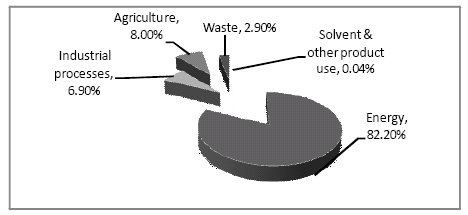
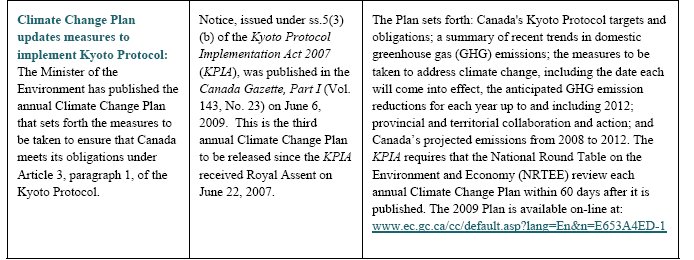
– micrograms per cubic metre While fluctuating from year to year, Canada's greenhouse gas
(GHG) emissions continue to maintain their upward trend. According
to the latest National Greenhouse Gas Inventory, total GHG
emissions in Canada in 2007 were about 747 megatonnes CO2
equivalent, an increase of 4% from 2006's 718 Mt. Energy
production is responsible for the lion's share of that total.
However, emissions are expected to level off or decline slightly in
2008 and 2009 due to a number of factors, such as weather patterns
and the economic downturn. According to the federal government's most recent
Climate Change Plan for the Purposes of the Kyoto Protocol
Implementation Act, Canada's current approach to climate
change must be amended to accommodate two major developments - the
global economic downturn and the election of a new Administration
in the United States that is committed to taking action on climate
change. As a result, the Government is adjusting its approach to
regulating GHG emissions in the industrial sector and will announce
the details of this approach later this year. "The Government
has a long-term vision, one that sees Canada mastering clean
technologies, such as carbon capture and storage and successfully
developing a range of clean energy alternatives," the Plan
states. One billion dollars of the federal Economic Action Plan
will be devoted to such research and demonstration projects. Ottawa has also renewed its commitment to develop and implement
a North Americawide cap and trade system for GHGs, together with
the provincial and territorial governments and other partners.
Domestic action will be aimed at reducing "carbon emissions at
their sources, which will involve improving the orderly
transformation of capital energy stock to less carbon-intensive
alternatives such as natural gas and nonemitting sources such as
nuclear and hydro." The government intends to boost the
contribution of such "non-emitting" energy sources from
the current 73% to 90%. According to the Plan's authors, the Clean Energy Dialogue,
launched by Prime Minister Harper and President Obama in February
2009, is "the most significant development in continental,
environmental and energy policy since the North American Free Trade
Agreement." The Clean Energy Dialogue will focus on expanding
clean energy R&D, developing and deploying clean energy
technology and building a more efficient electricity grid based on
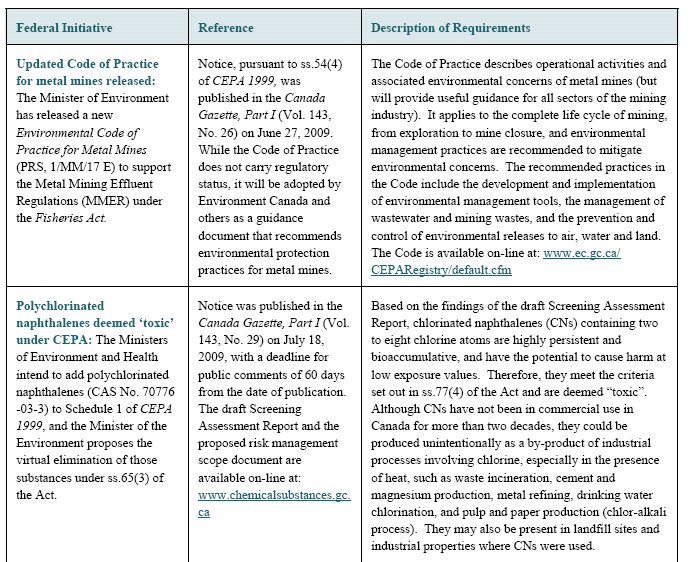
clean and renewable generation. Bill providing new federal enforcement powers,
sentencing provisions and higher fines receives Royal
Assent Ottawa has quickly passed, with minor amendments, its package of
updated enforcement measures and higher fines for nine federal
environmental statutes. The federal Environmental Enforcement
Act (Bill C-16) passed in the House of Commons on May 13,
2009, and received Royal Assent on June 18. The Act sets new
minimum fines, raises maximum fines to as high as $12 million for
repeat offenders and provides enforcement staff with new
investigative powers. In addition, 106 new enforcement officers
have been hired by Environment Canada and will complete their
training by August. A review of the legislation, prepared by W+SEL,
is available on our website. The final version of the Bill is little changed from the package
given first reading back on March 4, 2009. The Standing Committee
on Environment and Sustainable Development amended several of the
sentencing options. Judges can order offenders to fund scholarships
for environmental studies, conservation and environmental
protection research, or environment groups in the affected
community. In addition, the courts will not be permitted to award
compensation to parties that are otherwise eligible to make a claim
for costs under the Marine Liability Act or the Arctic
Waters Pollution Prevention Act. There were also several
technical amendments related to liability in the shipping
industry. The standing committee also learned why two other federal
environment acts – the Species at Risk Act
(SARA) and the Fisheries Act – were not
included in the omnibus package. When Bill C-16 was introduced, the
committee had already been asked to conduct the statutory five-year
review of SARA and is expected to make recommendations
regarding possible changes to that Act. According to an Environment
Canada official who appeared during the hearings on Bill C-16, it
was decided to exclude amendments to SARA out of deference
to the work of the standing committee. The Fisheries Act
was not amended, the representative said, because the "bill is
just dealing with statutes under the power of the Minister of the
Environment and Parks [Canada]." However, W+SEL notes that
Environment Canada is responsible for the enforcement of the
pollution control provisions of the Fisheries Act. The content of this article is intended to provide a general
guide to the subject matter. Specialist advice should be sought
about your specific circumstances. Edited by John Willms
Ontario looking for guidance on source protection plans
Ontario drafting regulations to implement Canada's first
toxic chemical reduction law
Ontario proposes new or amended air pollution standards to
reduce emissions of nine contaminants
Greenhouse gas emissions continue to creep upwards
ARTICLE
25 August 2009
Environment, Energy & Resources Law - July / August 2009
Willms & Shier Environmental Lawyers LLP
Contributor
Willms & Shier Environmental Lawyers LLP www.willmsshier.com is Canada’s recognized leading environmental law firm, delivering a full range of environmental, Indigenous and energy law services. For 40 years, our clients have benefitted from our innovative, practical solutions and extensive knowledge of environmental, Indigenous, and energy and natural resource issues. With 19 highly specialized lawyers, we are the largest private sector environmental law practice in Canada. Seven of our lawyers are Environmental Law Specialists, certified by the Law Society of Ontario. Willms & Shier has offices in Toronto, Ottawa, Calgary and Yellowknife. Our lawyers are called to the Bar in Alberta, British Columbia, New Brunswick, Nunavut, the Northwest Territories, and Ontario.
Sometime this fall, the Ontario Ministry of the Environment (MOE) is expected to release draft regulations detailing the requirements for source protection plans under the Clean Water Act, 2006.