

- within Corporate/Commercial Law topic(s)
- in Canada
- with readers working within the Insurance, Media & Information and Law Firm industries
- within Wealth Management, Employment and HR and Technology topic(s)
- with Inhouse Counsel
IN BRIEF
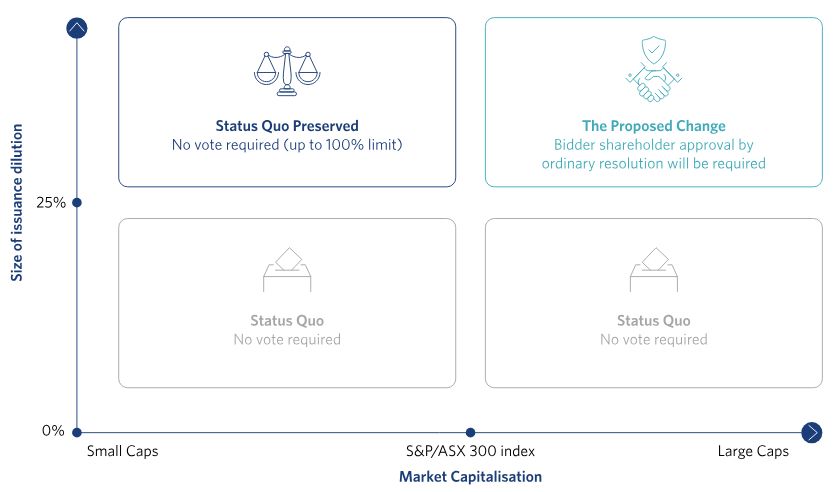
- In response to industry feedback on its consultation proposal to amend the ASX Listing Rules, ASX has proposed a 25% limit on the amount of an S&P/ASX300 entity’s issued capital that can be issued as scrip consideration under a regulated takeover or merger (or to fund the cash consideration for a regulated takeover or merger) without shareholder approval, or such higher amount authorised by its constitution or by shareholders in general meeting.
- Its other proposals relate to dual-listed companies and will involve shareholder approval being required for a dual-listed entity to change to an ASX Foreign Exempt Listing or to delist from the ASX (the latter with carve-outs for listings that did not originate on the ASX).
- Importantly, ASX has decided to maintain the status quo for Listing Rule 11.1.2 following feedback during the consultation process as to the disproportionate impact on M&A activity that does not result in dilution.
- ASX is seeking further feedback on its exposure draft, which remains open for consultation until 5.00pm AEST on 29 July 2026. The changes are otherwise anticipated to take effect on 21 October 2026.
Overview of proposed changes
| Corporate Action | Current Rule | Proposed Future State | The Rationale |
|---|---|---|---|
| Admission: Dual-listed company changing to ASX Foreign Exempt | Currently no vote required | Ordinary vote | Major shift in governance rules |
| Exit: Dual-listed company delisting from ASX | Currently no vote required | Ordinary resolution vote (with origin carve-outs) | Protection of local trading liquidity |
| Dilution: Takeovers/Mergers (Exceptions 6 & 7) | 100% issuance limit (Reverse Takeover threshold) | 25% limit for Large Caps (ASX300) | Limiting unapproved massive equity dilution |
| Scale: Significant Changes to Activities (Rule 11.1) | Discretionary (used primarily for backdoor listings) | No change currently proposed | Avoiding blanket regulatory burdens on standard M&A |
Changes to Listing Rule 7.1
ASX Listing Rule 7.1 generally restricts an ASX-listed entity from issuing more than 15% of its issued capital in a 12 month period without shareholder approval, other than in accordance with exceptions set out in Listing Rule 7.2. These relevantly include exceptions for securities issued as consideration under a takeover or scheme of arrangement (or which are issued to fund the cash consideration for a takeover or scheme of arrangement).
The core changes proposed to the Listing Rules as a result of the consultation feedback will have the effect that entities in the S&P/ASX 300 index (as at the date of announcement of a regulated takeover or merger) will not be able to rely on these existing exceptions for a “prescribed transaction” that involves the issue of more than 25% of its issued capital, unless a higher limit has been approved by the entity’s shareholders or is set out in its constitution. There is no additional separate $300m market capitalisation test as previously considered by ASX.
What are the key changes?
| Current position | New position | |
|---|---|---|
| What are the Listing Rule 7.1 exceptions? |
|
|
| What transactions do the exceptions apply to? |
The exceptions apply to a takeover bid conducted under Chapter 6 of the Corporations Act, or scheme of arrangement under Part 5.1 of the Corporations Act. ASX waivers are required to extend the benefit of the exception to trust schemes and foreign transactions equivalent to a takeover or scheme. |
The exceptions apply to a new jurisdiction-agnostic term “regulated takeover or merger”, which is intended to remove the need for entities to seek waivers from ASX in relation to foreign transactions substantially similar to takeover bids and schemes of arrangement. The term expressly includes takeovers, schemes of arrangement and trust schemes, and will also include any foreign takeover or business combination effected by public offer process, security holder approval process on another exchange or that is approved by a court or securities regulator. |
| What are the limits on the exceptions? | Neither Exception 6 nor 7 applies to a reverse takeover, so there is an effective limit of 100% of the listed entity’s existing issued capital. |
A “prescribed transaction” is a “regulated takeover or merger” by an entity in the S&P/ASX 300 index where the number of securities to be issued by the entity as consideration (or to fund the cash consideration payable) under that transaction is equal to or greater than the “prescribed threshold” of the number of fully paid ordinary securities on issue at the date of announcement of the transaction. The “prescribed threshold” is 25%, unless a higher percentage has been approved by shareholders or is set out in the entity’s constitution. |
What options do S&P/ASX 300 index entities have?
An S&P/ASX 300 entity issuing more than 25% of its issued capital under (or to fund) M&A activity will be required to seek shareholder approval for the issue of the relevant securities (subject to its existing placement capacity and any other exceptions that may be available to it). Any securities to be issued in accordance with that approval must be issued within 12 months or the approval will become stale.
However, ASX’s response (and associated exposure draft changes) noted the concerns of industry participants that requiring shareholder votes may add timing uncertainty, cost and conditionality (which could disadvantage some ASX-listed bidders compared to private capital or foreign acquirers in competitive proposals).
In recognition of this concern, ASX has also proposed that an S&P/ASX 300 entity could obtain a mandate from its shareholders to pursue M&A involving the issue of further capital beyond the 25% limit. This could occur by way of:
- Shareholder approval: under proposed new Listing Rule 7.3B, an ordinary resolution of shareholders approving a higher threshold (less than 100%), which can operate for up to 36 months (unless a transaction under Listing Rules 11.1.2 or 11.2 is approved earlier). The notice of meeting for the relevant resolution would need to explain the reasons for seeking the higher threshold, the period of validity and previous issues under Exceptions 6 and 7.
- Constitutional authorisation: a higher prescribed threshold in the entity’s constitution (less than 100%), which can operate indefinitely.
Entities could also consider adopting both strategies, approving a modest indefinite limit by way of constitutional authorisation and separately seeking further increases by way of rolling shareholder approvals, which may become a common feature of the general meeting landscape in Australia.
In either case, boards should expect that institutional investors and proxy advisers will assess the company’s M&A strategy, opportunities, risks and track record (among other things) and the proposed threshold in considering any resolution to approve a specific mandate or an amendment to the entity’s constitution. Boards could face challenges justifying and obtaining standing approval or constitutional amendments in a landscape where, at the request of institutional investors, some listed entities have been introducing constitutional amendments to lower the threshold for all issuances (for example, to 25% of the entity’s issued capital, despite the currently available exceptions).
How do these changes line up internationally?
ASX has clearly considered the position in equivalent jurisdictions in proposing these changes. The proposal that S&P/ASX 300 entities could approve a higher threshold than 25% (up to 100%) at a meeting, valid for 36 months, takes inspiration from the practice in the UK, where issuances up to ~33% are routinely approved at each general meeting in accordance with institutional investor guidelines.
The 25% threshold would bring Australia closer to alignment with the 20% limit imposed by NYSE, Nasdaq, HKEx and SGX and 25% limit imposed by TSX (though these exchanges do not differentiate based on the size of the issuer). See here and here, where we have previously summarised the international approach.
What does this mean?
Although there are some precise details that we expect ASX will refine before the final changes to the Listing Rules become effective, boards and management teams of entities in (or close to inclusion in) the S&P/ASX 300 should review their acquisition pipeline, particularly those that may involve dilutive scrip issuances, and start preparing for commencement of the changes in October 2026.
This includes:
- Early engagement: engaging with ASX early in relation to announced transactions or transactions that may straddle the proposed commencement date of the changes to the Listing Rules.
- Strategy: considering the preferred strategy in relation to any shareholder approvals required for the purposes of a specific transaction or to obtain a shareholder mandate for M&A activity more generally.
In the case of shareholder approval for the purposes of Listing Rule 7.1, the timing to seek approval will also need to be considered. For a takeover bid, a bidder shareholder approval requirement as a condition will sit awkwardly in that it will be effectively an option for bidder shareholders to avoid a bid they do not want, so it would seem unintuitive for target shareholders to accept the bidder’s takeover offer until that condition had been cleared. That being the case it will be relevant to determine whether approval will be sought and obtained before offers are made, or whether a bidder shareholder approval condition is required (in turn affecting the competitiveness of the bidder’s offer). For a scheme of arrangement, the bidder shareholder meeting timetable will need to map onto the target’s usual scheme timetable. - Conditions: reviewing implementation agreements or bidder’s statements that are currently being negotiated or prepared to consider whether a condition in relation to bidder shareholder approval is required (or, alternatively, a waiver or confirmation from ASX). Bidders should also consider whether relief is required from ASIC to facilitate any bidder shareholder approval condition for the purposes of a takeover bid.
- Foreign transactions: taking steps to obtain formal advice from foreign jurisdiction legal advisers (as required) in relation to the application of a foreign transaction to the scope of the new “regulated takeover or merger” test. ASX has indicated in its exposure draft guidance that it expects entities to seek shareholder approval if the advice is qualified, equivocal or uncertain, and so for planning purposes it should be identified as soon as possible whether the exceptions are available.
There is no proposal to change the existing rights issue exception to Listing Rule 7.1 which allows a bidder to fund an acquisition, including a regulated takeover or merger, by a rights issue, which may be underwritten, with an offer ratio of up to 1:1, or more provided the rights issue is renounceable and appropriately discounted. A rights issue can be combined with a placement of up to 15%, or up to 25% where the proposed exception 7 applies. With a rights issue, existing shareholders will have the opportunity to participate and reduce or avoid their dilution. Bidders may choose to favour cash funding, or part cash funding and part scrip consideration to avoid the need for shareholder approval.
Outcome in respect of other changes considered by ASX’s Consultation Paper
Shareholder approval for change to Foreign Exempt Listing
Under the current rules, an application for an ASX listed entity to become a Foreign Exempt Listing is approved by the ASX – shareholders do not have the chance to vote.
An entity that is a Foreign Exempt Listing is exempt from complying with most of ASX’s Listing Rules on the basis that it is fully compliant with the rules of its home exchange.
ASX has proposed that shareholder approval by ordinary resolution will be required for an entity (other than an NZ listed entity) to change from an ASX standard listing to an ASX Foreign Exempt Listing. The justification is that such a change has a significant impact on the listed entity’s Listing Rule obligations and shareholder protections.
This change will impact very few entities, with ASX acknowledging the rarity of such a shift, given ASX records indicate only 3 such changes since 2020.
Shareholder approval for a dual-listed entity first listed on ASX or with majority Australian register to voluntarily delist
The existing framework requires ASX approval for an entity to voluntarily delist from the ASX. ASX can impose conditions when granting such approval, which may include shareholder approval. However, ASX’s practice is not to impose shareholder approval for the delisting of a dual listed entity given the securities can still be freely traded on a foreign exchange.
ASX has proposed that a dual-listed entity first listed on the ASX must obtain shareholder approval by ordinary resolution before it can be voluntarily removed from the official list, with such provisions to be enshrined in the Listing Rules themselves rather than the guidance notes. ASX has proposed a carve-out such that approval is not required for voluntary delisting of dual listed entities first listed on a foreign exchange (rather than ASX), with fewer than 25% of its securityholders in Australia or which are Foreign Exempt Listings. The differentiation is on the basis that shareholders of entities first listed on the ASX have a reasonable expectation of an ongoing ASX Listing (and associated compliance with those rules).
Maintaining the status quo on Listing Rule 11.1.2
While ASX had not proposed any changes to Listing Rule 11.1.2 in its Consultation Paper, it had invited submissions as to whether Listing Rule 11.1.2 should be amended such that shareholder approval is mandatory for any significant change to a listed entity’s activities (even if there is no dilutive issuance). Currently, Listing Rule 11.1.2 provides that ASX may impose a requirement for shareholder approval for a significant change to the nature and scale of the entity’s activities.
Following the feedback received, which noted potential unintended consequences, including on M&A activity which is not dilutive, ASX has not proposed any amendments to Listing Rule 11.1.2.
The content of this article is intended to provide a general guide to the subject matter. Specialist advice should be sought about your specific circumstances.
[View Source]

