Earlier this month, ASIC once again extended the transitional relief for Foreign Financial Services Providers (FFSPs), this time until 31 March 2027. The transitional arrangements for FFSPs wanting to provide financial services to clients in Australia were set to expire on 31 March 2026 but FFSPs now have another 12 months of transitional relief whilst the Australian Government seeks to formalise and legislate its proposed new licensing exemptions (discussed further below).
How can FFSPs currently provide financial services in Australia?
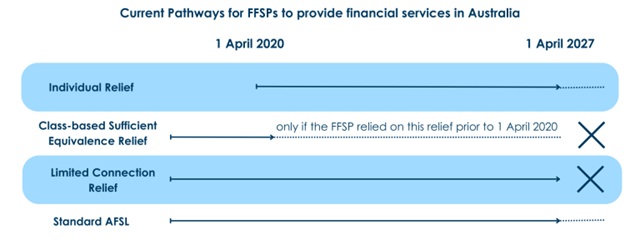
ASIC currently provides licensing relief and exemptions for new FFSPs via the following pathways:
- Individual Relief
- Class-based Sufficient Equivalence Relief
- Limited Connection Relief
- Standard AFSL
Individual Relief
At present FFSPs who are new entrants to the Australian market can apply to ASIC for individual relief. If individual relief is granted, the FFSP can provide financial services to Australian clients under a modified form of an AFSL. This means that some obligations under the Corporations Act, that would normally apply to standard AFSL holders, do not apply to the FFSP.
There are two pathways for individual relief:
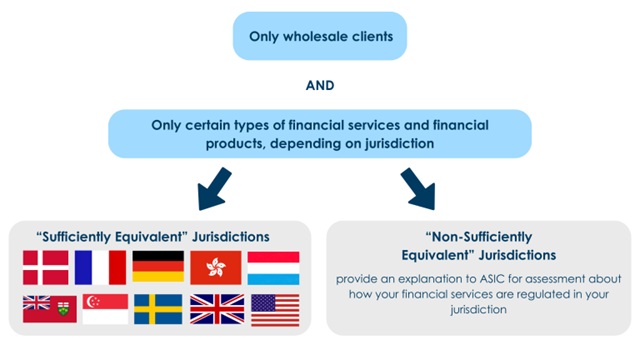
- Relief for FFSPs which are regulated by a "sufficiently equivalent" overseas regulator; and
- Relief for FFSPs which are regulated by a "non-sufficiently equivalent" overseas regulator.
Applications for relief are to be made via the ASIC Regulatory Portal. Note: the application process for individual relief for FFSPs which are regulated by a "sufficiently equivalent" overseas regulator differs from FFSPs regulated by "non-sufficiently equivalent" overseas regulatory regimes.
- "Sufficiently Equivalent" Regulation
The following overseas regulators are considered to be "sufficiently equivalent":
- Denmark - Danish Financial Supervisory Authority (FSA)
- France - Autorité des marchés financiers of France (AMF) or Autorité de contrôle prudentiel et de resolution of France (ACPR)
- Germany - Bundesanstalt für Finanzdienstleistungsaufsicht (BaFin)
- Hong Kong - Securities and Futures Commission (SFC)
- Luxembourg - Commission de Surveillance du Secteur Financier (CSSF)
- Ontario, Canada - Ontario Securities Commission (OSC)
- Singapore - Monetary Authority of Singapore (MAS)
- Sweden - Finansinspektionen (FI)
- United Kingdom - Financial Conduct Authority
- United States - Commodity Futures Trading Commission (CFTC), or Federal Reserve and Office of the Comptroller of the Currency (OCC), or Securities and Exchange Commission (SEC)
To be eligible under this pathway, the following criteria must be met:
- The FFSP is regulated by one of the above overseas regulatory authorities;
- The FFSP intends to provide financial services to wholesale clients only in Australia; and
- The financial services to be provided are specified in Schedule 1 of ASIC Corporations (Foreign Financial Services Providers - Foreign AFS Licensees) Instrument 2020/198.
"Non-Sufficiently Equivalent" Regulation
FFSPs regulated by a "non-sufficiently equivalent" regulator will need to provide to ASIC for assessment a detailed explanation about how their financial services are regulated in their jurisdiction.
Subject to the 2025 Bill being passed:
- FFSPs who have successfully obtained Individual Relief can continue providing financial services in Australia under the conditions of their modified AFSL until 31 March 2027; and
- FFSPs whose application for Individual Relief has been
submitted but not decided by the commencement date of the 2025
Bill:
- will continue to be subject to the requirements that existed at the time the application was submitted; and
- must satisfy the fit and proper person test as per section 913BA of the Corporations Act.
Class-based Sufficient Equivalence Relief
Prior to 1 April 2020, FFSPs were able to rely on the following Class Orders or Legislative Instrument (together Instruments) that provided an exemption from the requirement to hold an AFSL:
- CO 03/1099: UK regulated FFSP
- CO 03/1100: US SEC regulated FFSP
- CO 03/1101: US Federal Reserve and OCC regulated FFSP
- CO 04/829: US CFTC regulated FFSP
- CO 03/1102: Singapore MAS regulated FFSP
- CO 03/1103: Hong Kong SFC regulated FFSP
- CO 04/1313: German BaFin regulated FFSP
- ASIC Corporations (CSSF-Regulated Financial Services Providers) Instrument 2016/1109: Luxembourg CSSF regulated FFSP
These Instruments were repealed on 31 March 2020. FFSPs which relied on the licensing exemptions in these Instruments:
- as of 31 March 2020, and
- had notified ASIC of their intention to rely on these Instruments,
can continue to rely on the licensing exemptions until 31 March 2027.
Limited Connection Relief
Under the Limited Connection Relief, an FFSP does not need to hold an AFSL if all the following criteria are met:
- The FFSP does not have presence in Australia;
- The FFSP is taken to "carry on a financial services business in Australia" only because it engages in conduct that induces, or intends to induce, people in Australia to use the financial services provided by the FFSP (inducing conduct); and
- The financial services are provided to wholesale clients only.
No application is required to rely on the Limited Connection Relief and this relief will continue to be available until 31 March 2027. Any firm relying on this exemption should do so carefully and take advice.
Standard AFSL
If the above relief or exemptions are not available to a FFSP, the FFSP must apply for a standard AFSL to provide financial services to clients in Australia (including providing financial services to retail clients). More information about the standard AFSL application process and requirements is available here.
If you have any questions about the pathways for FFSPs, please contact us.
Note: there are other general exemptions in the Corporations Act and Regulations that may apply to FFSPs, which have not been explored in this article. Refer to Table 2 of ASIC Regulatory Guide 121for further information.
Proposed legislation
In 2023, the Australian Government first proposed a new licensing exemptions regime for FFSPs in the Treasury Laws Amendment (Better Targeted Superannuation Concessions and Other Measures) Bill 2023(2023 Bill). The 2023 Bill introduced new licensing exemptions which were expected to replace existing FFSP licensing exemptions. In November 2025, the Australian Government introduced the Treasury Laws Amendment (Genetic Testing Protections in Life Insurance and Other Measures) Bill 2025 (2025 Bill) re-introducing the proposed new licensing exemptions to parliament. As at the date of this article's publication, the 2025 Bill remains subject to passage of legislation.
The proposed new licensing exemptions for FFSPs under the 2025 Bill are:
- Professional investor exemption - The FFSP provides financial services from outside Australia to professional investors only.
- Comparable regulator exemption - The FFSP is regulated by a comparable regulator and provides financial services to wholesale clients only (this exemption is designed to replace the individual relief pathway outlined below).
- Market maker exemption- The FFSP provides financial services from outside Australia that involve making a market for derivatives that can be traded on a specified licensed market.
If one of the above exemptions applies, the FFSP may provide financial services to Australian clients without the need to hold an Australian Financial Services Licence (AFSL).
Additionally, it is also proposed that where the FFSP is regulated by a comparable regulator and is applying for an AFSL to provide financial services to wholesale clients only, the fit and proper person test will not apply, thus fast-tracking the licensing process.
Sophie Grace will provide further details about how the new licensing regime will operate when the 2025 Bill has passed.
Further reading
- ASIC extends transitional relief for foreign financial services providers
- ASIC Regulatory Guide 121: Doing financial services business in Australia
- ASIC Info Sheet 157: FFSP - Licensing Relief
- Treasury Laws Amendment (Genetic Testing Protections in Life Insurance and Other Measures) Bill 2025
- Treasury Laws Amendment (Better Targeted Superannuation Concessions and Other Measures) Bill 2023
- ASIC Regulatory Guide 176: Foreign Financial Services Providers
- Foreign financial services providers
- Report 825: Licensing and professional registration activities: 2025 update.
The content of this article is intended to provide a general guide to the subject matter. Specialist advice should be sought about your specific circumstances.