

Summary
- Narrowing an in-house team to its core does not make peripheral work disappear, because the business still needs that work done by someone.
- The core and peripheral matrix plots each task against two axes, complexity and repeatability, and reads the appropriate solution off the quadrant the task lands in.
- The matrix deliberately uses complexity and repeatability rather than risk and value, because risk and value identify which tasks need a solution without indicating what that solution should be.
- The four quadrants resolve to four different answers: a subject-matter expert, a scale provider, a technology-led process, and a managed process combining lawyers with workflow.
- A structured legal services panel lets one team cover all four quadrants at once, routing each peripheral task to the supplier suited to it.
Tips for Businesses
List every task your legal team touched last quarter, then score each one for complexity and for how often it recurs. The four groups that emerge each point to a different answer: a specialist, a scale provider, a technology process, or a managed process with lawyers at the decision points. Our Legal Transformation team can help you build the panel around it.
If you are an in-house lawyer, your team might face ongoing pressure to cut legal spending. As explored in Part 1 of this series, your team can achieve this by re-aligning the focus of the legal function with core business objectives. Narrowing the focus to core activities doesn’t mean that the secondary, ‘peripheral’ legal activities of an in-house team simply fall away. Although peripheral to core business objectives, these activities are still needed for the business to function. In this article, we explore how in-house teams can use the ‘core/peripheral matrix’ to rethink peripheral legal functions. With this matrix, your team can identify the best tools for managing these activities while not detracting from core deliverables.
What Is the Core/Peripheral Matrix?
Not all tasks of in-house teams are created equal. Different tasks:
- might require esoteric black letter expertise;
- might require large teams;
- can be completed by non-lawyers; or
- should never end up with the in-house team in the first place.
Being able to quickly identify what each task requires is important in determining how your team should allocate resources. The core/peripheral matrix is a valuable tool used by some in-house teams to tackle this challenge. This matrix involves plotting each task against two axes:
- complexity; and
- repeatability.
By plotting tasks on this matrix, your in-house team will be able to identify the most appropriate solution for each category of peripheral tasks.
Returning to the hypothetical example in Part 1 of this series, A-Star Company’s key objective is to out-compete other retailers. They do this by reducing the costs of products and decreasing the time it takes to acquire new stores. Set out below is an example of how this retailer’s in-house team might use the core/peripheral matrix to categorise its activities.
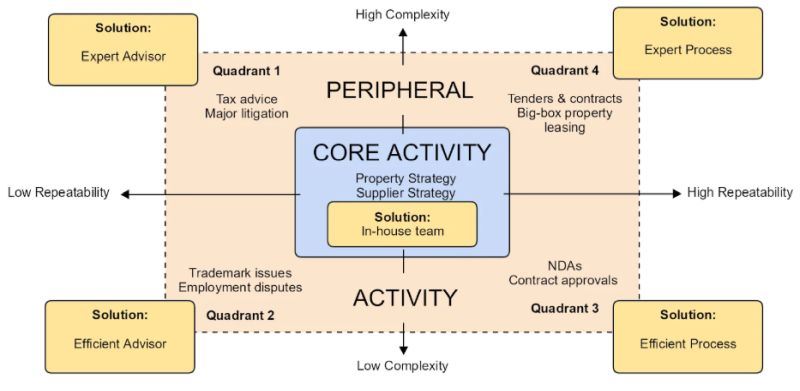
Let’s delve further into each part of this Matrix.
The ‘Complexity’ and ‘Repeatability’ Axes
The ‘complexity’ axis concerns the variability of the potential outcomes for certain tasks. It also looks at the specialist knowledge that is required to navigate these outcomes. ‘Repeatability’ looks at both the volume of the activity within the business and how similar each unit of activity is to the next.
The focus on complexity and repeatability rather than ‘risk’ and ‘value’ is important. The matrix intends to identify solutions. While ‘risk’ and ‘value’ can outline whether an individual task might merit a solution, they don’t tell us much about what that solution might be.
Take ‘value’ as an example. A million dollar contract can be incredibly simple, whereas a contract for no dollar value can be a minefield. Without knowing how complex or common these contracts are, an in-house team cannot identify the best solution for managing this task.
Core Activities
Whether or not an activity lies in the ‘core’ portion of the matrix depends on the strategy of your in-house team.
For example, A-Star Company’s in-house team is focusing on renegotiating supplier terms and improving the process of entering into leases for new stores. The property and supplier strategies are therefore marked as ‘core’ activities in the Matrix. These are the essential tasks that deliver the most value to A-Star Company and further the objectives of the in-house team’s legal strategy. The in-house team subsequently prioritises spending time on these activities.
Periphery Activities
An activity will move from the core to the periphery when:
- it does not align with core business objectives;
- the in-house team does not have the capacity to undertake the activity; or
- the in-house team does not carry that specialist capability.
Moving these activities into the ‘periphery’ promotes more effective decision-making on how to approach each task. This does not mean that the in-house team never completes peripheral tasks. Rather, if an activity sits within the ‘periphery’, any assistance from the team should not involve diverting resources from the ‘core’ priority tasks. The in-house team can still have a role to play, but they are only one of a range of possible solutions.
Identifying Solutions for Each Quadrant
When plotted across the two axes of ‘complexity’ and ‘repeatability’, the peripheral tasks of an in-house team can fall into four quadrants. Each quadrant will lend itself to a different solution.
The diagram places each quadrant on the grid, but the coordinates are worth stating plainly, because the quadrant names alone do not reveal them. Quadrant 1, expert advisors, holds high complexity and low repeatability: the one-off matter that needs deep specialist knowledge, such as a competition investigation or a cross-border restructure. Quadrant 2, efficient advisors, holds low complexity and low repeatability: work that is neither hard nor frequent, where a provider running the same task across many clients gives you scale you cannot build for yourself. Then Quadrant 3, efficient processes, holds low complexity and high repeatability: high-volume, low-variation work such as standard non-disclosure agreements, which suits a technology solution. Quadrant 4, expert processes, holds high complexity and high repeatability: frequent work that still needs judgement at particular points, where a designed process handles the volume and a lawyer handles the decisions. Plotting your own tasks takes an afternoon and a whiteboard. The value is not the picture; it is the argument it lets you make when someone asks why a task left the team. For Quadrant 3, see our guide to selecting legal technology.
The Four Quadrants Mapped Against the Two Axes
| Quadrant 1: Expert advisors | Highly complex tasks with low repeatability require expert knowledge. It is difficult for most in-house teams to carry such specialised capability internally. With these types of tasks, you should spread the risk by engaging subject-matter experts. |
| Quadrant 2: Efficient advisors |
Activities that occur infrequently and are not highly complex don’t require highly knowledgeable experts. However, they do call for additional capabilities that do not exist within the in-house team. The best solutions for this quadrant are ones that leverage economies of scale by conducting the same categories of tasks across multiple businesses. This ensures efficiency and cost-certainty. |
| Quadrant 3: Efficient processes | Where work is not very technical but happens at a high volume (such as tasks involving administrative box-ticking), the best solution is one that invests in efficient technological processes. |
| Quadrant 4: Expert processes | Activities within this quadrant are best solved by a combination of expert lawyers and an efficient process (such as the solution provided by LegalVision’s managed legal services model). A well-designed technological legal process can improve efficiency while involving legal experts at critical touchpoints in the process. This will help to account for the complexity of particular tasks. |
In-house teams can manage peripheral tasks across all four quadrants is through a clearly structured legal services panel. Here, various suppliers account for the different needs of each quadrant. This process allows in-house teams to carefully select the best solution for each peripheral task.
Key Takeaways
The core/peripheral matrix is a valuable tool for in-house teams to identify ways to manage tasks. By understanding where each task lands on the matrix, in-house teams can better navigate the legal market and identify the most appropriate providers. By implementing tailored solutions for peripheral in-house activities, your team can maximise its impact without blowing out legal spend.
If you have any questions about how your in-house legal team can better meet business aims, LegalVision provides ongoing legal support for all businesses through our fixed-fee legal membership. Our experienced Legal Transformation lawyers help businesses manage contracts, employment law, disputes, intellectual property, and more, with unlimited access to specialist lawyers for a fixed monthly fee. To learn more about LegalVision’s legal membership, call 1800 532 904 or visit our membership page.
Frequently Asked Questions
What is the core and peripheral matrix?
It is a tool for sorting an in-house team’s work. You plot each task against two axes, complexity and repeatability, and the quadrant it falls into indicates the most suitable solution, whether that is a specialist firm, a scale provider, a technology process or a managed service.
Why use complexity and repeatability instead of risk and value?
Risk and value tell you whether a task deserves attention. They do not tell you what to do about it. A million-dollar contract can be simple, and a contract worth nothing can be a minefield, so value alone cannot point you to the right provider.
When does an activity move from core to peripheral?
When it stops advancing the core business objectives, when your team lacks the capacity to take it on, or when your team does not hold the specialist capability it needs. Moving it does not mean your team never touches it again.
How does a legal services panel fit with the matrix?
A panel lets you cover all four quadrants at once. You appoint different suppliers for the specialist work, the scale work, the process work and the managed work, then route each peripheral task to whichever panel member matches its quadrant.
The content of this article is intended to provide a general guide to the subject matter. Specialist advice should be sought about your specific circumstances.
[View Source]