
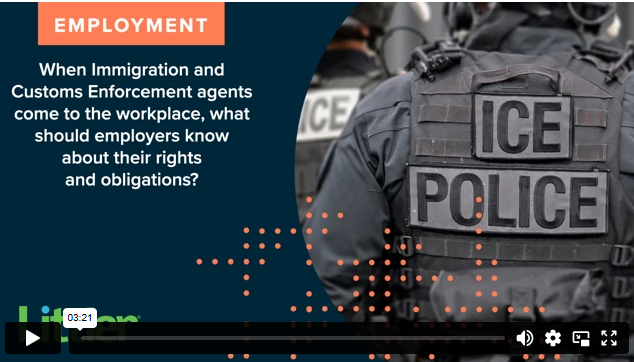
When Immigration and Customs Enforcement (ICE) agents come to the workplace, what should employers know about their rights and obligations?
Employers may encounter ICE activity, or site visits, with little—or no—notice in a range of enforcement actions, including raids, sweeps, or inspections.
Your rights and obligations as an employer turn on whether agents present a judicial warrant, an administrative warrant/subpoena, or no legal documentation at all.
What are the key distinctions?
Let’s start with the judicial warrant. A judicial warrant is an order signed by a judge or magistrate and typically references a U.S. District Court or a state court at the top. Albeit federal courts are more common.
A judicial warrant is valid only for a specific date, time, place, and purpose, such as an arrest, search, or seizure.
When ICE presents a valid judicial warrant, employers do not have discretion to refuse entry into the non-public areas listed in the warrant. The employer’s role is limited to verifying that the warrant is court issued and signed by a judge, reviewing its scope, and ensuring that agents do not exceed that scope. This is a matter of legal authority, not a cooperation preference.
An administrative subpoena, by contrast, is issued by an agency such as ICE or the Department of Homeland Security—not by a judge. Administrative subpoenas are commonly used in I-9 sweeps and other compliance investigations and typically seek records rather than physical entry.
While an administrative subpoena carries legal obligations to respond, it does not authorize entry into non-public areas of a workplace. Consent is required for that.
No legal documentation at all?
Sometimes, agents arrive without a judicial warrant or administrative subpoena but nonetheless request to speak with someone or seek consent to enter. This is commonly referred to as a “knock and talk.” Anyone—including ICE agents—can enter public areas of your business during operating hours without prior permission, but agents on a “knock and talk” do not have authority to enter non-public areas.
So, what is the main takeaway?
The label used to describe an enforcement action matters far less than the documentation the ICE agents present. Understanding these distinctions is essential to preparing an appropriate, legally sound response.
Littler’s Immigration and Global Mobility Practice Group is here to help employers before, during, and after an ICE workplace visit.
The content of this article is intended to provide a general guide to the subject matter. Specialist advice should be sought about your specific circumstances.
[View Source]