
Executive Summary
U.S. employers are recalibrating workforce strategies in 2026 as the rapid advance of artificial intelligence (AI) and an increasingly complex regulatory landscape compound ongoing pressures tied to various Trump administration priorities.
To understand how businesses are adapting to recent developments, Littler surveyed more than 300 U.S.-based C-suite executives, in-house lawyers and human resources (HR) professionals across a range of industries and company sizes. This year’s research shows that while issues at the top of employers’ agendas over the past year – including immigration and diversity, equity and inclusion (DEI) – remain consequential, other areas such as AI and data privacy are moving to the forefront.
AI AND DATA PRIVACY TAKE CENTER STAGE AS EMPLOYERS ADJUST TO IMMIGRATION AND DEI POLICY CHANGES
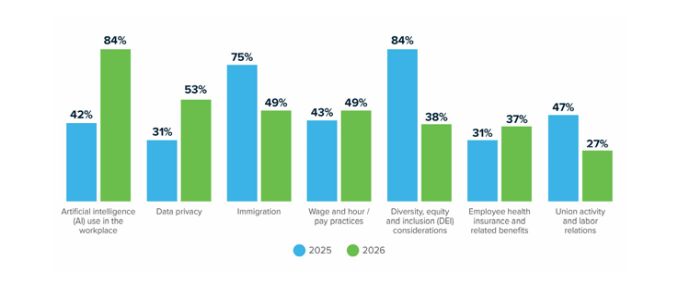
In a notable shift from last year’s survey, AI is now the leading area where employers expect changes to workplace policy and regulation to impact their businesses. The majority of respondents (84%) expect to be impacted by policy or regulatory changes related to AI use in the workplace over the next 12 months – double the share that said the same in 2025, when DEI ranked first. Data privacy rose in tandem, with 53% expecting workplace impacts over the next 12 months, up from 31% in 2025. This comes as accelerating AI use across business operations increases exposure to data privacy compliance risks.
By contrast, the share of employers expecting to be impacted by immigration policy changes over the next year fell to 49% this year from 75% in the 2025 survey, while DEI dropped to 38% from 84%. These declines do not mean these issues have gone away. Rather, they may reflect that many employers have adjusted to the current enforcement landscape in the second year of the Trump administration and have taken steps to prepare.
Employers are still highly attuned to immigration enforcement risks, as 73% expect enforcement by the Department of Homeland Security (DHS) and U.S. Immigration and Customs Enforcement (ICE) to impact their workplaces over the next year. Additionally, this year’s survey finds employers taking a range of proactive steps to address the workforce staffing impacts of immigration policy and enforcement changes, including clarifying plans and processes and preparing for worksite enforcement activity.
ACCELERATING AI ADOPTION PROMPTS SHIFTS IN WORKFORCE NEEDS, LITIGATION CONCERNS
As AI becomes more deeply embedded across workplace functions, employers are starting to reevaluate existing and future staffing needs. In light of expected AI-driven efficiency gains, 37% of respondents say their organizations have reassessed, or are reassessing, job responsibilities. Another 20% report that they have either reduced hiring or are in the process of doing so, while 15% say the same about workforce reductions.
The survey also reveals meaningful, but uneven, advances in AI governance. More than two-thirds of respondents (68%) report having a formal policy governing AI use in the workplace, a substantial increase from Littler’s 2025 Employer Survey when 38% said they had a specific policy to address employees’ AI use and 13% had developed guidelines. Yet only about half of respondents report having a formal review or approval process for AI tools or use cases (55%), or restrictions on the information that can be entered into them (54%) – steps that limit legal and operational risk at the point where AI is actually used.
Those readiness gaps come as 79% of respondents express concern about AI-related litigation over the next 12 months. Data privacy (49%), discrimination or bias (45%) and compliance with state and local AI laws (43%) are the leading areas of concern.
EMPLOYMENT LITIGATION AND WORKFORCE ACCOMMODATIONS ARE TOP OF MIND
Employers anticipate litigation risk across a broad range of workplace issues in the coming year, with concern rising in most of the areas queried. Among the most notable shifts came in the area of workplace accommodation, which saw a 17 percentage-point increase in employers concerned about employment-related litigation over the next year (67% expressed concern this year, compared with 50% in the 2025 report).
Employers continue to grapple with pandemic-era expectations regarding flexible work that complicate their push for more in-office work and, at the same time, report an ongoing rise in mental health-related leave of absence and accommodation requests.
Hybrid work remains the dominant model for positions that can be performed remotely, with most respondents (77%) indicating that their organizations are providing some type of hybrid work arrangement. Only 16% have employees that are fully on site and just 6% have employees that are fully remote.
Over the past year, 67% of employers say they experienced increases in the volume of mental health-related leaves of absence and accommodation requests. This follows two years of survey data in which employers reported a similar increase in the amount of leave and accommodation requests related to mental health conditions.
The report that follows examines these and other issues in greater depth, including the active role of state legislatures in advancing labor-friendly policies, evolving False Claims Act (FCA) enforcement trends (where respondents are particularly concerned about the enforcement activity related to unlawful DEI practices), and key challenges when employees depart to competitors (including the removal of confidential information and restrictive covenant violations).
WORKPLACE REGULATION AND POLICY
In which of the following areas do you expect changes to workplace policy and regulation over the next 12 months that will impact your business? (Select all that apply)
U.S. employers are bracing for new developments in workplace policy and regulation over the next year as technology-related issues – namely, AI and data privacy – come more to the forefront after a year largely defined by signature Trump administration priorities such as immigration enforcement and scrutinizing DEI initiatives.
AI’s potential to transform businesses and upend workflows continues to dominate headlines – and presents a range of compliance dilemmas. While states continue advancing AI-related laws that can impact private sector employers, the White House is pursuing a lighter-touch regulatory approach intended to limit state regulation of AI.
Given these shifts and the rapid evolution of AI tools in recent months, it follows that AI in the workplace is the leading area where employers expect changes to workplace policy and regulation to impact their businesses in the year ahead. A notable 84% of respondents chose AI – double the share (42%) that selected it in 2025, when DEI considerations ranked as the top area of concern.
Data privacy regulation is the next highest area where employers predict workplace impacts over the next 12 months. While it trails AI substantially at 53%, data privacy is weighing more heavily on organizations than it did last year, when 31% selected it. That jump is likely a result of state and local legislative moves inCalifornia, Maryland and elsewhere that continue to increase data privacy requirements for employers and businesses, as well as the prominence of data privacy issues associated with AI use.
Immigration tied for the third top area but saw a sharp drop compared to employer expectations on the issue last year. It fell to 49% – 26 percentage points lower than in 2025, when 75% of respondents anticipated impacts from changing immigration policy and regulation in the year ahead. This shift may reflect that many have already created protocols and action plans and are more prepared than they were last year. Large employers and employers in certain industries may bear a greater share of immigration-related impacts, however, with 61% of large employers and 70% of respondents in the hospitality and retail industries expecting effects.
To be sure, immigration remains a major focus for many employers after a year that saw major ICE enforcement surges in Los Angeles, Chicago and Minneapolis. In a separate survey conducted recently by Littler’s Workplace Policy Institute® (WPI), 65% of employers (and 79% of those from large organizations) reported that shifts in immigration policy during the first year of the second Trump administration impacted their businesses. By contrast, only 30% of employers said they had been impacted by AI-related policy changes over the past year.
The marked year-over-year decline on immigration may reflect an adjustment among employers to the new immigration normal after the initial shock from enforcement measures taken in the f irst year of the Trump administration. However, the landscape ahead is still characterized by considerable uncertainty, and employers would be prudent to expect more activity due to the significant increase in funding for ICE as part of the One, Big, Beautiful Bill Act.
DEI saw an even larger reversal from last year’s survey than immigration, likely for similar reasons. Fewer than 4 in 10 respondents (38%) expect business impacts due to changing policy or regulation, compared to the 84% who said the same in 2025. As with immigration, a greater share of large employers (52%) – who may be more likely targets for federal probes and scrutiny – anticipate impacts in the coming year.
The reversal on expected DEI impacts follows a tumultuous year in which the Trump administration’s push to dismantle such initiatives across the federal government and private sector included a flurry of executive orders, several rounds of guidance from the Department of Justice (DOJ) and Equal Employment Opportunity Commission (EEOC), and scrutiny of corporate DEI programs by the Federal Communications Commission. The majority of employers (71%) surveyed in the WPI report said DEI policy changes over the past year had impacted their businesses.
In another shift from 2025, the share of respondents who cite changes to union activity and labor relations policy as an expected area of impact also declined. Only 27% selected it this year, compared to 47% in 2025. These numbers are not surprising, in part because of anticipated (now actual) personnel and internal policy changes and a backlog of cases at the National Labor Relations Board (NLRB) along with data showing a decline in organizing and strike activity compared to prior years, and the current economic uncertainty workers and unions face. These are the key factors driving state and local leaders in California, New York, Illinois, Washington and other places that are advancing pro-union laws and policies that companies need to keep a close eye on.
Finally, the jury remains out on how big or how fast a role AI will play in labor relations in the coming months. There are early signs that unions are raising the specter of machines and “bots” displacing employees as an issue for the union-curious to organize around and address at the bargaining table. As AI plays a role in workforce reductions and reshapes workers’ roles and responsibilities, as discussed later in this survey, some employers could see a resulting uptick in organizing interest among employees or increased focus by unions on AI use during bargaining negotiations. This is an important reminder that as businesses further integrate AI into their operations, they should also assess the employment-related implications and adapt their employee engagement focus.
How much impact do you expect enforcement by the following regulatory agencies, and compliance with their respective requirements, to have on your workplace over the next 12 months?
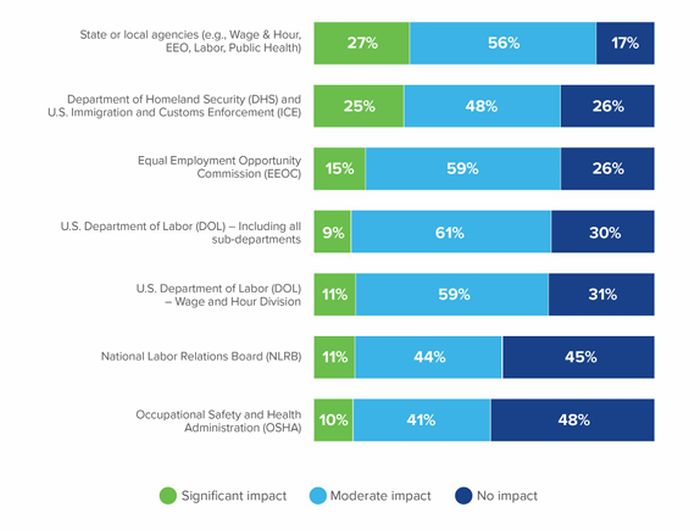
In the second year of the Trump administration, employers expect enforcement and compliance pressures in the next 12 months to be driven primarily by state and local regulators, as well as by federal agencies responsible for implementing key parts of the president’s agenda.
More than 8 in 10 respondents anticipate some degree of impact on their workplace from state and local agencies in areas such as wage and hour, equal employment opportunity, labor and public health, with 27% expecting a significant impact. This comes amid legal challenges to some administration moves on workforce policy, as well as actions from states and localities such as California and New York City to step up efforts in areas where federal agencies favor a more deregulatory approach. It also tracks with the recent WPI report, in which 89% of employers said they had been impacted by legislative changes and new workplace regulations at the state and local levels over the past year (see page 6 here).
To read this article in full, please click here.
The content of this article is intended to provide a general guide to the subject matter. Specialist advice should be sought about your specific circumstances.
[View Source]