- within Intellectual Property, Criminal Law and Strategy topic(s)
The software engineering landscape is experiencing its most dramatic transformation in decades. While executives debate whether artificial intelligence is merely another technological trend, the data tells a starkly different story: companies that strategically implement AI across their software development lifecycle are achievinggame-changingproductivity gains, while those that don't risk being left behind by more agile, AI-enabled competitors.
The message is clear—software engineering excellence powered by AI isn't just an opportunity; it's a strategic imperative. Yet, most organizations are approaching this transformation with the wrong mindset, treating AI as a simple add-on tool suite rather than the catalyst for fundamental organizational change it actually represents. To successfully address thistransformation,a holistic program is required.
The competitive divide is already here
The numbers paint a compelling picture of an industry in rapid transition. Microsoft reports that AI now writes 20-30% of its internal code, while Mark Zuckerberg has set the ambitious goal of having AI handle half of Meta's coding by 2026. These aren't distant aspirations—they're current realities that are reshaping competitive dynamics.
Meanwhile, GitHub Copilot users are completing tasks 55% faster than their non-AI-enabled counterparts, while IBM Software reports observing productivity increases of 30-40% in software development areas such as code documentation, explanation, and test case generation. But here's the critical insight most executives miss: these productivity gains don't automatically translate to business value without the proper organizational foundation.
The hidden barriers to AI-driven success
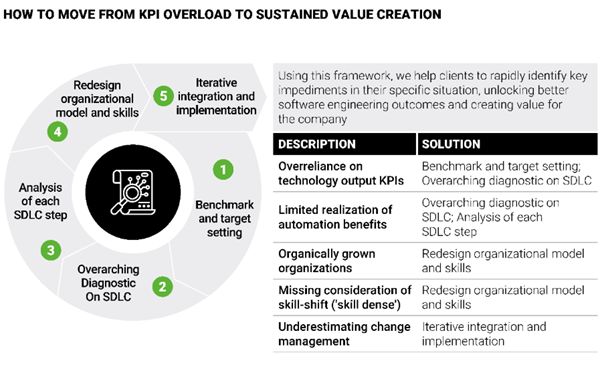
Through our experience with dozens of software engineering transformations, we've identified five critical constraints that prevent organizations from realizing AI's full potential:
- Overreliance on Technology Output
KPIs
Many organizations focus on technical metrics rather than business impact. Without ROI-led prioritization and capacity discipline that ties product work to business value, teams may produce more code faster without creating more value. - Limited realization of automation
benefits
The prevalence of manual processes across the entire software lifecycle means that AI-driven automation can only unlock value after fixing underlying processes and organizational setup. As our analysis reveals, automating broken models first amplifies inefficiency, not impact. - Organically Grown Organizations
Product and technology organizations are often overbuilt, driven by a "more personnel equals better outcomes" mindset. These oversized teams and in particular overloaded support functions add complexity, slow decision-making, and dilute accountability—creating friction that neutralizes AI's speed advantages. - Missing consideration of skill-shift
The use of AI technologies will ultimately reduce or fundamentally change the skill requirements of the broader engineering workforce towards more "skill-dense" and experienced profiles. We do not see this challenge being strategically addressed in most companies. - Underestimating the Change Management
Required
Organizations often treat AI adoption as a technology deployment rather than an organizational shift. Teams need time to learn new workflows, adapt existing processes, and build confidence with AI tools. Without proper change management, even the best AI implementations struggle to gain meaningful traction across development teams.
A comprehensive framework for AI-enabled excellence
Based on our extensive experience helping organizations navigate transformation in software engineering, we've developed a five-step framework that addresses both the technical and organizational dimensions of theaforementioned barriers:
- Benchmark and target setting
Before implementing AI tools, establish clear performance baselines andvalue-based investment targetsaligned to business strategy. This includes benchmarking against peers and industry leaders while adjusting for business model complexity and maturity stage.
- Overarchingdiagnosticon SDLC
performance
Conduct a comprehensive assessment across four critical dimensions: Quality, Productivity, Predictability, and Organizational Talent. This diagnostic identifies bottom-line-relevant pain points for deeper analysis and shows how operational metrics, such as deployment frequency, change failure rate, change lead time, and failed deployment recovery time,impact bottom-line value.
- Analysis of each SDLC process
step
Deep-dive into pain point dimensions across the software development lifecycle, from concept through deployment. Our analysisshowsthevalue of AI varies significantly by stage—25-40% productivity gains in build and test phases, compared to 15-25% productivity in concept and design, and these productivity gains do not automatically translate into bottom-line value.
- Redesign organizational model and skill
profiles
This is where most organizations stumble. AI doesn't just change how code gets written—it fundamentally alters role responsibilities and skill requirements. Based on our analysis, successful transformations require updating role fidelity, right-sizing layers, and rebalancing skill-mix and capacity across the software development lifecycle.
- Iterative integration and
implementation
Launch structured pilots with lighthouse products and teams, measure impact through established metrics, and scale across the organization based on proven results. The key is coordinated implementation across process, tooling, and organizational levers.
Follow our series to learn more about key success factors and successful implementations. Our next article will focus on product-centric software development organizations.
The authors gratefully acknowledge co-authorship of Florian Nie and Niklas Heckmann and valuable contributions from Stefan Stroh, FilipFlögel,and Qiuyue Zhang.
The content of this article is intended to provide a general guide to the subject matter. Specialist advice should be sought about your specific circumstances.