
- with Inhouse Counsel
- with readers working within the Law Firm industries
Business executives are feeling the pressure of geopolitical uncertainty. From the US military intervention in Venezuela to the US-Israel war with Iran, the start of 2026 has been defined by crisis. The human and economic consequences have been profound. For businesses, the consequences are a fractured global market and slower growth.
In late January and mid-February 2026, we surveyed 300 executives from companies with at least £500 million in annual revenue, and 71% told us they’re facing a high level of geopolitical risk. And 58% say that the risk has increased in the past 12 months.
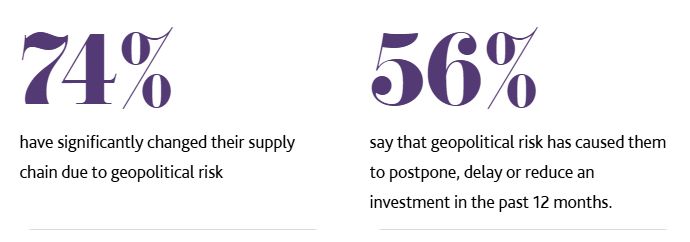
As a result, companies are changing how they operate and generate income:
Faced with relentless unpredictability, executives must go beyond simply managing geopolitical risk. Today, they need to build organisations that are capable of operating in an increasingly fragmented world.
The greatest risks are cross-border
International organisations bear the brunt of geopolitical risk. Executives list tariffs, data sovereignty, foreign investment screening, cross-border disputes and sanctions among the top three challenges of geopolitical risk. This explains why organisations with international operations feel the risk more than organisations that only operate domestically. For instance, 71% say that geopolitical risk has caused them to postpone, delay or reduce an investment in the past 12 months, compared with just 41% of organisations that only have domestic operations.
David Lowe, Partner and Head of International Trade at Gowling WLG, sees these pressures intensifying as global trade rules fragment.
“What we’re seeing is not just volatility but a structural shift in how governments use trade and investment controls as geopolitical tools,” says Lowe. “Tariffs, export controls and sanctions are no longer exceptional measures, they’re becoming a permanent feature of the commercial environment. For internationally active businesses, that means trade compliance and geopolitical awareness can no longer sit at the margins of strategy.”
Even a single new regulation or geopolitical event can have significant consequences for our business. We operate in more than 20 countries, where political volatility can emerge at any time. The challenge is distinguishing which developments require legal or structural intervention and which simply need monitoring.
Risks are growing as geopolitical tension intensifies
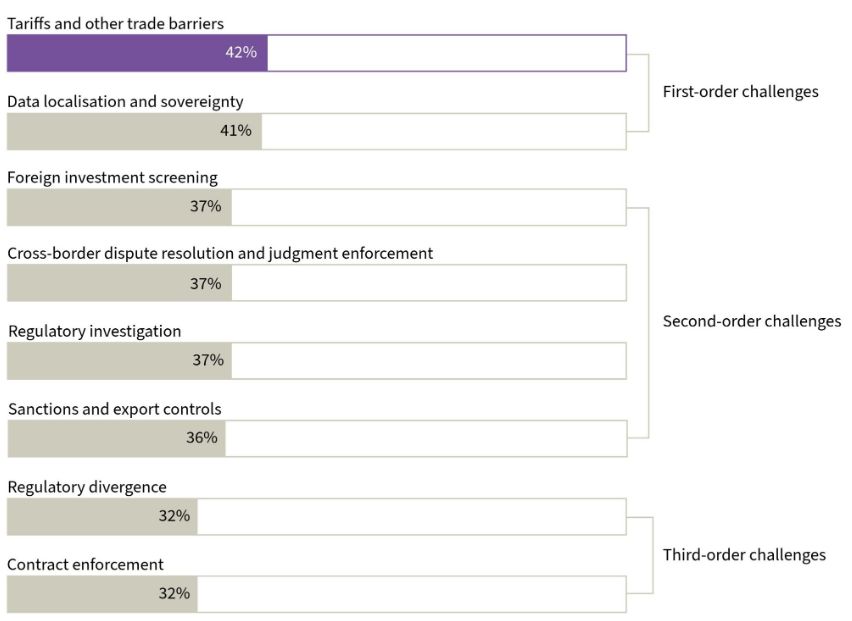
Which of the following legal and regulatory risks have increased most due to geopolitical developments in
the past 12 months?
Geopolitical shocks expose just how brittle global supply chains can be. Businesses are reassessing not only where they source components, but whether they can legally and reliably trade through certain routes or jurisdictions at all. Building resilience increasingly means diversifying suppliers, stress‑testing trade routes and understanding how sanctions or export controls could change overnight.
From reaction to resilience
Keeping up with geopolitical risk is a non-stop challenge. “The environment is moving much faster than any organisation’s internal processes are designed to handle,” says Flacco.
Recent events illustrate just how quickly disruption can unfold. Following US and Israeli military strikes on Iran in late February 2026, Iran retaliated by effectively blocking transit through the Strait of Hormuz — an important global energy and shipping route.
For businesses, this risks affecting:
- Costs, as they grapple with higher energy prices and increased shipping costs due to rerouting and insurance premiums.
- Investment decisions, as market volatility leads businesses to pause or delay investments.
- Supply chains, as businesses reroute shipping and air freight routes to avoid high risk areas.
Rapid developments are forcing organisations to continuously review and adapt their operations. We see this most clearly in supply chain transformation: 74% of executives say they’ve already significantly transformed their supply chain, and 81% plan to over the next 12 months.
From a trade perspective, this shift is as much about redesigning supply chains as it is about crisis response. But such large-scale transformations cannot be completed overnight. To respond effectively, organisations must shift from reacting to geopolitical events to embedding resilience into their structures from the outset. “For us, geopolitical risk management is less about quick reactions and more about building resilience into the structure upfront,” says Flacco.
Unclear ownership leads to unclear responses
Who owns geopolitical risk? Over one-third of executives (34%) are unclear about who in their business is responsible for geopolitical risk. This is especially true for those working at organisations with international operations (43%, compared with 26% of those working at organisations with only domestic operations).
This is a serious issue for organisations facing fast-moving and unpredictable crises. Without clear ownership responses can be slower, as executives don’t feel they have the authority to act quickly. Decision-making can also become fragmented as different teams act in silos or duplicate efforts. And actions are more likely to diverge from overall business strategy or regulatory requirements due to there being no strategic or governance framework.
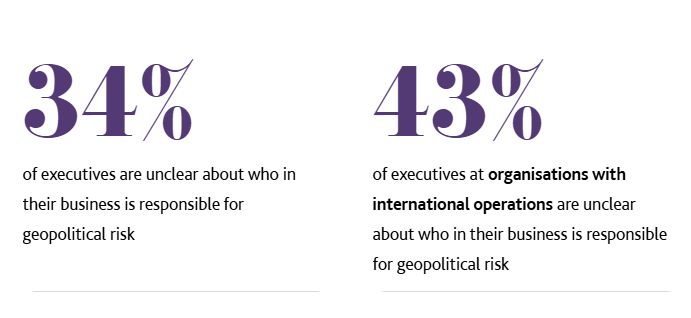
The lack of clarity could be because there’s rarely one person responsible for geopolitical risk.
"Geopolitical uncertainty is a growing concern from all GCs, but also for the executives they are advising," says Dr James Ryan, Chief Legal Officer & Chief Business Officer at global biotechnology company BioNTech. “There is a growing appreciation that understanding and addressing geopolitical risk is a joint responsibility between business, legal and compliance teams. What is becoming clear is that this is not a single act – it requires an evolution in cross-functional collaboration to ensure the risk is managed in a dynamic way.”
This shift towards shared ownership is already evident in how different functions are working together in practice.
The Chief Risk Officer will flag that a region is
becoming a higher risk, then the Chief Financial
Officer will model the financial downside through
simulations, while the General Counsel has to decide
how the organisation should act on that information
and what other challenges the business could face
should things go wrong.Alice Flacco, General Counsel, MicroPort® CRM
Nearly every executive says their GC is integral to their discussions on geopolitical risk. “With geopolitical risk, the GC’s role isn’t just about legal compliance – it’s about translating volatility into concrete legal exposure that the business can act on,” explains Flacco. “GCs today aren’t filtering risk. We’re helping to shape the business structure itself so that it remains agile amid uncertainty. That might mean renegotiating force majeure clauses, building jurisdictional flexibility into supply contracts, or advising the board on the legal implication of entering or exiting a market at a particular time.”
But the GC role is also evolving beyond risk translation into value creation, particularly in moments of disruption. “Part of the GC’s role is to look beyond the immediate risk and identify where the business can add value during periods of disruption — spotting opportunities that both strengthen the organisation and help mitigate exposure,” says Brenda Albert, Legal Director at lift and escalator manufacturer KONE plc.
Evidently, many leadership roles have an important part to play in mitigating geopolitical risk. So to make ownership clearer, organisations will have to cut through the complexity by creating a governance structure that clearly outlines who’s responsible at each stage of managing geopolitical risk — from alerting to analysing and acting.
Are you less prepared than you think?
The executives in our research are positive about volatility, despite the growing risk:
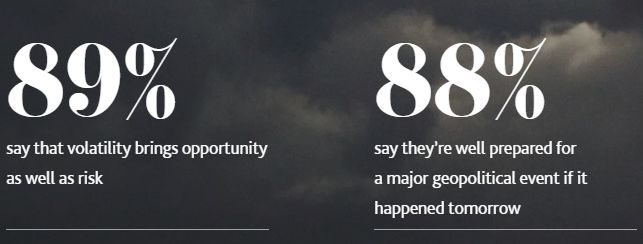
This reflects a growing recognition that geopolitical disruption can also be a strategic inflection point. “Geopolitical risk is not just about mitigation – it can also create opportunity. It may be a catalyst to rethink strategic direction or to negotiate new, more beneficial contractual arrangements,” says Albert.
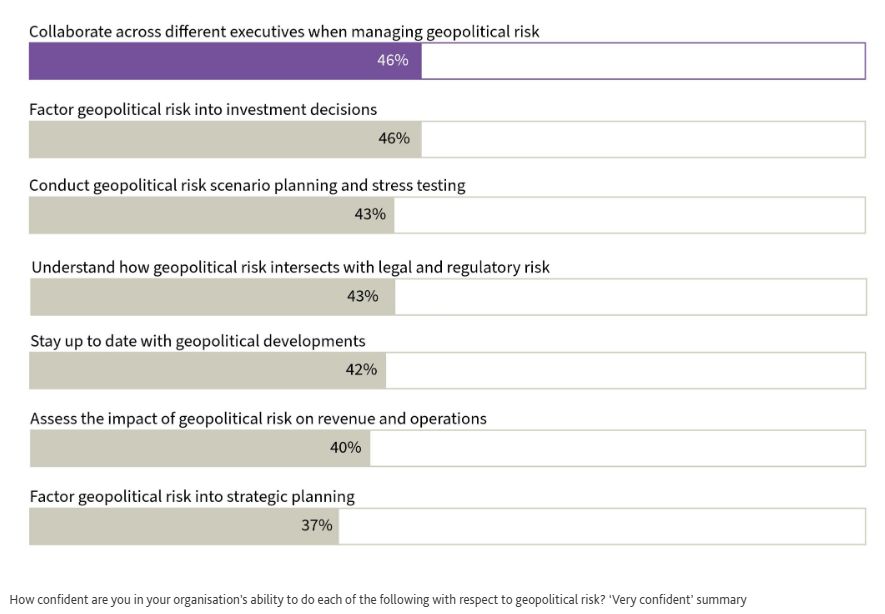
But this confidence is not matched by capability. Less than half are “very confident” about mitigating geopolitical risk. Confidence is particularly low in strategic planning, assessing the impact of geopolitical risk on revenue and operations, and staying up to date with geopolitical developments.
For many organisations, that confidence gap reflects untested assumptions about trade and market access.
Many businesses assume they’ll have time to adapt if trade rules change, but in reality those windows are shrinking. Sanctions, export bans or investment restrictions can be imposed with immediate effect. Organisations that haven’t mapped their trade exposure or practised scenario planning may find themselves compliant on paper, but operationally stuck.David Lowe, Partner and Head of International Trade at Gowling WLG
Geopolitical shocks can change the operating landscape overnight. So organisations can’t afford to just manage geopolitical risk – they must excel at it.
“We’re living in a world where Europe, the US and China are increasingly writing their own rule books on data, tech transfer, supply chain and due diligence,” says Flacco. “The risks are real and persistent. Organisations that invest in the right capabilities will navigate through these significantly better than the ones that don’t.”
This growing focus on capability-building is also drawing greater attention at board level. “This is an area where well-informed non-executive directors are increasingly engaging with executive teams to ensure geopolitical risk is properly assessed and actively managed,” explains Ryan.
In practice, that means hypervigilance. Organisations will have to continuously test their assumptions, strengthen their scenario planning, embed geopolitical insights into investment strategy, and align and prepare their teams. This is not just about withstanding shocks, it’s also about turning volatility into a competitive advantage.
Only a minority are very confident in their organisation’s ability to manage geopolitical risk
How prepared is your organisation for the next geopolitical shock?
Our lawyers work with boards, GCs and executive teams to help anticipate risk, strengthen governance and make confident decisions in volatile markets. If you’d like to discuss how geopolitical developments could affect your business, contact us for tailored advice.
About the research
The research was conducted by FT Longitude, a specialist provider of thought leadership and research services across seven countries in Europe, the Middle East and Asia: Belgium, China, France, Germany, Italy, the United Arab Emirates and the United Kingdom. Fieldwork was conducted between 23 January and 16 February 2026.
Read the original article on GowlingWLG.com
The content of this article is intended to provide a general guide to the subject matter. Specialist advice should be sought about your specific circumstances.
[View Source]