
A. Introduction
Generative artificial intelligence (“AI”) tools have become part of day-to-day legal practice in many jurisdictions. From summarising contracts and lengthy decisions to preparing first drafts of correspondence and supporting legal research, these tools now assist lawyers at many stages of their work. As their use becomes more widespread, the focus is increasingly shifting from whether AI should have a place in legal practice to the conditions under which it can be used consistently with lawyers’ professional obligations.
The growing use of AI in legal practice has raised similar questions in Türkiye, and these issues were addressed at the AI and Legal Profession Workshop held by the TBB in Ankara on 14 and 15 February 2026. The TBB subsequently published its Recommendation Guide on the Use of Artificial Intelligence for Lawyers in 20261 (Avukatlar İçin Yapay Zekâ Kullanımı Tavsiye Rehberi) (the “Guide”).
At the heart of this framework is a simple distinction: AI may assist the lawyer, but it cannot replace the lawyer’s professional judgment or responsibility. Professional secrecy, the protection of personal data and the client’s interests remain the lawyer’s responsibility throughout. The Guide therefore seeks to accommodate the practical benefits of AI while preserving the professional safeguards that govern legal practice. This article examines how that balance is reflected in the Guide and what it means for the day-to-day practice of lawyers and law firms in Türkiye.
B. Confidentiality, Anonymisation and Data Minimisation
The Guide takes a careful view of what anonymisation actually means in practice. Removing a client’s name, identification number or contact details from a document does not necessarily make it anonymous. Even where the client is not expressly named, a combination of information such as the date and place of an event, the nature of the dispute, monetary amounts, company names, the relationship between the parties or other case-specific facts may make the client or another individual identifiable.
Stripping out direct identifiers is therefore not always enough. Before a document goes into an AI tool, it should be assessed as a whole, including whether what remains can still be traced back to a person or a specific matter. The Guide also emphasises data minimisation, requiring lawyers to limit the information transferred to AI tools to what is necessary, proportionate and lawful, while anonymising the data where possible.
C. A Risk-Based Approach to AI Use
The Guide recognises that not every use of AI carries the same level of risk. The assessment takes into account the type of data involved, the potential impact on the client, the proximity of the use to a legal outcome, whether the system is open or closed, and the possibility of a cross-border data transfer. On this basis, the Guide groups AI use into four categories:
- Free auxiliary use
- Limited and controlled use
- Use subject to special safeguards and approval where necessary
- Uses prohibited under applicable legislation and professional rules
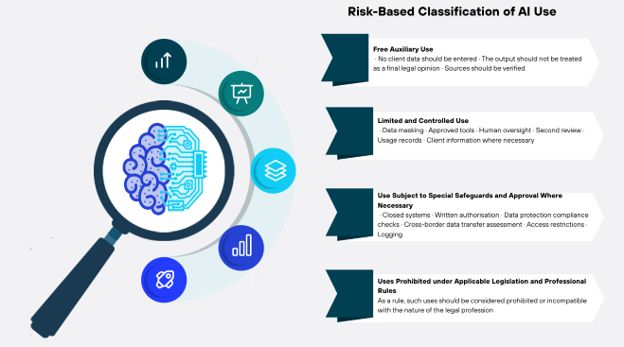
Under the Guide, free auxiliary use includes general research on legislation, topic planning that does not involve information relating to a client or a specific matter, language simplification and the summarisation of publicly available texts. In these cases, client data should not be entered into the tool, the output should not be treated as a final legal opinion, and the relevant sources should be verified.
Limited and controlled use covers tasks such as preparing the initial structure of a petition or contract, summarising anonymised documents, conducting a preliminary review of case law and drafting client e-mails. The Guide refers to safeguards including data masking, the use of approved tools, human oversight, record-keeping, second review and, where necessary, informing the client.
For uses involving documents containing sensitive data, litigation or enforcement files or trade secrets, the Guide envisages special safeguards and, where necessary, approval. These include the use of closed systems, written authorisation, compliance checks under Turkish data-protection rules, an assessment of cross-border data transfers, access restrictions and logging.
The Guide also addresses forms of use that fall within the scope of applicable legislation and professional rules and states that these should, as a rule, be considered prohibited or incompatible with the nature of the legal profession.
D. Verification of AI-Generated Outputs and Human Oversight
Accuracy is another focus of the Guide. AI outputs often read as coherent and persuasive, yet they are not always correct, current or legally sound. The Guide identifies hallucination, confirmation bias and automation bias among the risks associated with the use of AI and emphasises the need to verify AI-generated content.
Legislation and case-law references should be verified against reliable sources, while dates, names, monetary amounts, evidence and other information introduced by AI should be compared with the underlying file. The lawyer should also assess the output in light of the client’s interests and the legal strategy being pursued. For higher-risk matters, the Guide envisages review by a second lawyer.
If an inaccurate or fabricated output is subsequently identified in the file, the lawyer should promptly consider whether the relevant authority should be informed and whether the error can be corrected, taking the client’s interests into account.
E. AI Use and Disciplinary Risk
The Guide is clear that using AI is not, in itself, a ground for disciplinary sanctions. The relevant considerations instead include whether there has been a concrete breach or harm, the lawyer’s fault, a data-security violation or a failure to comply with the duty of professional care.
F. AI and the Rules on Publicity of Legal Services
The existing restrictions on the publicity of legal services continue to apply where AI is used. The Guide emphasises that AI-assisted services should not be presented to clients or the public in a misleading manner. Claims suggesting a “guaranteed result” or a “certain win analysis”, the ability to predict court outcomes, “legal advice without a lawyer” or the “fastest resolution of cases” are therefore considered inappropriate.
AI-assisted services should likewise not be presented as replacing the lawyer’s legal reasoning or independent assessment.
G. Fees and the Time Saved by AI
The Guide states that time saved through the use of AI should not be billed as time actually spent by the lawyer. This does not, however, mean that the use of AI automatically requires a reduction in legal fees, as the value of legal services also reflects legal knowledge, responsibility, strategy, risk management and professional care. Moreover, ordinary technology and software costs should not be separately passed on to clients without prior information and agreement, while client-specific costs arising from unusual tools or data processing may be charged where agreed in advance.
H. Professional Liability Insurance and AI-Related Risks
The Guide also addresses the implications of AI use for professional liability insurance. In this regard, it recommends that lawyers consider whether their existing policies cover losses arising from inaccurate AI-generated outputs, fabricated case law or citations, and data breaches. Where the policy is silent or the scope of coverage is unclear, the Guide recommends obtaining written clarification from the insurer.
At the same time, the Guide emphasises that insurance does not replace appropriate risk management, verification of AI-generated outputs or the secure use of AI tools.
I. Internal AI Governance in Law Firms
The Guide recommends that law firms adopt a written AI policy tailored to their size and operations. Such a policy should address approved tools, prohibited data categories, usage records, authorisation levels, verification procedures, client information, data-breach reporting and internal disciplinary processes. It should apply not only to lawyers, but also to trainee lawyers, administrative staff and external service providers.
The Guide also emphasises the need for particular care where AI tools are used by trainees or other law-firm staff. They should not use AI in matters involving client data without the express instruction and supervision of the lawyer responsible. Clients should also be informed where the use of AI may affect their rights, personal data, legal strategy or the outcome of the legal service.
J. Conclusion
Taken as a whole, the Guide published by the TBB provides a practical framework for integrating AI into legal practice while preserving the professional duties that govern lawyers’ work. Its approach is not to create an entirely separate set of obligations for AI, but to apply existing principles of professional secrecy, data protection, professional care and responsibility to the particular risks arising from the use of these tools.
In this context, the level of safeguards needed when using AI will vary depending on the nature and risk of each use. Nevertheless, the underlying principles remain consistent. Client information must be protected, AI-generated outputs must be verified, and legal judgment and professional responsibility must remain with the lawyer. As the level of risk increases, so does the need for appropriate safeguards and human oversight.
Ultimately, the Guide offers lawyers and law firms in Türkiye a practical reference point for incorporating AI into their day-to-day work without losing sight of the professional standards that remain at the core of legal practice.
Footnote
1. https://d.barobirlik.org.tr/2026/yapayzekatavsiyerehberi.pdf, Last accessed: 16.09.2026.
The content of this article is intended to provide a general guide to the subject matter. Specialist advice should be sought about your specific circumstances.