
- within Wealth Management, Employment and HR and Transport topic(s)
- with Senior Company Executives, HR and Inhouse Counsel
886 new cases, USD 14.53 billion in dispute, and new procedural tools – what the SIAC 2025 Annual Report data means for international arbitration practitioners
Key Takeaways
- SIAC handled 886 new cases in 2025, its second-highest annual caseload on record, of which 737 were SIAC-administered and 149 were ad hoc appointments.
- The total sum in dispute reached USD 14.53 billion (SGD 18.66 billion), with the highest single case valued at USD 3.93 billion.
- 89% of new cases were international in nature, with parties drawn from 79 jurisdictions – up from 72 in 2024.
- SIAC made 231 arbitrator appointments (out of 439 total appointments) – these spanned 36 jurisdictions, with 36% of the SIAC-appointed arbitrators being female.
-
Singapore law governed 52.1% of disputes, followed by English law (28.4%) and Indian law (5.0%).
SIAC 2025 Caseload: 886 New Cases and Second-Highest Year on Record
- As noted above – SIAC registered its second highest annual case load on record in 2025. However, it is worth noting that the 2025 figure includes a set of 135 related cases for which SIAC acted as the appointing authority, which partly accounts for the elevated caseload in recent years.
-
The proportion of international cases remains consistently high (over 85% every year since 2019), confirming SIAC’s status as a leading forum for cross-border disputes.
Total Number of New Cases Handled by SIAC 2016-2025
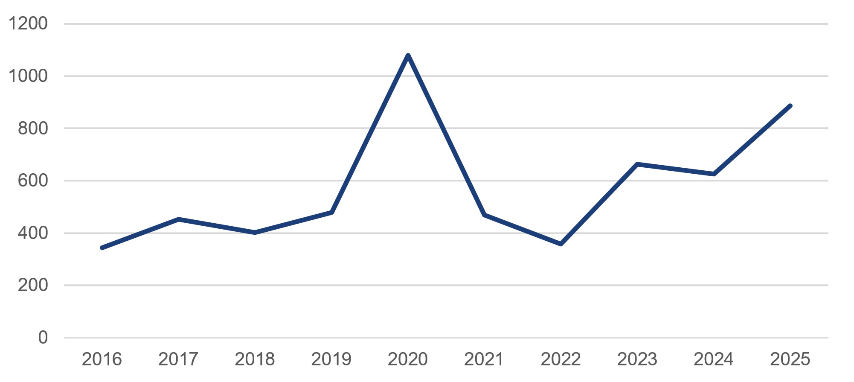
This line graph tracks the growth in new cases handled by SIAC from 2016-2025. The record high in 2020 remains an outlier, and the overall trajectory otherwise reflects a marked upward trend.
Who Uses SIAC? Parties from 79 Jurisdictions in 2025
- In 2025, parties from 79 jurisdictions engaged SIAC’s services. The top five foreign user jurisdictions are listed below.
- India, the USA and China have consistently been among the biggest users for the last decade so 2025 marks a continuation of the trend. It is particularly interesting to note that Vietnam and Thailand have made the top 5 list in 2025, and fewer parties from Hong Kong (otherwise always a common top user across 2021 to 2024). We also understand the surge in Vietnamese parties can be largely attributed to a particular set of related cases (many related arbitrations arising out of the same contract issues).
- That said, the total number of jurisdictions represented appears to be increasing (72 in 2024, 66 in 2023, and 65 in 2022), reinforcing SIAC’s growing international footprint.
Top User Jurisdictions in SIAC Caseload (by volume) 2021-2025
| Caseload ranking by volume | 2021 | 2022 | 2023 | 2024 | 2025 |
|---|---|---|---|---|---|
| Highest volume | India (187) | India (89) | Hong Kong (1436) | South Korea (295) | Mainland China (378) |
| Second highest | Mainland China (94) | USA (87) | Mainland China (851) | Mainland China (227) | Vietnam (337) |
| Third highest | Hong Kong (80) | Mainland China (74) | India (160) | India (183 | India (178) |
| Fourth highest | USA (74) | Hong Kong (37) | USA (123) | Hong Kong (129) | Thailand (100) |
| Fifth highest | Vietnam (55) | Indonesia (28) | UAE (59) | USA (128) | USA (83) |
SIAC 2025 Dispute Values: USD 14.53 Billion in Total Claims
- The total sum in dispute for new case filings with SIAC in 2025 reached USD 14.53 billion (SGD 18.66 billion), with an average value of USD 24.70 million (SGD 31.73 million) per case. The highest sum in dispute for a single administered case was USD 3.93 billion (SGD 5.05 billion).
- If ad hoc appointments are excluded, the average value of cases was higher at USD 32.18 million (SGD 41.33 million).
-
The average value year-on-year can fluctuate according to the presence or absence of mega-claims and the mix of case types, but the amounts in dispute in 2025 support the general upward trend.
Sectors in Dispute: Trade, Commercial, and Corporate Disputes Lead SIAC's 2025 Caseload
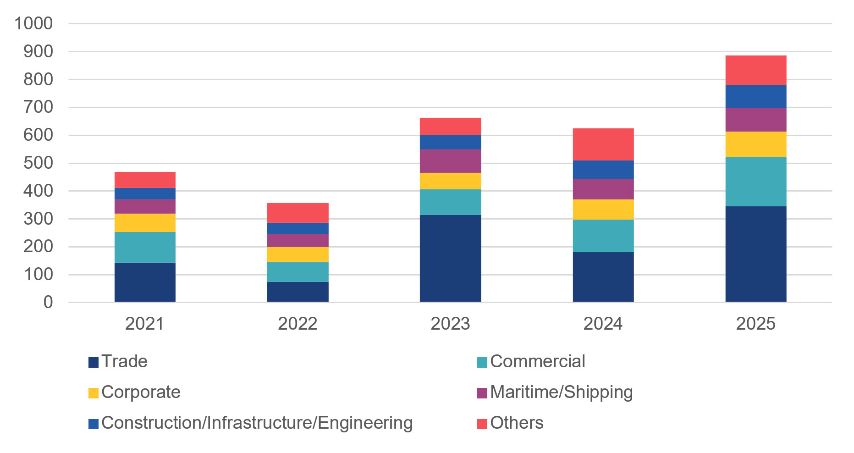
- Trade disputes dominated SIAC's caseload in 2025, totalling 346 cases (39%), followed by commercial (177 cases, 20%), corporate (90 cases, 10%), maritime/shipping (85 cases, 10%), and construction/infrastructure/engineering (82 cases, 9%). This distribution mirrors trends from previous years, where trade, commercial, and corporate disputes have consistently comprised the bulk of cases. The bar chart below also shows that the distribution has remained broadly stable year-on-year.
- Beyond these core categories, SIAC also has closely trailing volumes of cases in areas such as banking and financial services, blockchain and cryptocurrency, agriculture, education, employment, IP/IT, and real estate.
Sector representation in SIAC Caseload 2021-2025
Procedural Innovations: SIAC Rules 2025 and Dispute Resolution Timelines
-
The SIAC Rules 2025 came into force on 1 January 2025, introducing the Streamlined Procedure, Preliminary Determination, and the Protective Preliminary Order. Details on the SIAC Rules 2025 are set out in our article “7th Edition of the SIAC Rules published and to take effect in 2025” and key updates in the table below.
Factor Streamlined Procedure Expedited Procedure Case value (SGD) 1 million 10 million Time from constitution of Tribunal 3 months 6 months Number of arbitrators Sole arbitrator Sole arbitrator (or panel of 3 at the Tribunal’s discretion) - In 2025, 60 cases proceeded under the Streamlined Procedure, where cases have been concluded within three months of tribunal constitution.
- SIAC also accepted 55 of the 130 applications for the Expedited Procedure, under which arbitrations target a six-month timeline. Note however that not all applications are accepted – which suggest SIAC and/or counterparties may object and raise concerns as to whether the complexity of the case can be satisfactorily addressed by a compressed timeline.
- SIAC received four requests for Preliminary Determination, whereby the tribunal must issue its decision on the preliminary issue in question within 90 days from the filing of the application. Two applications were granted, one was rejected, and one was pending permission to proceed as at year-end.
- SIAC received four applications for a Protective Preliminary Order, which is an ex parte mechanism under which an emergency arbitrator is appointed within 24 hours and, without notice to the counterparty, makes an order to prevent that party from frustrating the purpose of urgent relief. One application was accepted. In the other three cases, the orders proceeded on notice.
- Note also that SIAC announced the establishment of the Institute of Ethics in International Arbitration (IEIA) and launched the Restructuring and Insolvency Arbitration Protocol (RIA Protocol) – a first for an international arbitration institution.
-
While SIAC’s procedural enhancements aim to reduce overall resolution times, several factors continue to affect duration. Complex disputes in sectors like shipping, construction, and infrastructure tend to require extended timelines due to document-heavy evidence, expert testimony, and the need for consolidation or joinder of parties.
Comment
The SIAC Annual Report 2025 reflects a year of sustained strength in international arbitration. Case volumes increased sharply, partly due to related filings, while aggregate dispute values remained high and the caseload overwhelmingly international. For users, the figures reaffirm SIAC’s position as a leading forum for complex cross‑border commercial disputes.
Beneath this headline continuity, the data also signals where practice is beginning to evolve. Trade, commercial and corporate disputes continue to anchor SIAC’s work, and established user jurisdictions remain dominant, but participation is broadening year on year. More notably for practitioners, the first year of the SIAC Rules 2025 points to a genuine recalibration towards speed and procedural flexibility. Uptake of the Streamlined and Expedited Procedures, alongside early engagement with tools such as Preliminary Determination and Protective Preliminary Orders, suggests that users are prepared to test these mechanisms in practice.
Taken together, the 2025 statistics underline both stability and change: a familiar dispute profile, coupled with growing procedural optionality that offers parties new levers to manage cost, timing and strategy in SIAC arbitrations.
The authors would like to thank Felicity White for their contribution to this post.
The content of this article is intended to provide a general guide to the subject matter. Specialist advice should be sought about your specific circumstances.
[View Source]