

- within Food, Drugs, Healthcare and Life Sciences topic(s)
- with Senior Company Executives, HR and Finance and Tax Executives
- in India
- with readers working within the Pharmaceuticals & BioTech industries
1. INTRODUCTION
“अन्नं ब्रह्म, अन्नं जीवनस्य मूलम्” (Atharvaveda 17.109.1), translated as “Food is Brahma (the Supreme Being), and it is the root of life”, aptly encapsulates the unique position food occupies within the Indian socio-cultural framework. In India, food transcends mere sustenance; it is intrinsically linked with spirituality, tradition, and community life. This elevated status naturally renders food safety not just a regulatory concern, but a matter of public trust and societal well-being.
In recent times, however, the integrity of this trust has been increasingly tested by a discernible rise in instances of food adulteration and the circulation of sub-standard food products. Against this backdrop, the Food Safety and Standards Authority of India (FSSAI) has intensified its enforcement measures, including targeted inspections and raids across major urban centres. These developments underscore the pressing need for a more robust, uniform, and far-reaching regulatory framework governing the food and beverages sector spanning the entire spectrum from informal street vendors to high-end fine dining establishments.
It is in this context that the Food Safety and Standards (Licensing and Registration of Food Businesses) Amendment Regulations, 2026 assume particular significance. The amendment represents a decisive regulatory intervention aimed at strengthening India’s food safety architecture by embedding stricter compliance mechanisms at every level of the supply chain. By expanding the scope of oversight, mandating more frequent inspections, and enhancing accountability standards, the framework seeks to institutionalise a culture of compliance within the gastronomic economy. Importantly, its emphasis on regulating even the most grassroots segments of the industry reflects a shift towards comprehensive governance recognising that food safety must be ensured not only at the top tiers of the market but also at its foundational levels.
2. INCREASED ACCESS AND ACCOUNTABILITY: PETTY FOOD BUSINESS OPERATOR
The amendment revisits the definition of ‘Petty Food Business Operator’ in Clause 4 of Regulation 1.2.1 under the Food Safety and Standards Regulations, 2011, broadening its scope and removing the earlier restrictive cap. This expansion is likely to bring a larger segment of small-scale and informal food operators within the regulatory fold, enhancing accountability while also facilitating ease of compliance through clearer categorization. To reflect the stark contrast to its erstwhile definition, the same has been put in a table for easy reference:
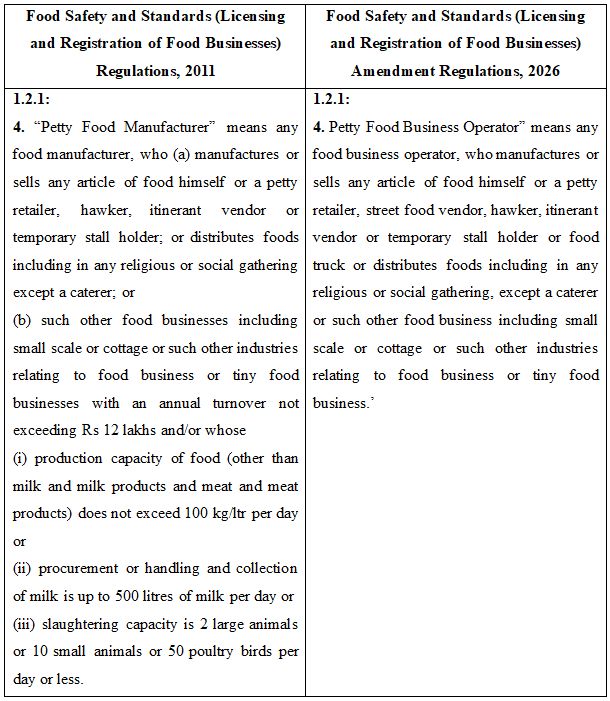
At the very outset, the amended regulatory framework reflects a marked expansion in the scope of “petty food business operators,” most notably through the explicit inclusion of street food vendors, hawkers, and food trucks within its ambit. This shift is further reinforced by the
removal of the earlier caps on production capacity, procurement, handling and collection of milk, and slaughtering limits, thereby, bringing a significantly larger segment of food business operators within the regulatory fold. While certain exclusions continue to apply, particularly in respect of small-scale, cottage, and other tiny food industries, the overall trajectory of the amendment clearly leans towards broader oversight and enhanced standardisation.
A particularly noteworthy development is the insertion of Clause (7) in Regulation 2.1.1, which effectively deems street food vendors, hawkers, carts, food trucks, and similar entities registered under the Street Vendors (Protection of Livelihood and Regulation of Street Vending) Act, 2014, to be registered under the Food Safety and Standards Act, 2006. This legal fiction not only streamlines the registration process but also substantially widens the regulatory reach of the Food Safety and Standards Authority of India (FSSAI). By bridging the gap between municipal-level vendor registration and central food safety regulation, the amendment ensures that a previously fragmented and often informal sector is now subject to a uniform compliance framework.
Consequently, a much broader class of food business operators is now brought within the purview of mandatory hygiene and sanitary standards, particularly those prescribed under Schedule 4 of the Regulations. This has important implications: it signals a transition from a largely reactive enforcement regime to a more proactive, compliance-driven model of food safety governance. At the same time, it raises practical considerations regarding the capacity of small vendors to meet these standards, the need for awareness and training initiatives, and the role of local authorities in facilitating compliance without undermining livelihoods.
3. BRIDGING REGULATORY GAPS: THE INTRODUCTION OF PERIODIC INSPECTIONS UNDER REGULATION 2.1.17
It is pertinent to note that the erstwhile regulatory framework was conspicuously silent on structured mechanisms for inspection and audit. This omission significantly constrained transparency, accountability, and effective oversight of food business operators, thereby increasing the vulnerability of consumers to sub-standard products, inadequate hygiene practices, and compromised sanitation conditions. The heightened frequency of enforcement actions and raids undertaken by the Food Safety and Standards Authority of India (FSSAI) in recent years serves as a testament of these systemic gaps, underscoring the urgent need for a more institutionalised and preventive compliance regime.
Against this backdrop, the introduction of Regulation 2.1.17 under the Food Safety and Standards (Licensing and Registration of Food Businesses) Amendment Regulations, 2026, marks a significant and timely intervention. The provision mandates the Food Authority to undertake periodic inspections and audits of food businesses, either through its own designated agencies or through duly authorised third parties. Importantly, it goes beyond a one-size-fits-all approach by requiring the formulation of a structured inspection scheme, wherein the frequency and nature of inspections are to be determined on the basis of a “dynamic risk-based mechanism.” This includes consideration of factors such as the nature and scale of the food business, past compliance history, outcomes of third-party audits, and the risk category associated with the food handled.
Further, the regulation imposes an affirmative obligation on food business operators to undergo food safety audits conducted by third-party auditing agencies or auditors recognised by the FSSAI. In doing so, it strengthens the compliance ecosystem by introducing an additional layer of independent scrutiny. The requirement to provide auditors with unhindered access to relevant records reinforces the principles of transparency and traceability both of which are foundational to a credible food safety regime.
In this regard, a calibrated approach becomes essential. While the regulation undeniably strengthens consumer protection and aligns India’s food safety standards with global best practices, it also necessitates parallel efforts in capacity-building, awareness generation, and facilitative support for smaller operators. If implemented with regulatory sensitivity and administrative efficiency, Regulation 2.1.17 has the potential to transform India’s food safety landscape into one that is not only enforcement-driven but also compliance-oriented and sustainable.
4. CONCLUSION
From a policy standpoint, the amendment strikes a delicate balance between public health imperatives and socio-economic realities. While the intent to formalise and regulate the informal food sector is both timely and necessary especially, in the context of urbanisation and rising food safety concerns, the success of this framework will ultimately depend on its implementation. Regulatory overreach, if not accompanied by adequate support mechanisms, may risk alienating the very stakeholders it seeks to regulate.
From a broader regulatory perspective, this shift reflects a transition from reactive enforcement to a more proactive, risk-based governance model. By embedding periodic inspections and third-party audits into the regulatory architecture, the amendment seeks to institutionalise continuous compliance rather than episodic enforcement. However, its efficacy will depend on the robustness of implementation particularly the accreditation and monitoring of third-party auditors, the avoidance of regulatory duplication and the capacity of smaller food business operators to absorb compliance costs. Therefore, a collaborative approach involving capacity-building, phased enforcement, and stakeholder engagement will be critical in translating these regulatory changes into meaningful improvements in food safety outcomes.
The content of this article is intended to provide a general guide to the subject matter. Specialist advice should be sought about your specific circumstances.


