- within Real Estate and Construction topic(s)
- in North America
- with readers working within the Business & Consumer Services, Media & Information and Metals & Mining industries
- within Criminal Law and Intellectual Property topic(s)
Industry snapshot
Switzerland's Construction, Engineering & Materials sector – encompassing diverse segments such as building construction, civil engineering, infrastructure projects, and building materials production – is a cornerstone of the country’s real estate development and physical infrastructure. Moreover, it carries Switzerland’s reputation for engineering excellence and quality into the built environment. While posting moderate growth, the sector nevertheless faces profound structural challenges: elevated financing costs that weigh on real estate and infrastructure activity, intense price competition, persistent shortage of skilled labor, and rising sustainability requirements that demand substantial change to traditional ways of building.
Compared with parts of the broader European construction market, Switzerland appears to show more resilient momentum, particularly in selected residential and infrastructure-related segments. However, the sector remains exposed to elevated material prices, cost volatility, skills shortages, and execution risk. These pressures play out differently across segments: residential construction is more sensitive to affordability, financing costs, and material prices, while industrial construction increasingly depends on lean execution, delivery reliability, and disciplined management of delays, budget overruns, and penalty costs.
This sector-specific perspective sits within a broader global disruption environment. The 2026 AlixPartners Disruption Index shows that global disruption remains structurally high, while the Swiss Disruption Score declined from 76 to 68 points — the sharpest drop in Europe, but still a clear sign that disruption remains embedded in the business environment. The sector’s fundamental challenges become visible in the following systematic analysis of the most recently published annual company reports and performance of Swiss stock exchange (SIX) listed firms.
Relevance of disruption
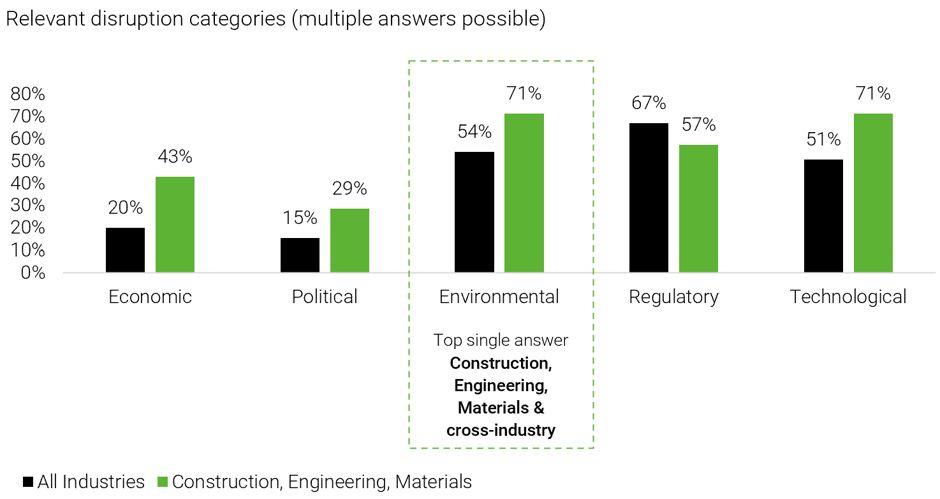
Key disruption categories based on AlixPartners’ Disruption Index
Our analysis shows that the Construction, Engineering & Materials sector faces highest disruption in Technological (71%) and Environmental (71%) categories. Technological disruption reflects digitalization pressures that fundamentally transform traditional processes. Environmental factors stem from embodied carbon concerns, circular construction principles, and strict energy efficiency standards.
The sector further shows disruption due to regulatory pressures (57%), which is below the cross-industry average despite high safety standards and sustainability requirements. Economic and political factors affect 43% and 29% respectively through cyclical demand, interest rate sensitivity, and infrastructure funding.
Key disruption factors as reported by Swiss companies
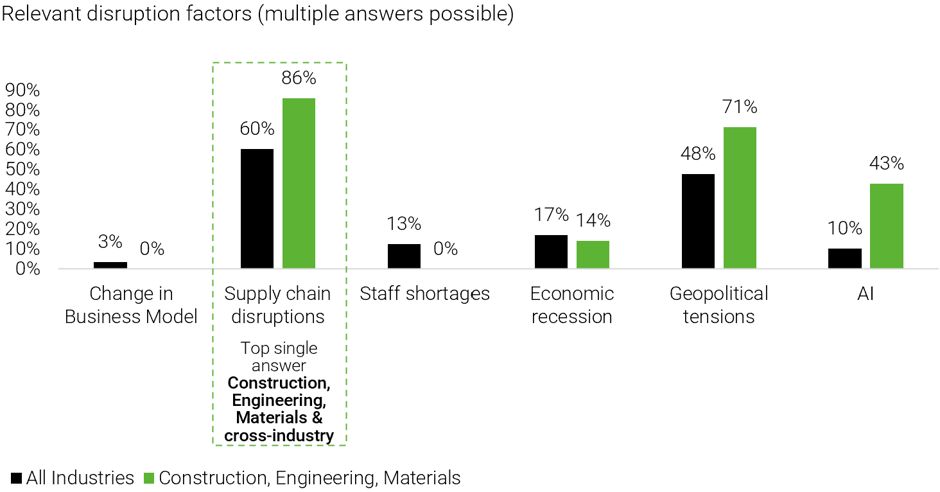
Supply chain disruptions affect 86% of construction companies, which reflects dependencies on diverse materials (steel, cement, timber, electronics), equipment availability, and subcontractor capacity that create vulnerabilities throughout project delivery. Geopolitical tensions impact 71% through material sourcing, energy costs, and international construction projects. Most recently, tariffs in important markets have added a further layer of complexity and uncertainty, which will impact the numbers going forward.
While the sector shares both disruption categories and factors, the extent and reasons behind the drivers affecting them are nuanced depending on the subsector, and ultimately the individual company:
- Construction: Technological disruption primarily affects construction through the digitalization and industrialization of project delivery. Building Information Modeling (BIM), digital project management, prefabrication, modular construction, and robotics are reshaping execution, while labour shortages further increase the need for productivity improvements. Environmental disruption is largely reflected in stricter building standards and embodied-carbon requirements, which require new construction methods and closer collaboration across the project lifecycle. Supply chain disruptions remain particularly relevant, with dependencies on materials, equipment, and subcontractor availability directly affecting project schedules and profitability.
- Engineering: Within engineering, technological disruption is centred on digital design and integrated project delivery. Digital twins, simulation tools, and data-driven engineering increasingly enhance planning accuracy, asset performance, and lifecycle management. Environmental disruption expands the role of engineering firms beyond traditional design towards decarbonization, resilient infrastructure, and energy-efficient asset optimization. Geopolitical developments primarily influence internationally active firms through cross-border project execution, procurement complexity, and changing infrastructure investment priorities.
- Materials: Environmental disruption as transformation driver together with evolving regulations and customer expectation increases the importance of decarbonizing products such as cement, concrete, steel, and glass. Increasing recycled content and developing circular construction solutions are also becoming key competitive differentiators. Technological disruption primarily improves manufacturing efficiency, process automation, and supply-chain transparency, while geopolitical developments and energy price volatility directly influence raw material sourcing, production costs, and overall competitiveness.
Impact on performance
The Swiss Construction, Engineering & Materials companies analyzed show modest revenue growth and resilient profitability. While residential construction is driving a recent boom, there are still structural hurdles for the industry including higher interest rates, delayed infrastructure projects, and intense price competition. However, the screening of annual reports of listed companies highlights, that those that explicitly identify and discuss disruption factors in their annual reports show a tendency to deliver stronger financial performances than those that do not. This suggests that a more comprehensive and proactive assessment and description of existing disruption drivers in annual reports is associated with greater strategic preparedness and more resilient business outcomes. Given this sector's heterogeneity, these findings should be interpreted as an indicative perspective based on publicly listed companies rather than as a uniform view across the industry.
Opportunities from disruption
Construction, Engineering & Materials companies failing to adapt risk severe competitive displacement and margin erosion. Digital laggards cannot compete effectively on cost, time, or quality with competitors leveraging BIM, digital project management, and data analytics. Traditional companies lose market share as clients increasingly require digital capabilities and integrated delivery models. Productivity stagnation leaves companies uncompetitive in labor-tight markets where companies unable to improve productivity through technology and industrialization cannot profitably execute projects. Talent flight accelerates as skilled workers with future-proof skills in demand prefer employers demonstrating innovation, technology adoption, and sustainability commitment.
Companies embracing disruption unlock substantial value-creation potential. With respect to the disruption categories highlighted above, all segments can benefit from responding proactively to technological and environmental disruption, in different ways.
- Construction: Digitalization and industrialization provide an opportunity to fundamentally improve project economics. Companies should standardize delivery, expand prefabrication and modular construction where economically viable, and use digital tools to improve planning accuracy, resource allocation, and project governance. At the same time, sustainability should be embedded early in project development to reduce lifecycle emissions while meeting increasingly stringent client and regulatory requirements
- Engineering: Engineering firms can capture higher-value work by positioning themselves as strategic partners throughout the asset lifecycle rather than purely design providers. Investing in digital engineering capabilities, sustainability expertise, and integrated advisory services enables firms to support clients in designing resilient, efficient, and future-proof infrastructure
- Materials: Material producers have the opportunity to reshape their product portfolio towards low-carbon and circular solutions before regulation and customer demand make these capabilities a market requirement. Companies should accelerate investment in product innovation, production technologies, and manufacturing efficiency to differentiate on both sustainability and cost competitiveness
The disruption factors point to equally concrete opportunities across the segments.
- Construction: Companies should diversify supplier networks, strengthen strategic partnerships with subcontractors, improve procurement planning, and selectively localize critical sourcing to improve delivery reliability and protect project margins
- Engineering: Companies should strengthen capabilities in risk assessment, supply-chain planning, regulatory navigation, and cross-border project management to support clients facing more complex investment decisions
- Materials: Companies should secure critical raw material supply through diversified sourcing, improve energy efficiency, localize production where economically justified, and increase supply-chain transparency to reduce cost volatility and strengthen customer confidence
Outlook & strategic implications
n a market that may grow more steadily than parts of the rest of Europe, the key question is less whether demand exists, but where companies can generate profitable growth in their core business. This will require sharper segmentation of customers, projects, and regions, a disciplined selection of attractive profit pools, and portfolio choices that prioritize scale, pricing power, and execution reliability over volume growth alone.
Material costs may ease but are likely to remain above historical averages, requiring continued focus on procurement discipline, pricing governance, supplier negotiations, and value engineering. The strategic challenge is not only to protect margins, but also to avoid pricing companies out of demand in a market where affordability and project economics remain under pressure.
Building on our research and deep industry experience, we recommend leaders to consider these levers:
- Accelerate digitalization:Mandate BIM on all projects, implement digital project management tools, and deploy data analytics for cost/schedule optimization.
- Industrialize construction:Evaluate prefabrication, modularization, and off-site manufacturing to improve productivity, quality, and sustainability. Start with pilot projects in controlled environments before broader rollout.
- Build sustainability capabilities: Develop expertise in low-carbon materials (timber, earth, recycled content), circular construction, and energy-efficient design. Establish carbon reduction targets and measurement systems.
- Address talent strategically: Invest in workforce development through apprenticeships, technology training, and university partnerships. Create compelling employer value propositions emphasizing innovation, technology, and sustainability.
Beyond these immediate priorities, the sector needs a more fundamental shift. After several rounds of cost reduction, many companies have already exhausted the most obvious efficiency levers. The next wave of value creation will not come from delivering the same projects with marginally lower costs, but from reassessing the operating model itself: how work is planned, sourced, industrialized and executed. For Construction, Engineering & Materials companies, genuine transformation means moving beyond incremental savings toward structurally different ways of building and delivering value.
The content of this article is intended to provide a general guide to the subject matter. Specialist advice should be sought about your specific circumstances.
[View Source]