

At the European Patent Office, two recurring defaults lean on the same factual proposition: antibody generation and selection can be routine. Generative antibody design is about to make the limits of that proposition harder to ignore. The same efficiency that can make an antibody look obvious does not, by itself, make the breadth of a functional claim enabled.
Modern antibody-design pipelines can use generative models to propose large numbers of candidate sequences or structures, and computational models to rank or filter them before experimental testing. The output is a set of hypotheses about what may bind or perform a desired function, not a measurement that it does.
This article is about what this is changing at the European Patent Office (the EPO), where the same factual proposition, that antibody generation and selection can be routine, repeatedly helps the applicant under sufficiency and hurts it under inventive step. It asks what follows once routine candidate generation, routine identification of individual qualifying hits and claim-wide enablement are recognised as different things.
Two recurring EPO defaults turn on that same idea. Raising an antibody to a known target is often treated as routine, so the disclosure of ordinary antibody generation and screening may be enough to leave the general presumption of sufficiency undisturbed unless serious doubts, substantiated by verifiable facts, are raised.
That rationale is not stated as an antibody-specific rule in the Guidelines. Its clearest Board statement is old: producing hybridomas secreting a monoclonal antibody with the desired features consists basically of a sequence of widely known routine technical steps where all that is normally called for is perseverance, and the work may be tedious and time-consuming but is nothing out of the ordinary (T 0431/96). Routineness is therefore not the Article 83 test; it is one factual reason why the ordinary sufficiency burden has often been easy to discharge in antibody cases.
The same routineness can work against the applicant under Article 56. An antibody that differs from the prior art only in its sequence is not inventive merely because its precise structure was unpredictable, and the Guidelines now say expressly that the unpredictability of an antibody’s amino acid sequence is not a reason to treat it as non-obvious (G-II, 6.2). Routine generation can therefore ease the practical sufficiency case while making an obvious-alternative attack easier to run.
That the same assumption cuts both ways is Bucher’s argument, made across four articles in epi Information and most fully in the fourth. Article 83 is a low hurdle, that argument runs, and the convenience of leaning on routineness in order to clear it “must be balanced against the serious consequence of viewing the field in this way in relation to Art. 56”. The objection is not that the sufficiency standard is wrong, but that routineness is the wrong instrument for meeting it: the test under Article 83 is undue burden, and invoking a routine-methods mindset is neither a necessary nor a sufficient condition for showing there is none. Treating all antibodies as routine to make is said to be technically inaccurate, the view having been formed for murine antibodies suitable for in vitro use and since applied to the whole class.
This article uses “routine” descriptively, in the sense the EPO gives it, and does not reopen whether that characterisation was ever sound. It starts where that criticism ends and asks a different question: what happens when producing candidate antibodies becomes routine, testing individual candidates may also be routine, but the move from one or a few qualifying hits to the functional breadth claimed still requires its own justification.
The proposition that structure alone does not carry the claim traces to T 0605/14, where anti-Ang2 antibody claims were revoked. The Board’s reasoning there is worth more than its outcome: a skilled person aiming at a particular functional property knows that the property is the result of the antibody’s amino acid sequence, and knows also that the same property may be embodied by various different sequences. On that view, the sequence was never what carried the claim.
The next paragraph of that decision is interesting. The specific variable-region sequences of the antibody before the Board did not impart any property differing from the property screened for that could be regarded as surprising, and in line with established jurisprudence in the field of antibodies the antibody was therefore obvious. Where a generative pipeline is optimised to find the very property later relied on in the claim, the sequence it returns does not acquire inventive weight merely because the particular sequence was not predictable in advance.
The case it cites is T 0735/00, decided in 2004, which states the rule in both directions in a single passage: inventive step is acknowledged where a monoclonal antibody prepared by routine methods shows unexpected properties, and denied where a further antibody achieves no unexpected effect over one having essentially the same desired properties (citing T 0645/02 and T 0512/94). The line runs from T 0512/94 in 1998 through 2004 and 2018 to the edition of the Guidelines in force, G-II, 6.2, now citing T 0605/14 and T 0187/04.
Generative design has not changed that line of authority; it has made its consequence unavoidable.
The same paragraph of T 0735/00 records an earlier instance in this molecule class: by 1989, thirteen years after the technology to produce monoclonal antibodies had been developed, their preparation was a matter of routine experiment, so no inventive merit lay in the method as such.
The Board’s second and separate ground is the one that carries over. Where the problem to be solved is the provision of an alternative, the search itself is not inventive merely because it required work, if the art already supplied an incentive to look for useful antibodies. A generative model does not create that incentive; the prior art and the problem do. What the model changes is the cost and reach of acting on it, by making a much larger candidate search accessible once the search is already motivated.
For applicants, this has long been an uncomfortable arrangement, and until recently a stable one. In my opinion, it is no longer stable.
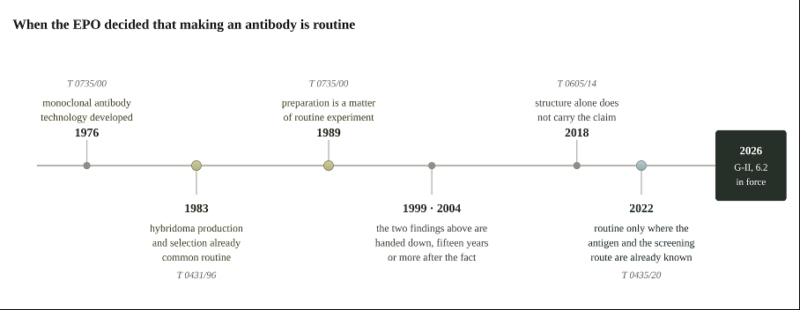
Fig. 1 — How the EPO’s ‘routine methods’ line developed. The core routineness findings in T 0431/96 and T 0735/00 were tied to priority dates in 1983 and 1989 and stated in 1999 and 2004. T 1466/05 and T 0435/20 later show the limit: routine antibody technology does not enable a functional claim without a reliable route to the claimed property. T 0605/14 supplies the inventive-step consequence now reflected in G-II, 6.2. Generative design arrives after that line was already established.
Generative design substitutes computation for part of the bench work on which these lines of reasoning were built. It does not create the tension between them. It makes it harder to leave unexamined which part of the workflow is actually routine, and what that fact does under Article 56 or Article 83.
Bucher’s criticism does not reach the technology at issue here. Generative design appears nowhere in it, and the methods it treats are immunisation, hybridoma work, display libraries and panning.
Take inventive step first
Inventive step is assessed through the problem-solution approach, and for a target already in the art the objective problem is usually the modest one of providing a further antibody against it. Where ordinary immunisation or display methods give the skilled person a realistic route to further antibodies, the Guidelines treat alternatives reached exclusively by techniques known in the art as obvious. A claim survives only if the facts supply a recognised reason for inventiveness: a surprising technical effect, no reasonable expectation of obtaining antibodies with the required properties, a technical difficulty overcome in generation or manufacture, or a novel functional antibody format.
The same Guidelines carry the applicant’s counter, and the second part of it is the one that matters. An antibody binding a known antigen involves an inventive step if the application shows a surprising technical effect, or if there was no reasonable expectation of success in obtaining antibodies having the required properties (G-II, 6.2, referring to G-VII, 13).
That second route is not new; it stood in this section in the March 2024 edition too, though the framing has since been inverted. The 2024 text said that such an antibody does not involve an inventive step unless a surprising effect is shown or there was no reasonable expectation of success; the 2026 text says it involves an inventive step if one of those is present. The Guidelines add that subject-matter relating to antibodies can be inventive where the application overcomes technical difficulties in generating or manufacturing them, and that a novel type of functional antibody format may also be inventive.
Two things follow. The reframing is cosmetic where it matters most, because the operative sentence is unchanged: arriving at alternative antibodies exclusively by applying techniques known in the art remains obvious. The second route, though, is named in its own right, and it is not the same enquiry as the first. Whether a technique is routine and whether its outcome could reasonably be expected are separate, and routineness of method does not by itself supply an expectation of success as to the properties the claim requires. That distinction is what the rest of this article turns on.
G-VII, 13 supplies both halves of that distinction. A solution is obvious not only where the results are clearly predictable but also where there was a reasonable expectation of success, and a mere try-and-see attitude in light of the closest prior art does not necessarily make a solution inventive. That is an objection an opponent may run where computational candidates are cheap to propose, and the downstream assay is straightforward. Whether it succeeds still depends on the prior art, the properties required by the claim and the facts of the particular workflow.
The same section then draws the line the applicant needs. A reasonable expectation of success is not to be confused with a hope of success, and where researchers know at the outset that reaching a technical solution will require not only technical skill but the ability to make the right non-trivial decisions along the way, that is not a reasonable expectation of success. If a generative model returns candidates but reaching the claimed property still requires those non-trivial decisions, routine candidate generation does not settle the Article 56 question.
Current case law applies the obvious-alternative line straightforwardly, but for different reasons on different facts. In T 2552/22, anti-LAG-3 claims were revoked as an obvious alternative: the epitope-defined feature was broad enough to cover an antibody disclosed in the patent itself that did not show the improved effect, so that the effect dropped out of the objective technical problem. T 1505/23 is different. There, the anti-SIRPα medical-use claims failed because the prior art supplied a reason to pursue the claimed therapeutic route, the Board finding a reasonable expectation of success on the first alternative and ordinary motivation on the second.
That decision belongs on the expectation-of-success side of the analysis, not as an example of routineness doing all the work.
Turn now to sufficiency
Routine methods can help the applicant without displacing the governing test. The disclosure must enable the invention over substantially the whole area claimed without undue burden, and a granted claim retains the ordinary benefit of the doubt until serious doubts are substantiated by verifiable facts. In antibody cases, standard generation and screening methods often make that requirement relatively easy to satisfy. The important limit is the claimed property: routineness helps only to the extent that the skilled person has a reliable route to embodiments possessing it.
That whole-scope demand is settled law, not something peculiar to antibodies; the monopoly must be enabled across its breadth and not only at the point where it was demonstrated (the sufficiency line running from Exxon, T 0409/91, onward).
In T 2164/21 a deamidation-resistant antibody claim failed for insufficiency on an auxiliary request despite routine production methods, the Board holding that where the skilled person can only determine by experimenting whether a satisfactory result will be achieved, “without the confidence that such result can be achieved at all, this constitutes an undue burden, even if it involves routine experimentation”, a passage the criticism discussed above also relies on.
In T 1466/05, a selectivity claim failed because the application did not sufficiently disclose a suitable specific antigen and screening route that would reliably lead the skilled person to further antibodies having the claimed selectivity. The skilled person therefore faced experimentation beyond the average effort in the field. The routine-methods reasoning holds only while the claimed property is one that the disclosed or commonly known workflow can reliably deliver.
The Boards have said as much, and said it plainly. In T 0435/20 the Board accepted that raising and screening antibodies involves only routine experimentation, but held that this is so only where the skilled person knows, from the patent or from common general knowledge, which antigens are suitable for raising antibodies having the desired properties and which screening process will select those antibodies without undue burden.
Generating antibodies that bound anywhere to the antigen would have been no burden at all.
Generating and selecting those with the required properties was, because the patent disclosed neither a suitable antigen nor a screening route to them.
The conclusion that raising antibodies to a known antigen is routine, the Board held, did not apply. Claims to anti-IL-23 antibodies defined by a conformational epitope were revoked for insufficiency.
Generative design unsettles the arrangement, and the reason is easy to miss. The word ‘routine’ can now hide three different questions. First, can the skilled person generate candidate antibodies? Second, can the skilled person identify individual candidates that meet the claim, for example, with a standard assay? Third, can the skilled person reliably obtain qualifying embodiments across substantially the whole breadth claimed without undue burden? The cases do not treat those questions as interchangeable, even when the same vocabulary is used around them.
The middle question needs stating carefully. Screening a library for binding, activity, or another measurable property may itself be entirely routine, especially with high-throughput methods. T 0137/24 shows the point outside antibodies: generation and testing of enzyme variants could both be routine where an ordinary assay reliably determined whether the recited activity was present, and non-working variants simply fell outside the functional claim. Article 83 becomes difficult when the disclosed route does not reliably identify the claimed property, or does not reliably lead to qualifying embodiments across the breadth claimed. A model may accelerate the first stage and sometimes the second; it does not, by that fact alone, answer the third. The middle stage is the least supported of the three in antibody law: no antibody decision yet turns on it expressly, and the clearest illustration comes from outside the field. It is set out here because the cases behind the first and third stages cannot be reconciled without it, not because a Board has named it.
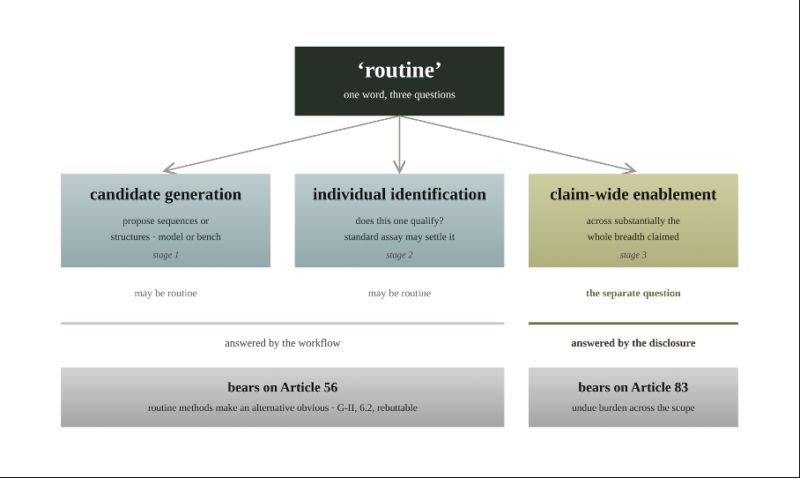
Fig. 2 — ‘Routine’ can refer to three different parts of the workflow. Candidate generation may be routine; identification of individual qualifying hits may also be routine where a standard assay settles the claimed property; the separate Article 83 question is whether the skilled person can reliably obtain qualifying embodiments across substantially the whole claimed breadth without undue burden. Non-working candidates may simply fall outside a functional claim, as T 0137/24 illustrates. The obvious-alternative line in G-II, 6.2 remains rebuttable. This three-stage split is an analytical tool, not wording used by the Guidelines.
A modern workflow may therefore run like this. A model proposes or ranks a large candidate set; a subset is expressed; ordinary assays may identify a few qualifying hits; one becomes the antibody in the claim. Candidate generation can be cheap and fast, and individual screening can be routine, while the legal value of the claim may depend on a further proposition: that the skilled person has a reliable route to qualifying embodiments across the breadth claimed. The distance between a ranked candidate set, an experimentally verified hit and claim-wide enablement is where the sufficiency and inventive-step enquiries begin to separate.
Follow that through inventive step. The problem-solution approach treats arriving at an alternative antibody exclusively by applying techniques known in the art as obvious absent some further inventive contribution. If, at the relevant date, generative tools form part of the skilled person’s ordinary toolkit and make more of the candidate space practically reachable, they may strengthen the argument that further alternatives were accessible without inventive skill. That does not dispense with the usual need for a reason to pursue the route and, where relevant, a reasonable expectation of success.
It is an awkward position: the efficiency the applicant invested in may be exactly what a competitor turns into part of the obviousness case. Letting the set of practically reachable alternatives expand with the skilled person’s tools is a defensible position for the EPO to take.
The Article 83 consequence, however, cannot simply be read off from that same fact. Routine generation says little by itself about whether the disclosure supplies a reliable test for the claimed property or a workable route to qualifying embodiments across the claimed breadth.
The weight moves onto evidence
Once routineness no longer answers the whole Article 83 enquiry, the missing support must come from the disclosure and common general knowledge at the relevant date. This is where in silico data can work in both directions at once. A model that cheaply samples or scores a much larger candidate region can support a search strategy, but a predicted property is not a measured one and prediction alone will rarely show that the skilled person can reliably obtain qualifying embodiments across the claimed breadth. The same computational accessibility may meanwhile strengthen an obviousness attack.
Post-published data cannot cure an enabling gap that existed at filing. It may confirm what the application as filed, together with common general knowledge, already sufficiently disclosed, but it cannot supply the missing enabling teaching. T 0709/23 is the cautionary case. A broad functional anti-IL-31 antibody claim was revoked for insufficiency after the patentee’s own post-published data showed that the lead antibody failed therapeutically while a different antibody, binding a previously unknown epitope, succeeded, and the Board dismissed the proprietor’s appeal. The correlation the claim had assumed was not there, and the patentee’s own later data confirmed its absence rather than repairing it.
The contrast with T 0326/22 is useful, but it is not a one-feature comparison. The surviving CD47 claim had an epitope-based structural anchor, disclosed antigens and selection assays, multiple antibody examples and sequence information, and a Board satisfied that routine methods could reliably generate further qualifying antibodies. T 0709/23 went the other way because the claimed functional generalisation itself proved unreliable: later evidence showed that the assumed relationship between in vitro binding and therapeutic efficacy did not hold. Notice the difference; prediction works only if verified.
Functional antibody definitions remain available in Europe, and they are not the same thing as claims drafted merely as a result to be achieved. The Article 83 question is whether the disclosure and common general knowledge give the skilled person a reliable way to obtain embodiments with the required function over substantially the whole area claimed without undue burden. G-II, 6.1.3 now states the antibody-specific point directly: the application must enable the skilled person to produce further antibodies having the claimed functional property without undue burden. Structural features such as an epitope or sequence anchor can help by narrowing the biological generalisation, but their value depends on the rest of the enabling disclosure.
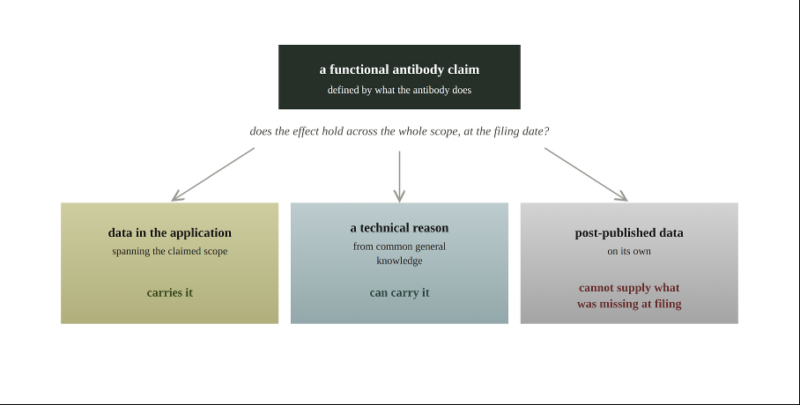
Fig. 3 — What can support claim-wide enablement for a functionally defined antibody. Representative data in the application, and/or a technical rationale or reproducible route grounded in common general knowledge, can support the breadth claimed. Post-published data may confirm support that was already present but cannot, on its own, cure an enabling gap that existed at filing (T 0709/23; and, by analogy, the narrower room for post-published evidence under sufficiency discussed in G 2/21).
The evidential asymmetry has a doctrinal spine. In G 2/21 the Enlarged Board addressed reliance on a technical effect for inventive step and, along the way, distinguished the role of post-published evidence under inventive step from the narrower room available under sufficiency. It did not endorse a separate plausibility test governing whether such evidence may be taken into account. The practical point for a functionally defined antibody remains: the more of the invention’s value that sits in the claimed effect, the more important the support for that effect in the application as filed becomes.
For an otherwise routine alternative antibody whose inventive contribution lies in a demonstrated function, that support can become the centre of both the Article 56 and Article 83 cases.
“Routine” was only ever a proxy
Step back from the antibody cases and the two lines of reasoning turn out to share more than a word. Underneath, each asks whether the claimed breadth is supported by what the skilled person could actually do and expect at the relevant date, though they remain distinct grounds with distinct legal tests and burdens of proof.
On inventive step, an effect relied on to make an invention non-obvious must be credible across substantially the whole breadth of the claim, the principle usually traced to AgrEvo (T 0939/92). On sufficiency, the disclosure must enable that breadth, the whole-scope line already mentioned. Routine was never a third rule sitting alongside these.
Routineness was one factual proxy that often made the sufficiency requirement relatively easy to satisfy: if ordinary generation and screening reliably delivered antibodies with the required property, there was less reason to doubt that the skilled person could work the claim over its breadth. Generative design does not remove the whole-scope requirement; it exposes the need to ask which part of the workflow the routine-methods assumption actually covers. Candidate generation, individual identification and claim-wide enablement need not travel together.
Seen that way, the decisions before AI arrived are not a drift towards a new position. They are the across-scope requirement reasserting itself in each doctrine separately. T 2164/21 and T 1466/05 are that return in antibody form, and no model was involved in either.
There is a second asymmetry beneath the first, in who must prove what, and it points the same way. The legal burden of establishing that a claim lacks an inventive step lies with the opponent, who must set out the state of the art that makes the invention obvious, whether the case is framed as a reasonable expectation of success or as a mere obvious alternative.
That legal burden does not shift, although the evidential burden may (T 1911/17). Where the proprietor answers by alleging an advantageous property or effect, the legal burden of proving that improvement rests on the proprietor. On sufficiency, once a prima facie case is made out on verifiable facts, the patentee must show the claim is enabled across its scope.
Generative design bears on both at once. It can strengthen an opponent’s expectation-of-success case, and modelled evidence suggesting that the claimed property is difficult to obtain across the breadth may help raise the serious doubts needed for an insufficiency attack, though whether such predictions alone amount to the verifiable facts the Boards require is unsettled. The drafting advice below carries the same cost: an applicant who relies on a demonstrated advantageous effect for inventive step assumes the burden of establishing that improvement.
The exposure is sharpest for the claims worth having. Many are medical-use claims, and there the therapeutic effect is itself part of what the claim requires. T 1505/23 concerned such a purpose-limited claim, though it fell on inventive step rather than sufficiency. A model’s prediction that an antibody will bind a target does not, without more, establish the therapeutic effect recited by the claim. The evidential gap can therefore be widest precisely where the commercial value sits.
There is a reflexive difficulty here, and the logic of the criticism set out earlier cuts against this article too. If abstract mindsets have no place under Article 83 because sufficiency is necessarily a fact-specific enquiry, then a generation-identification-breadth split applied across functional and medical-use claims as a class would be another abstract mindset.
The answer is that the split offered here is an analytical prediction about where fact-specific enquiries may land, not a rule to be applied instead of them. That is a real limit, and it is where this argument is most likely to be wrong.
The opposite case has been put in print: writing on US law, Bargmann and Bohrer conclude that artificial intelligence may overcome the enablement problem limiting broad antibody patents, on the footing that AI can reduce the experimentation needed to move from sequence or structure to useful binders. Under Article 83, the question remains whether the disclosure enables the claimed functional breadth; easier access to binders does not by itself establish that breadth.
The broader two-directional mechanism is not new. Langdon argued in 2024 that as AI raises the level of ordinary skill, the disclosure burden can fall while the obviousness hurdle rises. Yao and Yang in 2026 likewise identify the paradox that reducing early-stage unpredictability can make disclosure easier while making inventive step harder. Langdon is a US-law analysis; Yao and Yang frame the issue comparatively.
Neither, for present purposes, develops the specific EPO link between Article 83’s routine-methods reasoning and the antibody inventive-step default in G-II, 6.2.
Closer to home, Cordery and French observed in March 2026 that EPO practice has historically justified broad functionally defined antibody claims on relatively modest disclosure by assuming that antibody generation is routine, which is the sufficiency half of the mechanism considered here. Their argument focuses on the generation burden for the claimed subset and does not address generative AI.
The claim here is therefore narrower than priority for the paradox itself: it works that mechanism through EPO antibody law, separates candidate generation from individual identification and claim-wide enablement, and tests the result against the Board decisions.
I should concede the obvious counter. Nothing compels the EPO to make the two uses of routineness symmetrical. It can continue applying Article 56 and Article 83 on their own facts, and the same factual proposition can legitimately have different consequences under different legal tests. The pressure point is narrower: once a party relies on “routine” methods, the Board may increasingly need to say what part of the workflow is routine and why that matters to the particular ground.
There is a second and more practical reason why the issue may emerge slowly. What the skilled person knew is fixed at the filing or priority date, and many antibody patents now reaching opposition have relevant dates before generative design could plausibly be treated as common general knowledge. The clean tests will come from patents whose relevant dates fall after particular generative capabilities had demonstrably entered the ordinary toolkit of the skilled person. There is no safe calendar date for that transition: publication or specialist availability is not the same thing as common general knowledge. On the interval between priority and decision in the cases discussed here, which runs to several years, the first properly contested examples should be expected within a few years rather than a decade, although that is an inference from the timing of this small set of decisions and not a rule.
My view is that the present shorthand will not last unchanged. Not because the Boards need to choose a single meaning for the word, but because parties can put the workflow distinction directly in front of them. If generation is said to be routine for Article 56, the next question under Article 83 is whether the same evidence also makes identification of qualifying embodiments and claim-wide enablement routine. The answer may differ, but it will need to be explained.
How the word settles
There are three broad ways the tension can settle, and each carries a drafting consequence. The EPO can leave sufficiency relatively easy where routine methods and ordinary assays reliably lead to qualifying embodiments across the breadth claimed, while obviousness does most of the work. It can scrutinise functional breadth more strictly, requiring stronger support for claim-wide enablement. Or it can make the workflow distinction explicit, treating routine candidate generation as relevant to obviousness without assuming that it answers the separate Article 83 questions of identifying qualifying embodiments and enabling the breadth claimed.
One further outcome belongs on that list, because it is the one the professional literature is urging. The criticism set out earlier asks for the presumption of obviousness in the 2026 Guidelines to be removed outright, which would relieve applicants; the prediction here is that the sufficiency floor rises, which would not. They are the opposite sides of the same ledger, and either would end the arrangement in which one word does the work of two.
My own expectation is: the EPO resolves this without ever admitting that it has. Boards decide cases; they do not announce new meanings for words.
The EPO is also no longer the only forum in which the question settles. The UPC Court of Appeal has set out its own approach to inventive step and, on sufficiency, held in November 2025 in an antibody case that a functionally defined claim need not disclose how every conceivable embodiment is obtained, that the non-availability of some embodiments can be immaterial if suitable embodiments within the scope are obtainable, and that a reasonable amount of trial and error does not prevent enablement. That language pulls materially in the other direction from a strict reading of an across-scope floor and may produce a different practical breadth analysis on some facts. It does not, however, make the EPO and UPC tests simple opposites.
The pattern I expect from case-by-case decision is therefore not a simple split by claim type. Scrutiny should be lightest where the disclosed or commonly known workflow both produces candidates and uses a standard assay that reliably identifies the claimed property, with a workable route to qualifying embodiments across the relevant breadth. It should be hardest where individual hits can be found but the step from those hits to claim-wide functional or therapeutic breadth remains uncertain.
The resolution, if it comes, is more likely to be a separation by workflow and claim feature than by the word itself. That is a prediction, so it should be capable of failing. It fails if the Boards continue to treat routine generation, without further analysis, as sufficient to carry broad functional or therapeutic claims wherever individual qualifying embodiments can be found. On any reading, the safer specification is the one that explains not only how the molecule was generated, but why qualifying embodiments can be obtained across the breadth sought.
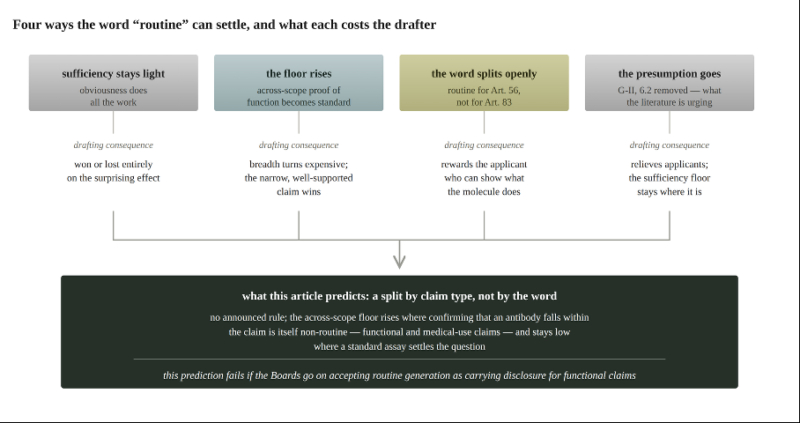
Fig. 4 — Four ways the tension around ‘routine’ can be handled. Three are paths open to the EPO; the fourth is removal of the obvious-alternative default in G-II, 6.2, as urged in the professional literature. The slate band is this article’s prediction, not a position any Board has stated: the resolution arrives case by case, by separating candidate generation, individual identification and claim-wide enablement.
The sufficiency half of this has already appeared outside antibodies, once. In T 0137/24 a claim to genetically modified yeast cells, whose recited polypeptides were defined by at least 90% sequence identity together with a required enzymatic activity, survived an insufficiency attack: the functional limitation put polypeptides lacking that activity outside the claim, and generating and testing variants required only techniques routine in the field of recombinant enzyme variants, no contrary evidence having been filed.
Inventive step was not in issue, so the decision says nothing about the other half. It can be read as a Board in 2026 applying the routine-methods reasoning outside antibodies, and an opponent will read it that way. The important feature for present purposes is that both generation and identification of qualifying variants were routine because a standard assay settled the recited activity.
That makes it a useful example of the middle stage in Fig. 2, not proof that routine generation alone enables every functional claim across its breadth. One decision in one molecule class is a straw in the wind rather than a trend, and nothing in the decisions discussed here settles how far the mechanism carries.
What to do about it
Reflecting on the above, here are some practical recommendations:
Never let the specification rest on the assumption that antibody work is routine
That assumption is also the strongest argument against the claim’s inventive step. The drafting lesson is defensive: whatever the specification concedes about how easily the molecule was made, an opponent will read back under Article 56.
Anchor the inventive case on what the application can actually support over the breadth sought
Where a surprising or advantageous effect carries Article 56, include representative data and, where appropriate, a technical rationale grounded in the disclosure or common general knowledge for why the effect is relevant across the claim. Under Article 83, make sure the skilled person has a reliable route to further qualifying embodiments without undue burden. A bare functional recital is the high-risk case, not because data must literally cover every embodiment, but because neither ground is helped by breadth the disclosure cannot carry.
Give the effect a structure to hold onto where the science supports it
T 0326/22 shows what an epitope or sequence anchor can contribute when it sits inside an enabling package of suitable antigens, examples and workable screening methods; T 0709/23 shows the danger where the claimed functional relationship itself is unreliable. Structure can narrow the breadth that the disclosure must enable, but it does not replace the enabling route.
Choose functional versus structural-plus-functional claiming deliberately rather than defaulting to the broadest wording, because the wider the functional definition the more the disclosure must carry.
Do not let an AI model output alone dictate filing strategy where patentability depends on an unvalidated functional effect
Early filing can matter, but so can the evidence needed to support the breadth and effect relied on. The drafting question is therefore a balance: file early enough to protect priority, but do not assume that later validation can cure an enabling gap or supply support for a claimed effect that was missing at the filing date.
Where the science favours the application, put it on the record
If the target- and property-specific evidence shows that the skilled person had no reasonable expectation of obtaining antibodies with the required characteristics, that is a route to inventive step in its own right under G-II, 6.2. The same evidence must be handled carefully, because what rebuts an obviousness attack can also be read under Article 83 as evidence of difficulty in obtaining embodiments across the scope claimed.
Tie that evidence to the properties the claim recites rather than to the field at large
A record built to show that success was improbable is the same record an opponent will later read as an admission that the skilled person could not have worked across the scope claimed.
The take-home
If the specification of your patent application reads as though the achievement was merely generating the molecule using an AI model, it risks conceding the ground that matters.
For an otherwise routine alternative antibody, the patentable contribution must usually lie in a demonstrated effect, a technical difficulty overcome, a novel functional format or another feature that the prior art did not make obvious.
The application must then support that contribution over the breadth actually claimed.
One word, “routine”, was doing too much work.
The task now is to make clear which work the skilled person could really do, and which part of the invention still had to be earned.
References
Guidelines for Examination in the EPO (April 2026 edition). G-II, 6.2, inventive step of antibodies. · G-II, 6.1.3, functional definitions. · G-VII, 13, inventive step in biotechnology. · F-III, 1, sufficiency of disclosure.
Commentary. T. Bucher, “Antibody Claims: Routinely Sufficient?”, epi Information 1/2026, pp. 49–57; preceded by “The Barrier Around Antibody Inventions at the European Patent Office”, Parts 1 and 2, epi Information 4/2024, pp. 22–31, and Part 3, epi Information 1/2025, pp. 6–14.
Inventive step. T 0735/00 (23 Mar 2004), Anti-CRP antibodies/IATRON LABORATORIES, Reasons 26. · T 0605/14 (7 June 2018), anti-Ang2/MEDIMMUNE, Reasons 24 and 25. · T 0187/04 (11 Jan 2007), Antikörper/KREBSFORSCHUNGSZENTRUM, Reasons 11 and 13. · T 2552/22 (13 May 2025), anti-LAG-3/E. R. Squibb & Sons, Reasons 30 to 32. · T 1505/23 (3 July 2025), anti-SIRPα/OSE Immunotherapeutics, Reasons 13 and 25 to 30. · T 0939/92 (12 Sept 1995), AgrEvo, headnote II and Reasons 2.5.4. · T 1911/17 (11 May 2021), BNP(1-32)/BIORAD, Reasons 24. · B. Cordery and C. French, “Antibody claims: breaking the routine methods mindset”, Kluwer Patent Blog, 19 March 2026. · R. Hughes, “EPO pharma case law trends 2025: Antibodies and biologics”, IPKat, 17 November 2025. · T. R. Langdon, “Artificial Intelligence and Antibody Genus Claims”, Missouri Law Review 89(3), 2024, pp. 1031–1054. · Y. Yao and F. Yang, “Patentability of antibodies in the artificial intelligence era”, Trends in Biotechnology, online 6 May 2026, doi: 10.1016/j.tibtech.2026.04.014. · B. Bargmann and R. A. Bohrer, “AlphaFold 3, AI, Antibody Patents, The Future of Broad Pharmaceutical Patent Claims, and Drug Development”, AIPLA Quarterly Journal 53(2), 2025, pp. 247–276.
Sufficiency. T 0431/96 (23 Feb 1999), Monoclonal antibody/AGEN, Board 3.3.4, Reasons 6; qualified in T 0435/20, Reasons 28 and 31, and applied in T 0326/22, Reasons 8.1 to 9.9. · T 0409/91 (18 Mar 1993), Exxon, Reasons 3.3 and 3.4. · T 1466/05 (27 July 2007), Reasons 24 and 25. · T 2164/21 (9 Sept 2022), Reasons 49. · T 0435/20 (14 July 2022), anti-IL-23/MERCK SHARP & DOHME, Reasons 28 to 31. · T 0137/24 (22 Jan 2026), EP 3 615 667, Reasons 28, 29 and 31.
Evidence and the effect. T 0709/23 (17 June 2025), Interleukin-31 monoclonal antibody/ZOETIS SERVICES, Reasons 12 to 14. · T 0326/22 (1 Aug 2024), CD47 antibodies/INHIBRX, Reasons 9.6 and 9.7 on reliably arriving at further antibodies within the claim; Reasons 24.3 on the epitope as a non-arbitrary feature with a technical effect of its own. · G 2/21 (23 Mar 2023), Enlarged Board, Reasons 77.
UPC. Amgen v. Sanofi/Regeneron, Court of Appeal, 25 November 2025, UPC_CoA_528/2024 and 529/2024, patent EP 3 666 797, headnotes 7, 8 and 10, and Reasons 124 and 126.
Positions reflect EPO practice and case law as understood in August 2026.
The content of this article is intended to provide a general guide to the subject matter. Specialist advice should be sought about your specific circumstances.
[View Source]