
- within Intellectual Property topic(s)
- with Senior Company Executives, HR and Inhouse Counsel
- in South America
- with readers working within the Accounting & Consultancy, Healthcare and Technology industries
Indonesia’s Ministry of Law has issued Regulation No. 6 of 2026, introducing updated procedural requirements for patent applications in line with the new Patent Law.
Enacted on 23 February 2026, the regulation affects multiple stages of the patent lifecycle, including electronic filing requirements, publication options, divisional applications, substantive examination timelines and post‑grant re‑examination. These changes align with the new Law No. 65 of year 2026 regarding Patents.
This article outlines the key changes and what patent applicants should be aware of when filing and managing patent applications in Indonesia.
Patent Filing Requirements
It is a mandatory requirement to file an application electronically through Directorate General of Intellectual Property (DGIP) system.
The regulation also further regulates the application as follows:
- The additional fees for claims exceeding ten claims must be paid at the time of filing.
- Biological sequences must be filed in recognized format and PDF format.
- Genetic Resources and/or Traditional knowledge must be accompanied by the statement letter of the origin of the Genetic Resources and/or traditional knowledge.
- If an application claiming its priority right cannot be filed within 12 months as of its priority date, the application may still be filed within a maximum of 4 months with fee.
The applicant has three months to complete the administrative requirements for a new patent application with only two months extension of time.
Patent Publication
Upon the completion of administrative requirements, an application may request for a publication acceleration that is no sooner than three months as of the filing date of the application. The application will be officially published for six months. This publication acceleration does not apply for application claiming its priority rights.
Divisional Application
A divisional patent application must be filed while the parent application is still pending. It generally retains the filing date and priority rights of the parent application. While requirements vary by jurisdiction, some, such as Indonesia, have introduced a 3-month deadline to file a divisional application following a response to an office action.
Regular Substantive Examination
This substantive examination will be conducted after the end of publication period. The Minister will make the decision to grant or to reject the patent application within:
- 30 months from the date the applicant files a request for substantive examination; or
- 30 months from the expiry of the publication period, when the request for substantive examination is filed before the end of the publication period.
Early substantive examination
The substantive examination will start when the administrative requirements are completed and before the publication of the application based on the request made by the applicant. The Minister will make the decision to approve or reject the application within 12 months as of end of publication period.
In the event, there is an objection filed by the third party during the publication period, the Minister shall issue a decision to approve or reject the request for an early substantive examination no later than 30 (thirty) months after the publication period.
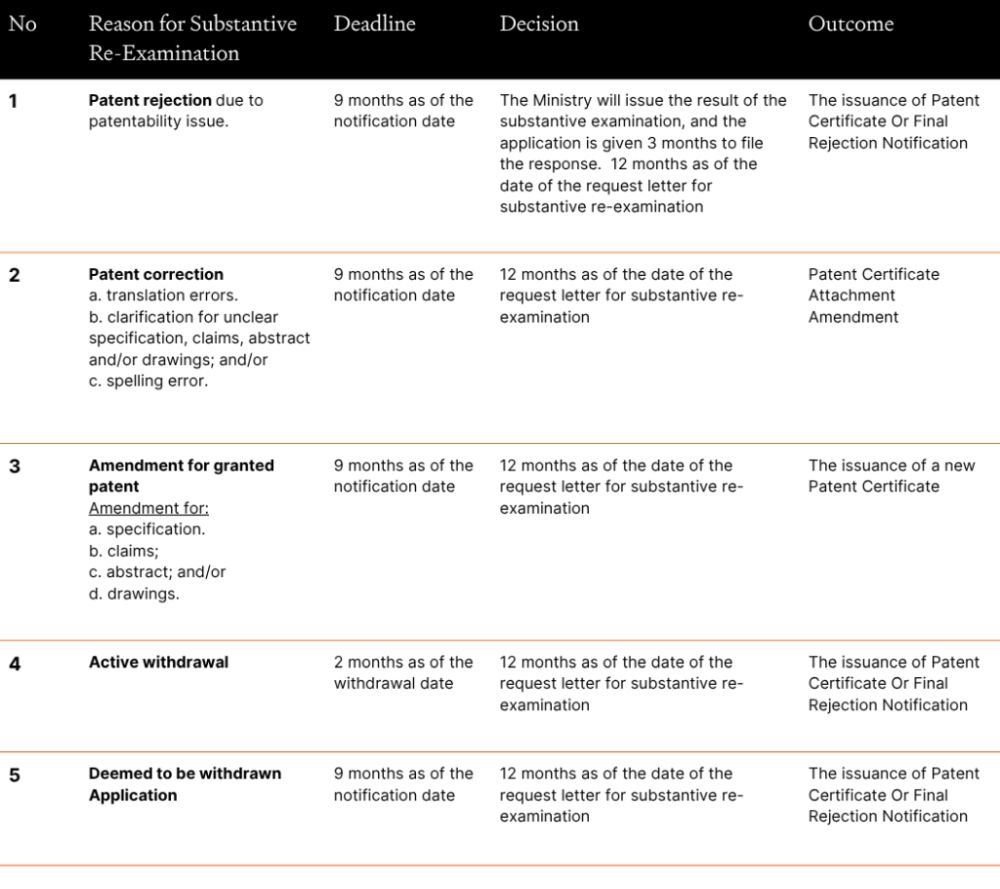
Substantive Re-Examination
The substantive re-examination is requested for the following reason:
Legal Action
Against the Ministry’s decision for regular substantive examination, early substantive examination and simple patent, an applicant can file a request for Substantive Re-Examination within (9 Nine) months as of the date of the notification.
Against the Ministry’s decision for regular substantive examination, early substantive examination, simple patent, substantive re-examination, an applicant can file an appeal request to Patent Appeal Commission within (9 Nine) months as of the date of the decision.
Against the Patent Appeal Commission’s decision, an applicant can file an appeal to the Commercial Court within 3 (three) months as of the date of the decision.
How we can help
Navigating updates to patent filing and examination procedures in Indonesia requires careful attention to timing, documentation and formal requirements. Our patent teams work closely with applicants to help them understand how regulatory changes affect filing strategies, examination options and post‑grant rights.
We advise clients on complying with updated filing requirements, managing priority claims and divisional applications, and selecting appropriate examination pathways. We also assist with responding to office actions, publication and examination requests, and re‑examination or appeal processes where required, helping clients manage risk and maintain momentum for their patent portfolios in Indonesia.
The content of this article is intended to provide a general guide to the subject matter. Specialist advice should be sought about your specific circumstances.
[View Source]