- within Intellectual Property topic(s)
- with Senior Company Executives, HR and Finance and Tax Executives
- in United States
- with readers working within the Accounting & Consultancy, Business & Consumer Services and Healthcare industries
In Short
The Situation: On March 23, the Japan Patent Office ("JPO") published its JPO Status Report 2026 ("2026 Report"). The yearly status reports provide comprehensive statistical data and policy updates in both English and Japanese regarding intellectual property in Japan. This Commentary offers highlights from the report that pertain to patent applications, trademark applications, invalidation trials, and oppositions.
The Result: Except for a noticeable uptick in the number of patent applications, there have been no major changes from the previous year with respect to filings, registration, time to first action of patent and trademark applications, or the number of invalidation trials and oppositions. The success rates for invalidation trials and oppositions continue to be relatively low.
Looking Ahead: Intellectual-property stakeholders should continue to monitor activities at the JPO to see whether these trends continue. The JPO will publish its next Annual Report on Patent Administration in July (only in Japanese), which will contain further statistics and information.
Patent Applications
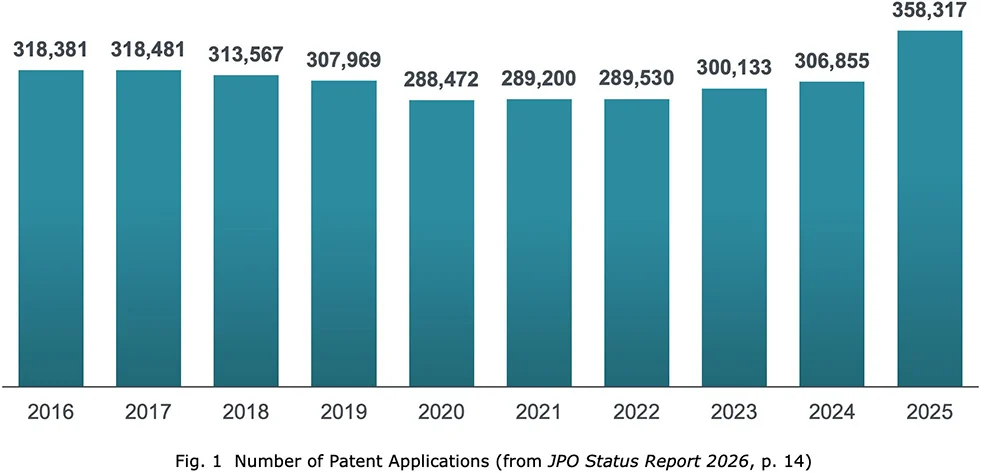
There was a 17% increase in the number of new patent applications in 2025 from the previous year, with the total being noticeably higher than in any of the past 10 years owing to an unusual surge of more than 82,000 applications in December 2025 (see Fig. 1). Japanese entities filed 80.3% of the applications, with U.S., Chinese, and Korean entities filing the next most applications (2026 Report, Fig. 1-1-5, p. 17).
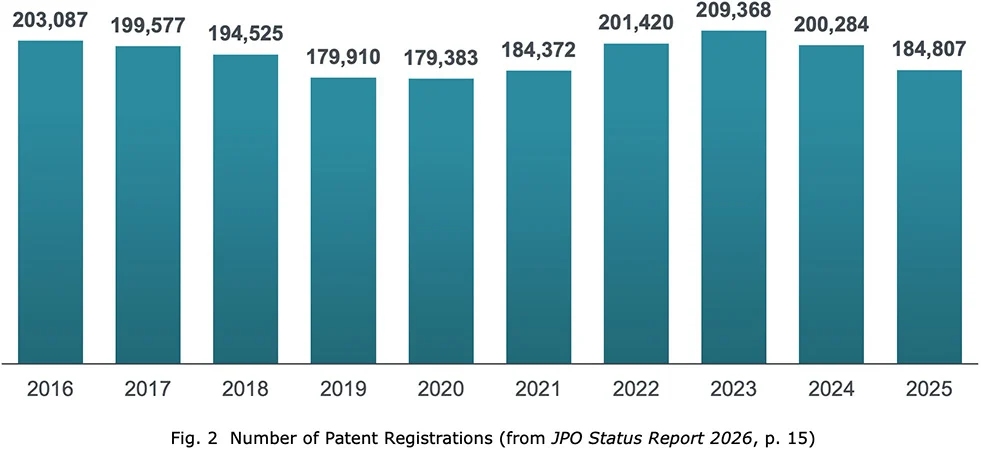
The number of registrations (issuances) decreased for the second year in a row (Fig. 2).
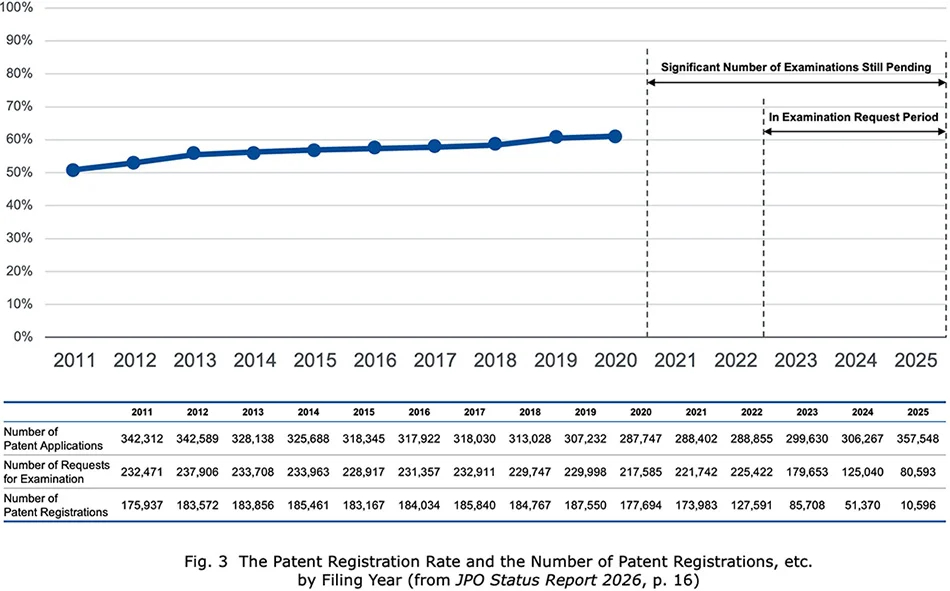
The registration rate, at 61.7%, remained fairly steady from the previous year, following a gradual increase over the last decade from 51.4% (Fig. 3).
The average time for a first action is now 9.1 months for a normal examination, 2.3 months for an accelerated examination, and 0.9 months for a super-accelerated examination (2026 Report, p. 5).
Trademark Applications
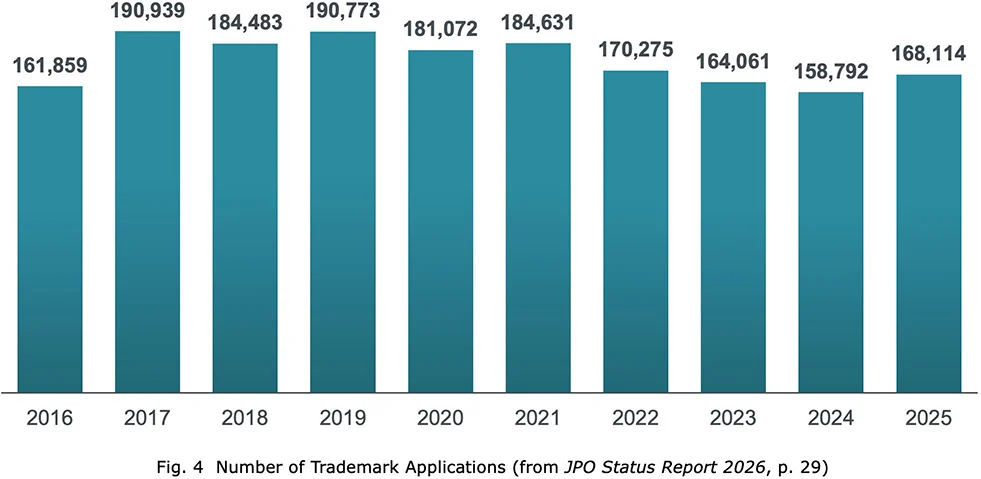
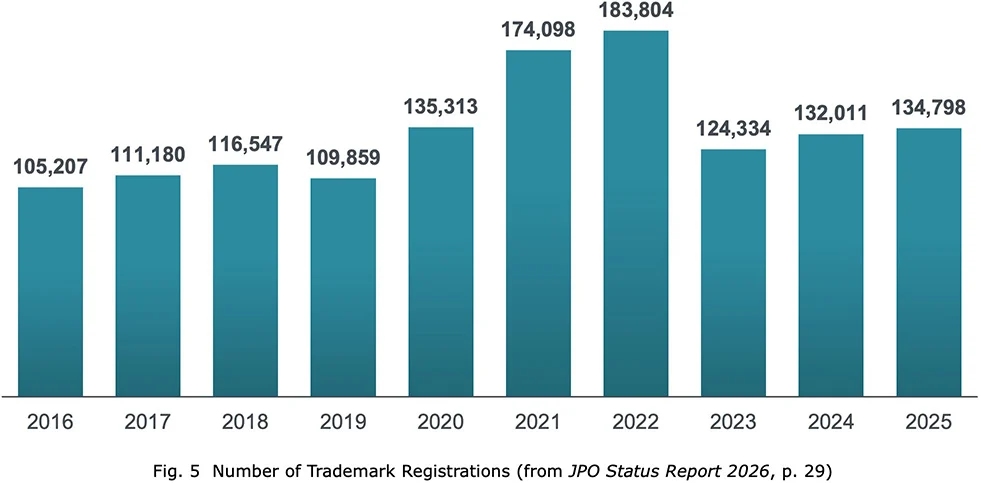
There was a small uptick in new applications for trademarks in 2025 (6%), as well as in total registrations (2%), compared to the previous year (Figs. 4, 5).
The average time to a first action is now 6.8 months for a normal examination and 1.9 months for an accelerated examination (2026 Report, p. 5).
Invalidation Trials
The number of requests for invalidation of a patent held steady in 2025 from the previous year, when requests more than doubled. The number of requests for invalidation of a trademark decreased by 10.5% (Fig. 6).
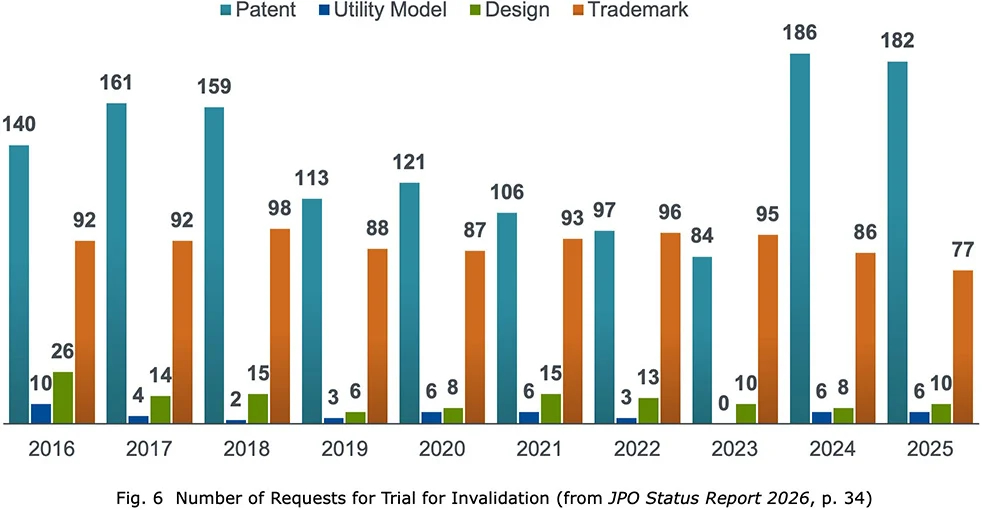
The number of dispositions of patent invalidation trials was 133, with an average pendency of 13.9 months (2026 Report, Fig. 2-1-17, p. 76). The dispositions of trademark invalidation trials numbered 86, with an average pendency of 13.4 months (2026 Report, Fig. 2-1-17, p. 76).
Although the 2026 Report does not provide the success rate of the requests, for patent cases in 2024, if we exclude both the withdrawn cases—often owing to a settlement—and the abandoned ones (35 cases, 40% of the total), the JPO invalidated a patent in 27% of the cases (14 of 52), which is a slight increase from the three preceding years (see Annual Report on Patent Administration 2025, p. 74). However, of the 73% of the cases (38 of 52) wherein the JPO maintained a patent, some involved narrowing corrections to the claims. Thus, the success rate in 2024 for requestors can be deemed higher than 27%.
For trademark cases in 2024, if we exclude the withdrawn or abandoned cases (23 cases, 23% of the total), the JPO invalidated a trademark in 31% of the cases (23 of 75; see Annual Report on Patent Administration 2025, p. 74).
Oppositions
The number of oppositions to patents decreased by 9.4% from the previous year, whereas the number of oppositions to trademarks increased by 5.8% (Fig. 7).
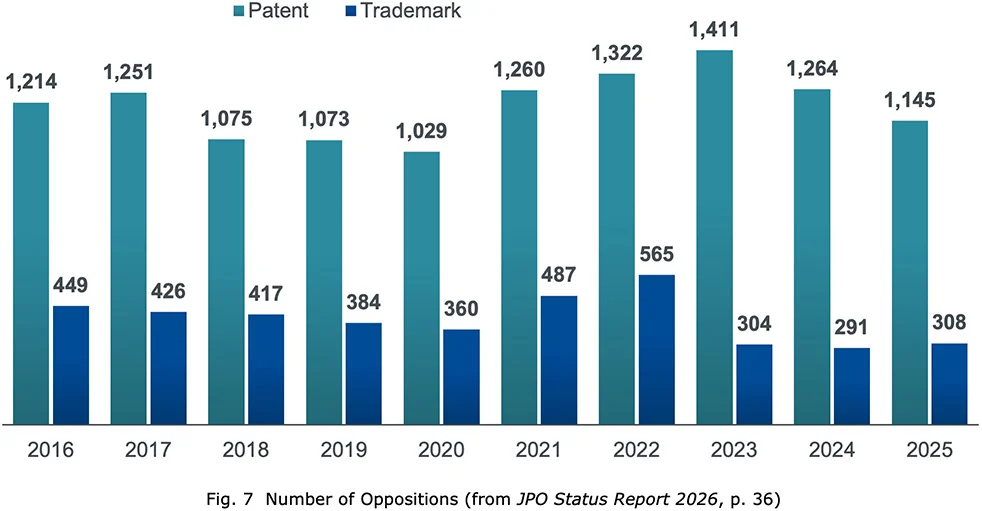
The number of dispositions of patent oppositions was 1,229, with an average pendency of 8.3 months (2026 Report, Fig. 2-1-17, p. 76). The dispositions of trademark oppositions numbered 284, with an average pendency of 9.1 months (2026 Report, Fig. 2-1-17, p. 76).
The 2026 Report does not provide the success rate of the oppositions, but in 2024, the JPO revoked a patent in 10.5% of the cases (141 of 1,342), which is about the same as for the three preceding years (see Annual Report on Patent Administration 2025, p. 77). However, of the 89.5% of the cases (1,201 of 1,342) wherein the JPO maintained a patent, some involved corrections that narrowed the claims. Thus, the success rate for opposers in 2024 can be deemed higher than 10.5%.
For trademark cases in 2024, if we exclude the withdrawn or abandoned cases (42 cases, 12% of the total), the JPO revoked a trademark in 7% of the cases (20 of 297; see Annual Report on Patent Administration 2025, p. 77).
Three Key Takeaways
- The JPO Status Report 2026 is a manifestation of the Japanese government's aim to protect and promote the use of intellectual property in Japan.
- There are no major changes from the previous year in trends related to patent applications, trademark applications, invalidation trials, and oppositions.
- For requestors in invalidation trials and for opposers in oppositions, success rates continue to be relatively low with regard to both patents and trademarks.
The content of this article is intended to provide a general guide to the subject matter. Specialist advice should be sought about your specific circumstances.
[View Source]