

Introduction
Ministry of the Environment and Energy Security (MASE) Ministerial Decree No. 291 of 8 September 2026 sets out the criteria for additional capacity on the National Transmission Grid (RTN) and the “open seasons” procedures for the allocation of grid capacity to renewable energy plants and storage facilities (Ministerial Decree No. 291/2026).
For RES and storage operators, the logic governing access to the grid is changing. Priority is shifting from the connection request at the time of publication of the authorisation or approval for projects or the start of works (for projects authorised under ‘free activity’).
Ministerial Decree No. 291/2026 is one of the implementing measures for the reform introduced by Article 7 of Decree-Law No. 21 of 20 February 2026, converted by Law No. 49 of 10 April 2026 (Bills Decree), amending the new Article 10-bis of Legislative Decree No. 190/2024 (FER Consolidated Act).
Ministerial Decree No. 291/2026 is a fundamental step, but it doesn’t complete the reform.
The practical operation of the new model will depend on subsequent measures by ARERA, which is tasked with updating the technical and economic conditions and connection procedures, and regulating the new capacity allocation system in detail.
It’s during this second regulatory phase that some of the most sensitive aspects for operators will be defined: timelines, the methods of the allocation procedures, fees, the effects on existing connection arrangements, and the mechanisms for transitioning from the old to the new regime.
The aim is to regulate the phenomenon known as “virtual saturation” of the network, caused by the extremely high number of connection requests that tie up the network’s theoretical capacity, even when these relate to projects that haven’t yet reached an adequate stage of regulatory approval.
New grid rules reshape the path for existing projects
Ministerial Decree No. 291/2026 came into force on 8 September 2026. Its adoption was announced in the Official Gazette No. 217 of 18 September 2026.
The transitional regime provides that, before the provisions of Ministerial Decree No. 291/2026 become binding and applicable, ARERA must adopt measures to amend grid connections in accordance with Article 10-bis, paragraph 1, of Legislative Decree No. 190/2024, as amended (FER Consolidated Act).
The new regulations don’t apply to offshore installations, which are expressly excluded from their scope.
Projects already under development – particularly those that have already reached the authorisation stage – need careful consideration.
The new system distinguishes between the mere availability of a connection solution and the definitive reservation of grid capacity. Ministerial Decree No. 291/2026 defines this as the notification from Terna that determines the definitive allocation of feed-in power and the connection point, and the consequent removal of that capacity from the available supply in the relevant microzone.
Projects falling out of the scope of these regulations are those that have obtained:
- either the single authorisation or the PAS, or which have notified the start of works;
- or confirmation of the definitive allocation of grid capacity.
Projects for which Terna has already definitively reserved capacity don’t have to compete again, within the framework of the Open Seasons, for the allocation of the same capacity, subject to compliance with the conditions laid down for maintaining the reservation.
But the situation is more complex for projects that have already been authorised and have a connection solution (STMG), but for which the final reservation of capacity has not yet taken place.
Once after these implementing regulatory measures have been approved Terna will have 15 days to notify which solutions are no longer valid and which are still valid.
Terna confirms the validity of connection solutions relating to renewable energy plants and storage systems that involve only grid works for connection:
- whose Terna has already validated the Technical Plan for National Transmission Network (RTN) works; or
- whose RTN works have already been authorised; or
- whose RTN works are already in place.
The distinguishing factor is crucial: it’s not merely the existence of an STMG, nor even necessarily the mere granting of authorisation for the plant, that shields the project from the new system; rather, it’s necessary to verify the status of the connection solution, the related RTN works, or whether Terna has already issued the definitive allocation of grid capacity.
For parties who have already received approval for the customer works required for connection but whose RTN works have not yet been authorised or approved, the validity of the approval is suspended until the necessary authorisations or approvals required for the construction and operation of the RTN works provided for in the connection solution have been issued.
Parties who, as at the date of publication of the ARERA measures, have already received a favourable environmental decision must notify Terna within 15 days of the publication of the ARERA measures. Terna will then assess whether to include the relevant RTN works envisaged in the approved project in the bid for the Open Seasons procedures
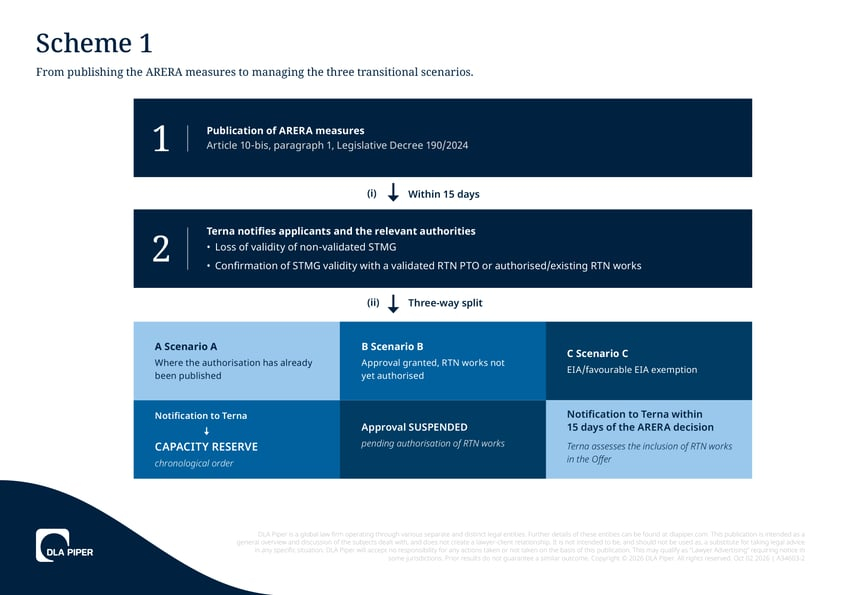
The fact that the previous connection solution is no longer effective will not in itself lead to authorisation applications already submitted being rejected or dismissed. But the procedure will be suspended until the new solution is produced, without prejudice to the preliminary investigations already carried out and not affected by the change. Timeframes for permitting or authorization proceedings – including environmental assessment processes – concerning projects affected by the loss of validity of the existing connection solution shall resume upon the submission by the project proponent of documentation regarding the new connection solution issued following participation in the Open Season.
Within 90 days of the publication of the measures adopted by ARERA pursuant to Article 10-bis, paragraph 1 of Legislative Decree 190/2024, Terna has to notify the distributors concerned of any updates to the connection solutions falling within its remit.
The new framework for the allocation of network capacity is essentially divided into four stages:
- Identifying the RTN microzones;
- publishing the capacity offer and connection points;
- conducting periodic “open season” procedures;
- allocating capacity to projects that have obtained the necessary authorisation or licence, or have commenced works.
Microzones map capacity for open seasons
A key feature of the new system is the division of the network into microzones to help identify available additional capacity.
This is the basis used in competitive procedures – open seasons – to allocated network capacity.
This gradually moves away from the traditional model based on the chronological order of connection requests.
The principle that will characterise the new system can be summarised as: “first authorised, first reserved.”
In other words, capacity isn’t definitively “reserved” merely because a technical connection solution has been obtained and accepted: instead it’s important to obtain authorisation or approval for the project.
The procedure stipulates that, within 30 days of the Ministerial Decree coming into force, Terna must submit to MASE a proposed methodology for identifying the microzones. Following ministerial approval of the methodology, Terna has to publish the microzones within 15 days (see Article 3). The microzones have to be updated every two years.
Terna turns theoretically committed capacity into available capacity
The new system fundamentally changes the way in which grid access is planned.
Terna will have to identify, for each microzone, the maximum additional capacity – defined as the extra power from renewable energy sources (RES) and battery energy storage systems (BESS) that can be integrated into the grid – taking into account national and European targets for the development of renewable energy sources and the capacity actually available.
The maximum additional capacity will be made available via the Terra portal.
The maximum additional capacity will be updated quarterly, taking into account:
- the licences and authorisations issued
- connection requests
- the commissioning of plants
- development works on the National Transmission Grid (RTN)
- the capacity expected to be connected to the distribution networks;
- the degree of utilisation of connection solutions already allocated.
When defining the connection points in each microzone and the maximum additional capacity, Terna will have to ensure compliance with the provisions of Article 10-bis of Legislative Decree 190/2024. It will also have to minimise the costs of the National Transmission Grid works associated with the various connection solutions, and take into account the level of saturation of the connection solutions and the related residual additional capacity, which is progressively updated. Finally, Terna will have to make available a total connection capacity equal to at least 150% of the 2030 power targets set out in Table 1 of Annex C-bis to the Consolidated Law on Renewable Energy Sources (TU FER), net of the additional capacity envisaged on the distribution networks.
The new model also allows for the provision of connection solutions even beyond the maximum capacity that can be immediately accommodated at a given point on the network. Overbooking becomes a standard planning tool, while the actual availability of capacity will subsequently be allocated through transparent and non-discriminatory procedures, known as “open seasons.”
Terna will publish the offer and open seasons procedures
For each microzone, Terna will publish on its portal an offer containing the minimum technical solutions available for connection (the offer).
The offer is intended to facilitate the “open season” procedure, namely a transparent and non-discriminatory procedure pursuant to Article 10-bis of Legislative Decree 190/2024, through which applicants select, for each connection request, a minimum technical solution for connection to the National Transmission Grid (RTN) from among those constituting the offer. The offer has to specify, for each connection point (defined as the boundary between the transmission network and the part of the installation for the user’s connection, such as the ‘bay,’ ‘section’ or ‘station’):
- the capacity immediately available without further network works
- the capacity available only following the completion of new network works
- the status of the network works in terms of design, authorisation and construction
- the maximum additional capacity associated with the station, section and bay
The offer must be published at least 30 days before the start of the relevant open season, to allow operators to assess the available solutions.
Connection solutions will be allocated through periodic open season procedures, to be conducted in accordance with criteria of transparency, impartiality and non-discrimination.
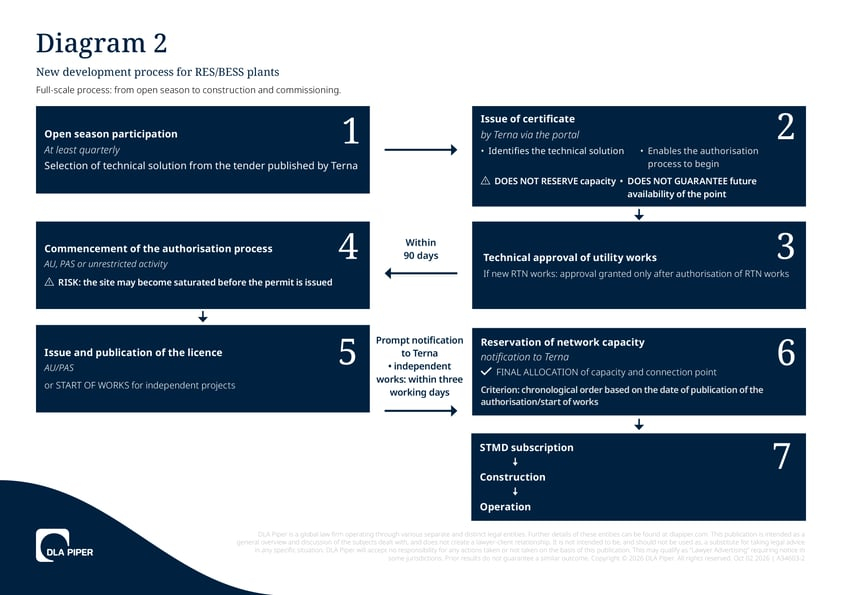
Open season procedures will take place at least quarterly and aim to select, within the scope of the offer published by Terna, the most appropriate minimum technical solution for each initiative.
Terna may also allocate connection solutions in excess of the maximum available capacity or the number of available connection points. But this possibility won’t entail granting a definitive right to grid capacity, given that any over-allocation of technical solutions is intended to broaden the pool of projects that can proceed through the authorisation process, while capacity will be confirmed only for those initiatives that are subsequently authorised.
We’re moving from a model based on advance reservation of network capacity, which begins when accepting the connection quotation, to a system in which multiple projects can compete for the same capacity, with subsequent selection based on the actual progress of the authorisation process and the subsequent granting of the relevant authorisation.
Certification of the connection solution isn’t reservation of network capacity
Pursuant to Article 7 of Ministerial Decree No. 291/2026, following the conclusion of the open season, Terna will issue a “Certificate of Connection Solution” to the proposer via the Terra portal.
The “Certificate of Connection Solution” enables the authorisation process to be initiated. But the “definitive allocation of grid capacity” takes place via a notification from Terna regarding the reservation of grid capacity only after the publication of the licence or authorisation. It takes place in chronological order according to the date on which the licence or authorisation was published, or, in the case of projects authorised under the “free activity” scheme, according to the date of the notification of the commencement of works.
The Certificate of Connection Solution:
- identifies the technical connection solution;
- enables the project and authorisation process to proceed;
- does not entail the definitive allocation of capacity;
- does not guarantee the future availability of the specified connection point.
This is where one of the main new features of the system comes to the fore: the Connection Solution Certificate is sufficient to initiate the authorisation process, but it’s not a definitive allocation of capacity or of the connection point.
The availability of the connection solution during the authorisation process is necessarily provisional, and the project is exposed to the risk that, before the authorisation or licence is obtained or the notice to commence works is issued following the “free activity” procedure, the capacity associated with the identified point may be fully allocated to other, more advanced projects (see Chapter 2).
Technical approval or validation triggers the authorisation process
The amendments introduced by Article 10-bis of Legislative Decree 190/2024 (FER Consolidated Act) have meant that works to develop and upgrade the National Transmission Grid (RTN) relating to renewable energy sources or to energy storage systems battery energy storage systems (BESS) are authorised, upon application by Terna, pursuant to Article 1-sexies, paragraphs 1, 2, 3, 4, 4-bis, 4-bis.1 and 4-bis.2, of Decree-Law No. 239 of 29 August 2003, converted, with amendments, by Law No. 290 of 27 October 2023. Excluded from this regulatory framework are interconnection works between the National Transmission Grid (RTN) and primary substations of distribution networks that fall within the category of "connected works" pursuant to Art. 4, paragraph 1, letter f-quater) of Legislative Decree 190/2024.
This “transfer of competence” to Terna is subject to a transitional regime as provided for in paragraph 9 of Article 10-bis. This article stipulates that the transfer of competence to Terna won’t apply where the development and upgrading works on the RTN have already been validated by Terna and are included in projects for renewable energy (FER) plants or battery energy storage systems (BESS), for which the licensing or authorisation procedures have already been initiated as at the date of publication of the measures adopted by ARERA. This is, however, without prejudice to the right of parties proposing FER or BESS plant projects relating to the same development and upgrading the RTN to jointly request from Terna to submit an application for authorisation pursuant to paragraph 8, first or second sentence. There are differing interpretations of this provision, given that the regime governing RTN works contained in the STMG is unclear particularly where one of the conditions is not met.
In other words, it’s unclear whether Terna has the authority to authorise RTN works from the entry into force of Decree-Law 21/2026 as converted (Decree-Law Bolette) in respect of STMGs that have already been accepted but for which Terna’s validation has not yet been granted, or whether the transfer of powers will take place only after the issuance of ARERA’s measures, even during the authorisation procedure where Terna’s validation has not yet been granted.
Article 8 of Ministerial Decree 291/2026 governs the issue of the Benestare, that is, the notification by which Terna certifies the compliance of the technical documentation for the user works required for connection, limited to the interface with the grid facility for connection, in accordance with the procedures to be established by ARERA. This provision applies only after ARERA issues the relevant measures and the solution connection identified has been certified following the open season procedure.
For each connection point, a distinction is made between (a) the connection capacity available – even if only partially – without the need for additional network works; and (b) the connection capacity available – even if only partially – following the construction of new network works by Terna, and the corresponding capacity made available only upon completion of said works. In case sub (a), Terna issues its approval. In case sub (b) (that is, where the technical solution requires new works on the National Transmission Grid (RTN) to be authorised and carried out), approval will only be issued once Terna has obtained the necessary authorisations to carry out its own RTN works.
While this mechanism aims to prevent the initiation of authorisation procedures for solutions lacking a sufficient degree of infrastructural feasibility, it also risks creating a deadlock for the authorisation procedures of RES and BESS installations that have not yet obtained approval because Terna has not yet carried out the grid works.
The Benestare is of particular importance because it constitutes:
- the opinion on technical compliance with the design solutions;
- the point from which the 90-day deadline for submitting the application for a PAS or single authorisation for the renewable energy plant or storage facility begins. In this regard, this provision contained in Article 8(3) of Ministerial Decree 291/2026 appears to conflict with Article 10-bis(7) of Legislative Decree 190/2024, which stipulates that the 90-day period begins from the acceptance of the connection solution and not from the approval. In fact, following the issue of technical approval for the connection works, the applicant, if they have not already done so, must submit an application for a PAS or a Single Authorisation within 90 days and, in the cases specifically provided for by Legislative Decree 190/2024, the impact assessment must be initiated or the building permit applied for within the same timeframe.
If the authorisation or permit expires, the relevant connection solutions cease to be valid. The completion of the unfinished part of the project is subject to a new application for the issue of the connection solution.
Authorisation secures grid capacity – and determines priority
To obtain the Network Capacity Reservation, the applicant must notify Terna:
- that the qualifying authorisation has been obtained in accordance with Article 8 of Legislative Decree 190/2024 (ie the PAS); or
- the Single Authorisation pursuant to Article 9 of Legislative Decree 190/2024h has been issued; or
- for projects under the “free activity” scheme, that the requirements set out in Article 7 have been met, namely all the requirements necessary to actually commence works.
The final allocation of grid capacity will be based on the chronological order of the date of publication of the authorisations or permits, or the date of notification of the commencement of works (in the case of the “unregulated construction” procedure), and not on the date of the original connection request or the issue of the Connection Solution Certificate.
The operator has to promptly notify Terna of the publication of the authorisation, and, with specific reference to works carried out under the “free construction” scheme, this notification must be made within three working days of the start of works.
The new system makes the speed of the authorisation process a determining factor not only for the development of the project, but also for the actual availability of the connection.
Network saturation occurring during the authorisation process
If the connection point indicated in the Connection Solution Certificate becomes saturated before final allocation, Terna has to notify the operator that the connection solution is no longer valid and will proceed:
- identifying an alternative technical connection solution; and
- adapting the previous solution.
In this case, the operator can participate in a subsequent open season.
If the authorisation procedure is already pending, it’s not automatically closed or rejected, but the relevant time limits are suspended and resume from the date of submission of the documentation relating to the new connection solution. However, preliminary investigations already carried out for aspects not affected by the change to the connection solution to the electricity grid are still valid.
If saturation occurs after the authorisation or licence has been granted or work has commenced:
- for installations authorised via the PAS in accordance with Article 8 of Legislative Decree 190/2024, changes to the connection arrangement are subject to the same simplified procedure as the PAS;
- for installations authorised under the Single Authorisation referred to in Article 9 of Legislative Decree 190/2024, the variation must be approved as part of the single procedure, with priority processing.
A permanent technical coordination committee comprising MASE, Terna, and distributors has been established to ensure the progressive updating of the Ministerial Decree's implementation procedures.
Conclusions and impact on operators
The new regime requires operators to review their development strategies for RES and BESS projects. It’s advisable to:
- Check, for each project, the status of the connection solution and any validation of the RTN PTO.
- Ascertain whether the RTN works are in place or have already been authorised.
- Monitor Terna’s publications relating to microzones, tenders and open seasons.
- Where possible, expedite obtaining and publishing authorisation or approval documents and submit the notice of commencement of works, which will be a key criterion for chronological priority in the final allocation of network capacity.
- Promptly notify Terna of the commencement of proceedings and the granting of administrative measures.
- Ensure compliance with the 90-day deadlines for initiating the authorisation procedure.
- Prepare, from the outset, any alternative connection scenarios in the event of sudden saturation.
- Assess the impact of the new regulations on timetables, development contracts, acquisitions and the bankability of projects.
- The new model reduces the risk that initiatives lacking concrete progress might tie up grid capacity, but shifts a greater burden of coordination between connection, the authorisation process and infrastructure development onto the operators.
The mere availability of a technical solution will no longer be sufficient to guarantee the feasibility of the project; instead, the authorisation status of the initiative and the constant monitoring of available capacity in the relevant microzone will become decisive factors.
In acquisition processes, it will be increasingly important to jointly verify:
- the status and validity of the connection solution
- the microzone in which the project is located and the available capacity
- the status of the authorisation process
- whether the milestones set out in the new regulations have been met
- whether the project is subject to future open seasons
- the financial and contractual consequences of any failure to be allocated capacity and the need to amend the connection works
These factors may affect the due diligence process, the economic valuation of the project, the conditions precedent to closing, price adjustment mechanisms and the seller’s guarantees.
The real strategic asset will no longer be merely the availability of a technical connectivity solution, but the ability to rapidly bring genuinely feasible projects to the authorisation stage.
For developers, investors and financiers, connection to the grid is becoming less and less a purely technical issue and increasingly a central element of the authorisation strategy and the bankability of the investment.
The content of this article is intended to provide a general guide to the subject matter. Specialist advice should be sought about your specific circumstances.
[View Source]


