Indian economy | July 2026
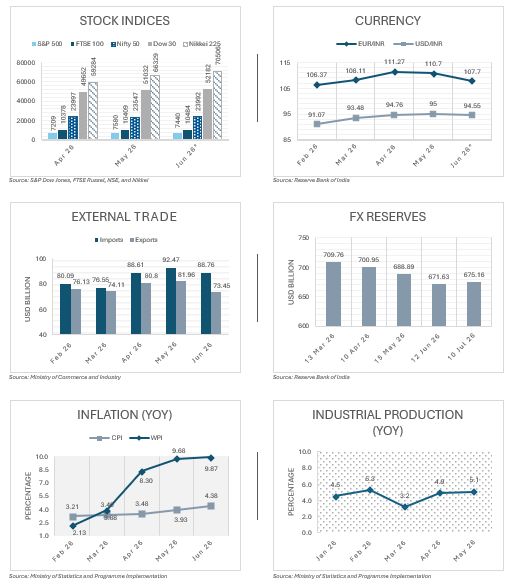
Snapshot of key indicators
As per the latest available data for July 2026
RBI overhauls India's credit derivatives market with new products and broader participation
The Reserve Bank of India (RBI) has issued a revised framework governing credit derivatives in India (Directions), giving effect to the proposals announced in the February 2026 Monetary Policy Statement. The Directions introduce Total Return Swaps (TRS) and credit index derivatives, while significantly revamping the existing framework for Credit Default Swaps (CDS).
Key proposals
- Expanded product landscape
- The Directions now permit CDS, TRS, and exchange-traded futures on credit indices, enabling participants to transfer or hedge credit risk through a wider range of instruments.
- TRS have been introduced, allowing counterparties to transfer the full economic performance of eligible debt instruments.
- The Directions also permit specified participation by non-residents, including Foreign Portfolio Investors (FPIs), subject to investment limits, funding and Foreign Exchange Management Act (FEMA)-related conditions.
- Broader participation across market segments
- The framework significantly widens participation by allowing scheduled commercial banks, select Non-Banking Financial Companies (NBFCs), primary dealers, and specified financial institutions to act as market-makers.
- Insurance companies, pension funds, mutual funds, Alternative Investment Funds (AIFs), and eligible Foreign Portfolio Investors (FPIs) are also permitted to participate, subject to prescribed regulatory conditions. Resident corporates meeting specified financial thresholds may participate as non-retail users.
- Exchange-traded credit derivatives: Recognised stock exchanges may offer single-name CDS, CDS on credit indices, and credit index futures, subject to prior RBI approval, with operational guidelines to be prescribed by the Securities and Exchange Board of India (SEBI).
- Comprehensive regulatory architecture: Beyond introducing new products, the Directions create a unified regulatory framework governing credit derivative transactions from inception to settlement. The framework standardises participant eligibility, product design, valuation, settlement, reporting, accounting and prudential requirements, providing greater regulatory certainty while strengthening governance and market integrity.
- Strengthened governance and market infrastructure
- A Credit Derivatives Determinations Committee will be constituted by the Fixed Income Money Market and Derivatives Association of India (FIMMDA) to determine credit events, succession and substitution events, and oversee auction settlements. Its decisions will be binding on market participants.
- Market-makers must report over-the-counter transactions to Clearing Corporation of India Ltd (CCIL) within 30 minutes, while exchanges are required to report FPI positions and other prescribed information to facilitate regulatory oversight.
The Directions represent a significant step in the gradual development of India's corporate bond market by creating a more comprehensive framework for transferring and managing credit risk. The revised regime seeks to deepen India's corporate bond market, strengthen credit risk management, broaden investor participation, and enhance the overall resilience of the market through improved infrastructure and regulatory oversight.
While the introduction of TRS, credit index derivatives, and broader market participation is expected to improve liquidity and risk distribution, the success of the framework will depend equally on robust market infrastructure, standardised documentation, timely reporting and effective governance mechanisms.
Revised framework of purpose-driven compliance for foreign contributions
Foreign Contribution (Regulation) Amendment Rules, 2026
For over a decade, the Foreign Contribution (Regulation) Act, 2010 (FCRA) has governed the acceptance and utilisation of foreign contributions by associations, trusts, societies, and Section 8 companies in India. While the existing framework imposed stringent controls over registration, utilisation, and reporting, the Foreign Contribution (Regulation) Rules, 2011 (Rules) have been amended by the Ministry of Home Affairs to strengthen the compliance architecture (Amendment).
Key changes
- Permissible activities: For the first time since the enactment of the FCRA, an exhaustive Schedule identifying the activities for which registration may be granted has been introduced. The Schedule spans a wide range of recognised charitable and developmental activities – from education, healthcare, and livelihood generation to heritage conservation, disaster relief, environmental protection, and religious institutions.
- Purpose and geography: Applicants must now select their objectives only from a newly prescribed Schedule containing approved activities under 5 broad sectors – religious, cultural, economic, educational, and social – while also specifying the exact States or Union Territories where they propose to operate. Existing FCRA-registered organisations have been given 1 year (till June 21, 2027) to update these particulars through the newly introduced Form FC-6F.
- Release of subsequent foreign contributions: Where prior permission allows foreign contribution to be received in instalments, subsequent instalments will now be released only after:
- Utilisation of at least 75% of the previous instalment
- Submission of the newly prescribed Form FC-3BB
- Chartered Accountant certification
- Verification through a field enquiry
- Utilisation for continued eligibility: An objective test for determining whether an organisation has undertaken ‘reasonable activity’ has been introduced. An association must now utilise at least INR 10 lakh of foreign contribution during the preceding 2 financial years to satisfy this requirement for renewal and to avoid cancellation of registration.
- Restrictions on foreign nationals: Associations having foreign nationals (other than persons of Indian origin) as key functionaries will ordinarily not be eligible for FCRA registration or prior permission unless specifically permitted by the Union Government.
- Widened governance disclosures: The Amendment introduces a comprehensive definition of ‘key functionaries’, which now covers directors, trustees, partners, Karta of HUF, governing body members, and any individual exercising managerial control over the organisation. This expands the pool of individuals whose particulars must be disclosed in FCRA filings.
- Enhanced disclosures across the compliance lifecycle: Organisations may now be required to disclose, among other things, social media accounts, official websites, project-wise activity reports, activities undertaken over the previous 3 financial years, geographical areas of operation, publications issued by the organisations, ultimate donor details (where applicable), and additional governance and audit-related particulars.
The Amendment marks the most significant recalibration of the FCRA compliance framework since 2020. Unlike previous amendments that primarily focused on tightening restrictions, the 2026 Amendment seeks to make FCRA registrations far more purpose-driven, activity-based, and transparent. Organisations are now required to clearly define what they intend to do, where they intend to operate, who exercises control over the organisation, and how foreign contributions are actually utilised.
RBI introduces comprehensive regulatory framework for financing REITs and InvITs
RBI (Commercial Banks – Credit Facilities) Third Amendment Directions, 2026
The Reserve Bank of India (RBI) has amended its Commercial Banks – Credit Facilities Directions, 2025, introducing a detailed prudential framework governing credit facilities extended by regulated entities to Infrastructure Investment Trusts (InvITs) and Real Estate Investment Trusts (REITs). Effective from October 1, 2026, the framework seeks to facilitate greater access to institutional credit while strengthening prudential safeguards relating to leverage, valuation, refinancing, acquisition finance, and security enforcement.
Key changes
- Governance requirements: Regulated entities are now required to adopt board-approved policies governing such financing, covering, among other matters, appraisal standards, underwriting criteria, Debt Service Coverage Ratio (DSCR), exposure limits, and post-disbursement monitoring.
- Valuation methodologies: Given that the valuation of InvITs and REITs is primarily dependent upon projected cash flows and the performance of the underlying assets, lenders are additionally required to independently evaluate the valuation methodologies and assumptions adopted by borrowers while assessing credit proposals.
- Applicability: The framework only applies to listed InvITs and REITs regulated by the Securities and Exchange Board of India (SEBI). Further, at least 80% of the value of the trust's assets must comprise completed and income-generating assets that have generated positive operational cash flows for a minimum period of 1 year. Regulated entities must also verify that the governing trust documents expressly permit the proposed borrowings and do not contain restrictions that could impede the creation or enforcement of security interests or otherwise prejudice lender rights.
- Restrictions on borrowings: Credit facilities cannot be utilised for financing Special Purpose Vehicles (SPVs) that have existing borrowings from regulated entities and are classified as financially stressed under the applicable RBI prudential framework. However, refinancing of existing SPV credit facilities relating to completed and operational projects continues to be permitted. In the case of REITs, such refinancing is restricted to projects that have obtained the requisite Completion Certificate, Occupancy Certificate, or other equivalent statutory approvals.
- Prudent leverage and cash flow assessment: Lenders must independently assess the projected cash flows available for servicing debt and ensure compliance with leverage limits prescribed by SEBI or such lower internal thresholds as may be adopted by the lender.
- Repayment structuring: Loan repayment structures should not involve bullet or balloon repayments resulting in a substantial concentration of principal repayment obligations towards the end of the loan tenure. Instead, repayment schedules are expected to be appropriately aligned with the projected cash flows of the underlying assets. Notably, this restriction does not extend to investments in bonds, debentures, or commercial papers issued by InvITs or REITs.
- Exposure limits: The aggregate exposure of all banks to an InvIT or REIT, together with its underlying SPVs and holding companies, must not exceed 49% of the value of the trust's assets, or such lower limit as may be approved by the lender's board. Asset valuation for this purpose is required to be undertaken in accordance with the applicable SEBI valuation framework.
- Comprehensive security requirements: Financing extended to InvITs and REITs must be fully secured through appropriate security interests over the underlying assets, including immovable property, receivables, cash flows, and equity interests in SPVs. Lenders are also expected to incorporate robust contractual protections, including escrow mechanisms, cash flow ring-fencing arrangements, step-in rights, and restrictions on the incurrence of additional indebtedness.
Ancillary amendments
- Commercial Banks – Concentration Risk Management Third Amendment Directions, 2026: Banks are required to establish internal exposure limits for the real estate sector and prescribe that aggregate exposure to REITs must not exceed 10% of a bank's eligible capital base.
- Commercial Banks – Prudential Norms on Capital Adequacy Eighth Amendment Directions, 2026: Exposures to REITs are classified as Commercial Real Estate (CRE) exposures for capital adequacy purposes, thereby attracting the applicable CRE risk weights.
- All India Financial Institutions – Credit Facilities Amendment Directions, 2026: A dedicated acquisition finance framework has been introduced for InvITs. All India Financial Institutions (AIFIs) may finance InvITs and eligible holding structures for acquiring control of infrastructure assets, subject to prescribed prudential safeguards. These safeguards include eligibility criteria, independent valuation of target entities, leverage restrictions, security creation requirements, and financing caps. Credit appraisal is required to be undertaken on a pro forma consolidated basis, while acquisition financing is capped at 75% of the independently assessed acquisition value. The framework also permits refinancing of acquisition finance following completion of the acquisition, provided all applicable prudential requirements continue to be satisfied.
SEBI approves sweeping capital markets reforms across multiple sectors
SEBI Board's 214th meeting
The Securities and Exchange Board of India (SEBI), in its 214th Board meeting, has approved a comprehensive suite of proposals for regulatory reforms and improvements relating to capital markets, investment funds and depositories, securitisation and handling of municipal debt, investor services, and the Board's regulatory governance.
Key approvals
- Simplified transmission of securities: SEBI has approved the wider reforms to the transmission process of securities registered/owned by deceased investors. The reform allows for introduction of the Quick Transmission Processing scheme for small value claims (up to INR 10,000 for physical holdings and up to INR 30,000 for dematerialised holdings), enhancement of the upper limit of the simplified documentation process (from INR 5 lakh to INR 10 lakh for physical holdings and from INR 15 lakh to INR 30 lakh for dematerialised holdings) as well as relaxation of the provided documentation, including elimination of certain procedural requirements such as submission of PAN and probate of will in certain cases.
- Re-introduction of open market buy-backs: Revisions to the SEBI (Buy-back of Securities) Regulations, 2018 have reintroduced open market buy-backs through stock exchanges from August 1, 2026. The amended provisions offer increased operational liberty subject to a series of requirements relating to completion of the buy-back within 66 working days, utilisation of at least 40% of the earmarked funds during the first half of the buy-back period, disclosure to shareholders, and restrictions on the extent of promoter involvement.
- Intraday borrowing by mutual funds: The facility of intraday borrowing by mutual funds to address interim liquidity mismatches ensuing from settlement obligations will be allowed (subject to safeguards such as repayment by the end of the day, prohibition on usage of borrowings as leverage, and limiting such borrowings up to receivables sighted during the day, with borrowings beyond this threshold permitted only for meeting redemption payments to investors).
- Changes to the framework for Securitised Debt Instruments (SDIs): Major modifications to the SEBI (Issue and Listing of SDIs and Security Receipts) Regulations, 2008 have been made to make the listed securitisation framework consistent with the Reserve Bank of India's (RBI) securitisation regime. The reforms enable single-asset securitisation by RBI-regulated entities, ease disclosure and governance norms, and reinvigorate the regulatory framework governing trustees and securitisation structures.
- Municipal debt securities reforms: The SEBI (Issue and Listing of Municipal Debt Securities) Regulations, 2015 have been amended to deepen the municipal bond market by promoting refinancing of existing debt, permitting issuance of General Purpose Municipal Bonds, enhancing pooled financing structures, promoting retail investor participation in the municipal bond market, and enabling the introduction of a disclosure-based regulatory framework with increased flexibility in review of post-issue compliance timeline.
The resolutions passed during this Board meeting are one of the most detailed reforms implemented in the Indian capital markets landscape. The impact of these reforms will become apparent only after their implementation through amending the pertinent regulations and operational instructions issued by SEBI. However, from the analysis of the proposed reforms, it becomes clear that there is one common goal – the promotion of capital formation and strengthening of the capital markets.
SEBI fast-tracks AIF launches through the GARUDA framework
Green channel: AIF Rollout Upon Document Acknowledgement
To address growing delays in the launch of Alternative Investment Fund (AIF) schemes amid rapid expansion of India's private capital markets, the Securities and Exchange Board of India (SEBI) has introduced a fast-track framework culminating in the Green channel: AIF Rollout Upon Document Acknowledgement (GARUDA) mechanism. This framework seeks to accelerate capital formation by replacing extensive pre-launch regulatory scrutiny with a disclosure-driven, time-bound approval process while retaining post-launch oversight.
Key changes
- Faster scheme launches: Regular AIF schemes may now be launched 10 working days after filing the Private Placement Memorandum (PPM), reducing the earlier waiting period of 30 days, unless SEBI raises objections within the prescribed timeline.
- Relaxation for sophisticated investors: Schemes offered exclusively to Accredited Investors and Angel Funds are no longer required to obtain merchant banker certification of the PPM. Instead, a declaration by the AIF manager's Chief Executive Officer and Compliance Officer is sufficient, enabling near-immediate launch upon filing.
- Risk-based regulatory oversight: Rather than reviewing every scheme before launch, SEBI will conduct post-launch, risk-based examinations of selected filings. Regulatory scrutiny therefore shifts from an ex ante approval model to an ex post supervisory framework.
- Greater accountability for fund managers: While procedural timelines have been shortened, responsibility for the accuracy and completeness of disclosures now rests more directly with AIF managers and their senior management, who remain liable for regulatory action in case of misstatements or non-compliance.
- Time-bound fundraising: Schemes launched under the framework must achieve first close within 12 months of becoming eligible to launch.
The GARUDA framework reflects SEBI's shift towards a proportionate regulatory model that distinguishes between investor categories based on sophistication. By reducing procedural delays while preserving regulatory enforcement through post-launch supervision, the reforms are expected to facilitate quicker fundraising, improve capital deployment, and enhance the ease of doing business for the private equity and venture capital ecosystem, without materially diluting investor protections.
RBI aligns FEMA framework with fast-track cross-border mergers
FEM (Cross Border Merger) (Amendment) Regulations, 2026
The Reserve Bank of India (RBI) has amended the Foreign Exchange Management (Cross Border Merger) Regulations, 2018 (Regulations), replacing the standalone definition of ‘National Company Law Tribunal (NCLT)’ with the broader term ‘Competent Authority’(Amendment). ‘Competent Authority’ has been defined as any authority empowered under the Companies Act, 2013 or the rules thereunder to approve a scheme of merger or amalgamation between Indian and foreign companies undertaken under Section 234 of the Companies Act, 2013 with the Companies (Compromises, Arrangements and Amalgamations) Rules, 2016.
While the Companies Act had previously been amended to provide for the approval of certain cross-border mergers by authorities other than the NCLT (including under the fast-track merger route), the Regulations continued to refer only to the NCLT, resulting in an inconsistency with the Foreign Exchange Management Act (FEMA) regime.
With the Amendment, timelines relating to asset disposal, operation of foreign currency and Special Non-Resident Rupee (SNRR) accounts, payment of compensation under merger schemes and filings for deemed RBI approval are now linked to the authority sanctioning the merger, rather than the NCLT alone. Eligible transactions undertaken through the fast-track route can now rely on the FEMA framework without the ambiguity created by the earlier NCLT-specific references, providing greater certainty for cross-border restructuring.
However, the definition of ‘Competent Authority’ is left intentionally broad and does not identify specific authorities, thereby requiring transaction participants to determine the appropriate approving authority under the company law framework. Further, the amendment does not relax the substantive FEMA requirements governing cross-border mergers – pricing guidelines, sectoral conditions, valuation requirements, reporting obligations, and timelines for disposal of assets that cannot be retained following a merger – continue to apply and must be carefully complied with.
RBI transforms conduct standards for NBFCs with customer-centric selling rules
RBI (Non-Banking Financial Companies – Responsible Business Conduct) (Second Amendment) Directions, 2026
The Reserve Bank of India (RBI) has significantly expanded the scope of its Non-Banking Financial Companies (NBFCs) – Responsible Business Conduct Directions, 2025 (Directions) by introducing a comprehensive conduct framework governing how NBFCs advertise, market, and sell their own and third-party financial products and services (Amendment). The framework is broadly aligned with the G20/OECD High-Level Principles on Financial Consumer Protection and forms part of a broader package of 17 entity-specific directions issued by the RBI on the same day, effective from January 1, 2027.
Key changes
- Stronger governance framework: NBFCs are now required to adopt a comprehensive policy governing the advertising, marketing, and sale of their own as well as third-party financial products and services. The policy must address matters such as product suitability, customer feedback, compensation for mis-selling and, where Direct Selling Agents (DSAs) or Direct Marketing Agents (DMAs) are engaged, their eligibility, due diligence, training, monitoring, and disciplinary framework. NBFCs must also adopt a code of conduct for employees and sales intermediaries and maintain an updated list of empanelled DSAs on their websites.
- Mandatory suitability and appropriateness: Before selling certain financial products to individual customers, NBFCs must assess whether the product is suitable and appropriate for the customer based on factors such as age, income, financial literacy, risk tolerance, the product's complexity, risk-return profile, and fee structure. Where sectoral regulators prescribe separate suitability standards, those requirements must also be followed. This marks a shift from a disclosure-based approach to one that requires NBFCs to actively assess whether a product is appropriate for the customer.
- Explicit customer consent and greater transparency: Financial products may now be sold only after obtaining the customer's explicit consent through a signed declaration, OTP-based approval, digitally recorded confirmation or another documented affirmative action. Where multiple products are offered together, customers must be able to separately choose each product. Digital consent journeys must default to ‘No’ or ‘I do not agree’, and customers must be provided with clear disclosures regarding fees, interest rates, risks, lock-in periods, and exit conditions before consent is obtained. Consent records must also be preserved for 1 year after the contractual relationship ends.
- Formal definition of ‘mis-selling’: The Amendment defines ‘mis-selling’ to include unsuitable product recommendations, misleading or incomplete disclosures, sales without explicit consent, and compulsory bundling. Where mis-selling is established, NBFCs must refund the entire amount paid by the customer and compensate the customer for any resulting loss in accordance with their approved policy.
- Greater accountability for employees and sales channels: The conduct framework has been expanded beyond NBFC employees to cover DSAs, DMAs, their sub-agents, and representatives of third-party product providers. These persons must provide accurate information, avoid coercive or misleading sales practices, respect customer privacy, and clearly identify themselves as agents rather than employees of the NBFC. Marketing calls and customer visits are also subject to prescribed standards, and promotional communications may be sent only where customers have expressly consented to receive them.
- Restrictions on incentives: To minimise conflicts of interest, NBFCs must ensure that their sales policies do not incentivise mis-selling. In particular, employees of an NBFC are prohibited from directly or indirectly receiving incentives from third-party product providers for selling third-party financial products.
- Dark patterns expressly prohibited: NBFCs and their DSAs or DMAs are expressly prohibited from deploying ‘dark patterns’ in digital interfaces that manipulate or mislead customers into taking actions they did not intend. Digital platforms must be subject to periodic user testing and internal audits to identify such practices and must comply with the Central Consumer Protection Authority's Guidelines for Prevention and Regulation of Dark Patterns, 2023.
- Enhanced customer documentation and feedback: The Amendment also strengthens customer communication requirements. Customers must receive acknowledgements upon submitting applications, copies of executed agreements in a secure manner, and documentation in the regional language or another language understood by them. Further, NBFCs must obtain customer feedback within 30 days of a sale through an independent mechanism to assess whether customers have understood the product and its associated risks, with the findings feeding into periodic policy reviews.
- Prohibition on forced bundling and stronger mis-selling protections: The Amendment prohibits NBFCs from making the purchase of one product conditional upon the purchase of another. Where a third-party product, such as insurance, is required as a legitimate risk mitigant, customers must remain free to purchase it from any provider of their choice.
- Companion changes to distribution activities: Alongside the Amendment, the RBI has also amended its NBFC Undertaking of Financial Services Directions, under which customer appropriateness and transparency requirements applicable to insurance, mutual fund, and pension distribution have been consolidated with the broader conduct framework. Distribution arrangements are also required to operate on a fee-based model without risk participation by the NBFC.
With the Amendment coming into force on January 1, 2027, NBFCs should utilise the transition period to review their internal policies, audit loan-linked insurance and cross-selling practices, redesign digital consent journeys, strengthen governance over sales intermediaries, update customer-facing documentation, and revisit commission and incentive structures to ensure timely compliance with the revised regulatory framework.
RBI consolidates the regulatory framework for Government securities trading
Draft Master Direction on Secondary Market Transactions in Government Securities, 2026
The Reserve Bank of India (RBI) has proposed the consolidation of multiple circulars and directions governing secondary market transactions in Government securities into a single regulatory framework (Draft). The Draft seeks to streamline the existing regime by harmonising the rules governing outright transactions, ‘When Issued’ transactions, and short sale transactions, while providing greater clarity on participant eligibility, trading mechanisms, reporting, settlement, and market conduct. Once finalised, the Master Direction will supersede several circulars issued over the past 2 decades.
Key proposals
- Expanded market access: The Draft expressly permits a broad range of resident entities – including companies, trusts, pension funds, provident funds, Hindu Undivided Families and individuals – to participate in the secondary market. Eligible non-residents may also transact in accordance with the Foreign Exchange Management (Debt Instruments) Regulations, 2019. It further streamlines access to the Negotiated Dealing System – Order Matching (NDS-OM) platform through direct members, constituent gilt account holders, demat account holders, and the RBI Retail Direct Scheme.
- Standardised trading and settlement: The Draft prescribes uniform operational requirements, including market timings, minimum transaction size, mandatory reporting of over-the-counter transactions within 15 minutes, T+1 settlement, and Delivery versus Payment (DvP) settlement through the Clearing Corporation of India Ltd (CCIL) or other RBI-approved clearing agencies.
- Framework for ‘When Issued’ transactions: The Draft codifies eligibility, position limits, trading timelines, settlement procedures and audit requirements for ‘When Issued’ transactions. While banks and primary dealers may retain specified short positions until auction, other participants are generally required to close short positions before the auction concludes.
- Refined short sale regime: The Draft prescribes detailed eligibility criteria, exposure limits, operational requirements, accounting treatment, and reporting obligations for short sale transactions. It also introduces specific provisions governing ‘notional’ short sales by scheduled commercial banks and requires all short positions to be covered within 3 months.
- Strengthened compliance and market discipline: The Draft reinforces reporting, audit and conduct obligations by requiring adherence to RBI's market abuse framework and Fixed Income Money Market and Derivatives Association of India’s (FIMMDA) code of conduct. It also empowers the RBI to seek information, publish anonymised market data, penalise settlement failures, and temporarily restrict market access in cases of regulatory violations.
The Draft Master Direction primarily represents a consolidation and rationalisation of the regulatory framework rather than a substantive policy shift. By bringing dispersed regulatory instructions under a single, principle-based framework and standardising operational requirements across different transaction types, the RBI seeks to improve regulatory clarity, facilitate compliance, and strengthen the efficiency and integrity of India's Government securities market.
NHAI amends Additional Performance Security norms for highway contracts
Circular revising the APS framework
The National Highways Authority of India (NHAI) has issued a Circular revising the threshold for the requirement to furnish Additional Performance Security (APS) for works sanctioned at the NHAI level (Circular), giving effect to the decision of its Executive Committee’s 719th meeting.
The Circular supplements previous Circulars dated February 13, 2026 and February 21, 2026, which had introduced modifications to the APS framework applicable across Engineering, Procurement and Construction (EPC) projects, Operation and Maintenance (O&M) contracts, Short-Term Maintenance Contracts (STMC), Performance Based Maintenance Contracts (PBMC), Black Spot rectification works, and other specified categories of highway projects.
Under the revised framework, APS will be required where the successful bidder quotes a price that is more than 15% below the estimated project cost, in addition to the prescribed performance security, in the form of an irrevocable bank guarantee, including an electronic bank guarantee. The quantum of APS will be determined by multiplying the percentage by which the quoted bid falls below the 15% threshold by the quoted bid price.
The Circular further clarifies that the revised APS framework will apply not only to future works sanctioned at the NHAI level but also to ongoing procurement processes. The revised provisions apply to the following categories of contracts:
- National Road Connectivity Works (NRCW) executed under the EPC model
- O&M contracts
- STMC awarded under the Standard Bid Document for O&M works dated September 1, 2016
- PBMC
- Black spot rectification works
- Item-rate contracts based on the FIDIC framework under the Standard Request for Proposal (RFP) dated December 1, 2025
The Circular forms part of NHAI's continuing efforts to refine the APS regime, striking an appropriate balance between encouraging competitive bidding and mitigating execution risks associated with abnormally low bids. NHAI has sought to introduce greater clarity, consistency, and predictability in the treatment of significantly discounted bids. The revised framework is intended to preserve the benefits of competitive procurement while strengthening safeguards designed to ensure timely and effective project execution and minimise performance risks arising from unsustainably low bids.
The content of this article is intended to provide a general guide to the subject matter. Specialist advice should be sought about your specific circumstances.