This article forms one part of a broader decision framework for
evaluating whether patent or trade secret protection is appropriate
for AI innovation.
The framework is designed to help decision-makers (e.g.,
innovators, in house, CTOs) align patent and IP strategy with
underlying business realities and moving beyond purely
"legal" considerations.
How an AI system is commercialized and deployed affects
whether patent protection is appropriate. In many cases, the degree
of control retained by the provider over the deployed system acts
as a counterweight to other considerations that might otherwise
favor trade secret protection.
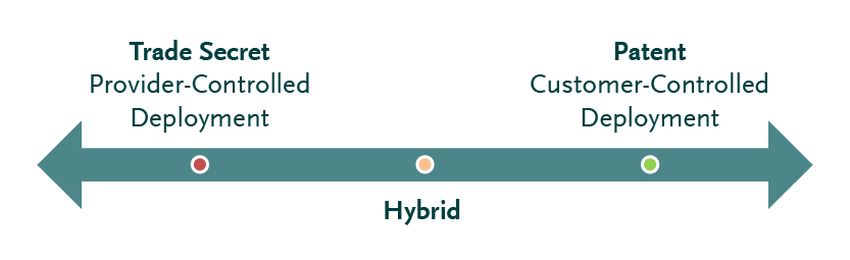
Where the deployment model is
customer-controlled, such as when the innovation
is licensed for use to the customer, sold as a stand-alone product
or deployed within a customer's own IT environment, patent
protection can play an important role. These delivery models
necessarily expose the technology to customers or integration
partners, increasing the risk that key aspects may be accessed,
replicated or reused. In such cases, patents provide enforceable
rights that extend beyond contractual use restrictions and
confidentiality obligations.
By contrast, where the deployment model is
provider-controlled, such as when the AI is
offered as a hosted SaaS service or used internally within the
company, access to the underlying implementation is more tightly
controlled. In these scenarios, trade secret protection may be more
suitable for certain aspects of the technology, particularly where
customers interact only with outputs rather than the system
itself.
|
Examples: Business Delivery Model
- Patents (Customer-Controlled Deployment): Financial
Risk-Scoring AI Platform
An AI risk-scoring platform that analyzes transaction data to
generate fraud or compliance scores and is deployed within a
financial institution's own IT environment.
Under this customer-controlled deployment model, the platform is
licensed to third-party financial institutions for local
installation and operation on their internal training data
repositories.
Because the developer does not retain operational control over the
deployed system, patent protection plays an important role in
protecting the core technology once it is transferred to customers
for independent use within their IT infrastructure.
- Trade Secrets (Provider-Controlled Deployment):
Logistics AI Optimization for Manufacturing
Workflows
An AI-based supply chain visibility platform offered to third-party
customers as a centrally hosted SaaS service. The platform ingests
logistics and operational data from multiple customers to provide
customer-specific real-time insights, forecasting and alerts. The
AI models and core system logic remain fully controlled and
operated by the provider.
In this example, customers may interact with the service through
dashboards and APIs but do not receive access to the underlying
models or deployment environment.
Because the provider retains control over the AI and its execution,
exposure to competitors is limited, making this deployment model
more conducive to protecting key aspects of the innovation as trade
secrets.
- Hybrid Approach (Patents/Trade Secrets): Retail
E-Commerce AI Recommendation Engine
A company develops an AI-based recommendation engine for the retail
e-commerce industry using a hybrid delivery model that combines
customer-controlled and provider-controlled elements.
The core recommendation engine is licensed to merchants and
integrated into their online storefronts, where it operates within
the merchant's environment to generate personalized product
recommendations based on local user behavior and product data. This
customer-controlled deployment exposes the system architecture and
integration interfaces to third parties, making this component well
suited to patent protection and external licensing.
At the same time, the company retains a provider-controlled AI
system that operates centrally across the platform. This internal
system analyzes aggregated interaction data across multiple
merchants to identify platform-level performance patterns and guide
ongoing product development. Because this functionality is never
deployed to customers and derives its value from cross-merchant
aggregation under the provider's control, it is not offered for
licensing and is better protected as a trade secret.
|
Applying the Decision Tool: Patents or Trade Secrets
For a further discussion of the decision framework and remaining
decision factors in the framework, please see the following:
Framework: Patents or Trade Secrets
Factor 1: Nature of AI Innovation
Factor 2: Enforceable Scope of Patent Protection
Factor 3: Reproducibility of AI Innovation
Factor 5: Commercial Longevity
Factor 6: Competitor Defensive Positioning
Factor 7: Patentability Potential and Layered
Strategies
If your organization needs assistance evaluating which aspects
of its AI innovation are better suited to patent protection versus
trade secret protection, our team can help. Our team can also
support patent filing and the development of a broader IP
strategy.
The content of this article is intended to provide a general
guide to the subject matter. Specialist advice should be sought
about your specific circumstances.