This article forms one part of a broader decision framework for
evaluating whether patent or trade secret protection is appropriate
for AI innovation.
The framework is designed to help decision-makers (e.g.,
innovators, in house, CTOs) align patent and IP strategy with
underlying business realities and moving beyond purely
"legal" considerations.
Defensive blocking considers whether a patent can
prevent others from patenting or controlling adjacent technical or
commercial space.
Defensive blocking matters for two main reasons: (i) to stop
competitors from obtaining AI patents that could later restrict
your ability to operate, and (ii) to provide leverage for
counter-assertion if a competitor brings a patent claim against
you.
This consideration also extends to the risk that competitors may
gain access to the technology through your former employees with
detailed knowledge of your systems (i.e., despite the internal
function of the system not being reproducible).
|
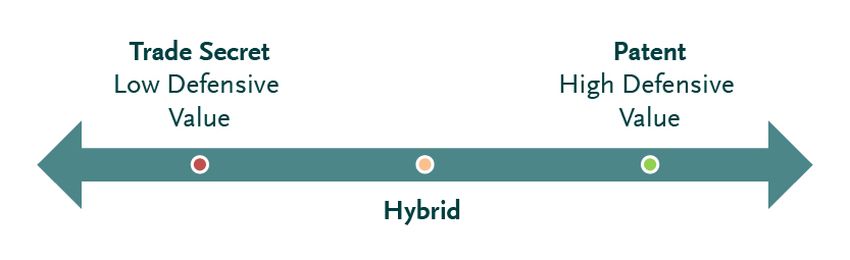
Examples: Competitor Defensive Positioning
- Patents (High Defensive Value): AI-Based Documentation
Classification and Compliance
An AI-based document classification or compliance analysis system
deployed in a highly competitive market, where multiple vendors are
developing similar solutions using overlapping techniques. Patents
in this space can block competitors from patenting incremental
variations and provide leverage in negotiations or disputes
involving overlapping rights.
- Trade Secrets (Low Defensive Value): Company-Specific
Maintenance Operations
An AI system used internally to optimize maintenance scheduling for
a company's proprietary equipment based on custom sensor
configurations and operational constraints. The use case is highly
specific to the company's internal processes and custom
hardware, with few external competitors and little incentive for
others to develop or patent similar solutions. This results in low
defensive value for patent protection and making trade secret
protection more appropriate.
- Hybrid Approach (Patents/Trade Secrets): AI for
Controlling Hydrogen Production with Client-Specific
Adaptations
A company offers a licensable AI-based control platform for
hydrogen production processes. The AI platform can manage
electrolysis or reforming operations using standard process data
including temperature, pressure and gas composition.
The platform is offered broadly in a competitive market with
multiple vendors providing similar AI-driven solutions. Patent
protection is used to cover the system-level application of AI for
monitoring and controlling hydrogen production. This provides
defensive value against competing platforms.
For individual customers, the platform is optionally further
adapted to account for site-specific equipment configurations, or
operating conditions, unique to a given hydrogen facility. These
customer-specific AI adaptations are novel but are tightly coupled
to the client's processes and provide little value outside that
context. Because non-client competitors have little incentive to
replicate them, these adaptations offer low defensive value and are
better protected as trade secrets.
|
Applying the Decision Tool: Patents or Trade Secrets
For a further discussion of the decision framework and remaining
decision factors in the framework, please see the following:
Framework: Patents or Trade Secrets
Factor 1: Nature of AI Innovation
Factor 2: Enforceable Scope of Patent Protection
Factor 3: Reproducibility of AI Innovation
Factor 4: Business Delivery Model
Factor 5: Commercial Longevity
Factor 7: Patentability Potential and Layered
Strategies
If your organization needs assistance evaluating which aspects
of its AI innovation are better suited to patent protection versus
trade secret protection, our team can help. Our team can also
support patent filing and the development of a broader IP
strategy.
The content of this article is intended to provide a general
guide to the subject matter. Specialist advice should be sought
about your specific circumstances.