
Overview: Who Qualifies for the GST/HST New Housing Rebate in 2026
If you have signed, or are about to sign, an agreement to buy a newly built home in Ontario, the HST you recover could be anything from nothing to $130,000. The difference usually comes down to a signing date, a price threshold, or whose name is on the purchase agreement, and not to whether you are buying your first home.
The GST/HST New Housing Rebate lets a purchaser recover part of the GST/HST paid on a newly built or substantially renovated home used as a primary place of residence. As of 2026, it is no longer a single program. At the federal level there is the standard rebate and the new first-time home buyers’ (FTHB) GST/HST rebate. In Ontario, the 8% provincial part of the HST is now covered by three overlapping rebates, one of which, the temporary Ontario enhanced new housing rebate, is available to every eligible purchaser and not only to first-time buyers. A separate Ontario payment can also cover the 5% federal part of the HST for purchasers who are not first-time buyers.
The rebate is also one of the more frequently litigated areas of GST/HST law, not because it is complicated, but because its eligibility conditions are strict, and the Canada Revenue Agency and the Tax Court have repeatedly denied claims that seemed, to the purchaser, entirely reasonable. This guide explains which rebates apply, how they interact, and the recurring ways claims get denied, with a link to our full case commentary on each decision.
Background: How the Federal and Ontario Rebates Fit Together
HST in Ontario is 13%: a 5% federal part and an 8% provincial part. Every rebate discussed below relieves one part or the other, never both at once, which is why several program names exist for what a buyer experiences as a single discount on closing.
The Standard GST/HST New Housing Rebate (Federal)
Under subsection 254(2) of the Excise Tax Act, a purchaser who buys a newly constructed or substantially renovated home from a builder, and who (or whose relation) acquires it for use as a primary place of residence, can recover part of the federal GST paid. This is the original rebate, and it remains available to any qualifying purchaser, first-time buyer or not. It is worth 36% of the GST paid, to a maximum of $6,300, on a home valued at $350,000 or less; it phases out between $350,000 and $450,000 and is not available above $450,000.
A purchaser who builds on land he or she already owns, or who substantially renovates an existing home, may also qualify under a related set of provisions. A renovation must generally remove or replace at least 90% of the interior of the building (other than the foundation, external walls, interior supporting walls, floors, roof and staircases) to count as “substantial.” An application must generally be filed within two years of the date ownership transfers, under subsection 254(3), using CRA Form GST190 for a home purchased from a builder or Form GST191 for an owner-built home. Ontario purchasers file the matching Ontario schedule with it: Form RC7190-ON or Form RC7191-ON.
A separate rebate, claimed on Form GST524, is available to landlords who purchase or build new residential rental property. It is a distinct program from the primary-residence rebate this guide otherwise covers, with its own eligibility rules and amounts.
The First-Time Home Buyers’ GST/HST Rebate (Federal, Bill C-4)
Bill C-4, the Making Life More Affordable for Canadians Act, received Royal Assent on March 12, 2026, and added a second, much larger federal rebate to the Excise Tax Act, available only to eligible first-time home buyers. The CRA is now accepting applications.
For a home purchased from a builder, the agreement of purchase and sale must be entered into on or after March 20, 2025 and before 2031, construction must begin before 2031 and be substantially completed before 2036, and ownership must transfer before 2036. The rebate eliminates 100% of the federal GST on a new or substantially renovated home valued up to $1,000,000 and phases out on a straight-line basis for homes valued between $1,000,000 and $1,500,000, disappearing entirely above that. The CRA’s own example is a $1,250,000 home at the midpoint of the phase-out, which yields a $25,000 rebate. The maximum benefit is $50,000, compared with the $6,300 cap under the standard rebate, and where both apply, the FTHB rebate operates as a top-up to the standard rebate.
To qualify, the purchaser must generally meet the conditions of the standard rebate, or would meet them if the $450,000 value limit were read as $1,500,000. The purchaser must also be the first individual to occupy the home as a place of residence after it is substantially completed, and neither the purchaser nor his or her spouse or common-law partner may previously have received an FTHB rebate.
“First-time home buyer” has its own statutory definition, and it is narrower than it sounds. The individual must be at least 18 years old and a Canadian citizen or permanent resident, and must not have lived, as a primary place of residence, in a home that he or she, or a spouse or common-law partner, owned or jointly owned (in or outside Canada) at any time in the current calendar year or the four preceding calendar years. For a home bought from a builder, the test is applied on the date ownership transfers, not on the date the agreement is signed.
This is a rolling window rather than a lifetime bar, and the closing date can decide the outcome. The CRA gives the example of a purchaser who sold a home he or she had lived in during June 2022: if ownership of the new home transfers in August 2026, the purchaser is not a first-time buyer, because 2022 falls within the four preceding calendar years; if ownership transfers in February 2027, the purchaser can qualify. Someone who owned a property during the window but rented it out without living in it was never disqualified in the first place, since the test turns on having lived in an owned home, not merely on having owned one.
Builders can credit the FTHB rebate directly against the purchase price at closing, the same way they do with the standard rebate. Some builders who signed agreements before Bill C-4 was finalized have instead required buyers to apply to the CRA directly after closing. That is a legitimate option under the rebate rules, but it means the buyer carries the cash-flow gap between closing and reimbursement, so it is worth confirming which approach a builder intends to take before relying on a closing-cost calculation.
Ontario’s Three Rebates for the 8% Provincial Part of the HST
Ontario now has three separate rebates that relieve the provincial part of the HST, and they are easy to confuse.
- The Ontario new housing rebate is the long-standing provincial rebate. It refunds 75% of the provincial part of the HST, to a maximum of $24,000, with no home-value ceiling, provided the home is the purchaser’s (or a relation’s) primary place of residence.
- The Ontario first-time home buyers’ rebate provides up to $80,000 of the provincial part of the HST to eligible first-time buyers. It follows the eligibility conditions of the federal FTHB rebate, including the March 20, 2025 start date, and it tops up the standard Ontario rebate rather than replacing it. The CRA is now accepting claims.
- The Ontario enhanced new housing rebate (ENHR) is a temporary measure, announced by Ontario on March 25, 2026, that is open to all eligible purchasers, not only first-time buyers. Together with the standard Ontario rebate, it provides combined relief of up to $80,000 of the provincial part of the HST on a new or substantially renovated home valued up to $1,850,000.
The Ontario Enhanced New Housing Rebate: Open to All Eligible Buyers
The ENHR is the measure most often misdescribed as a first-time buyer program. It is not one. A purchaser who has owned homes before, including someone upsizing or downsizing into a new build, can qualify, provided the usual conditions of the Ontario new housing rebate are met and the home is acquired for use as the purchaser’s or a relation’s primary place of residence.
For a home purchased from a builder, CRA Notice 346 sets out the additional conditions:
- the agreement of purchase and sale is entered into on or after April 1, 2026 and on or before March 31, 2027;
- construction or substantial renovation begins on or before December 31, 2028 and is substantially completed on or before December 31, 2031;
- the total consideration payable is less than $1,850,000; and
- the HST on the purchase becomes payable on or before December 31, 2032.
For an owner-built home, construction or substantial renovation must begin between April 1, 2026 and March 31, 2027 and be substantially completed before 2030. Higher value limits ($2,090,500) apply to homes on leased land and to co-op shares.
| New home value | Ontario ENHR amount (provincial part of the HST) |
|---|---|
| Up to $1,000,000 | Full rebate of the 8% provincial part, up to $80,000 |
| Above $1,000,000 up to $1,500,000 | Flat rebate of $80,000 |
| Above $1,500,000 and below $1,850,000 | Partial rebate, declining with price |
| $1,850,000 and above | No ENHR; only the standard Ontario rebate of up to $24,000 |
A purchaser who is eligible for both the ENHR and the Ontario first-time home buyers’ rebate may claim either or both, but the total of all rebates of the provincial part of the HST cannot exceed the lesser of $80,000 and the provincial part of the HST actually payable. The two provincial rebates do not stack past that ceiling.
The Ontario New Home Affordability Payment: Relief for the 5% Federal Part
The headline figure of $130,000 is $80,000 of provincial relief plus up to $50,000 of relief corresponding to the 5% federal part of the HST. For a first-time buyer, that federal-part relief comes mainly from the federal FTHB rebate. For every other eligible purchaser, it comes from the Ontario New Home Affordability Payment (ONHAP), a separate payment funded and administered by the Province of Ontario rather than a federal rebate.
The ONHAP provides up to $50,000 to individuals who are entitled to the ENHR. It is reduced by the federal part of any GST/HST new housing rebate or FTHB rebate to which the purchaser is entitled, so it fills the gap the federal rebates leave rather than paying the same tax twice. A purchaser eligible for the FTHB rebate must claim it first. No separate application is required: the purchaser completes the ONHAP consent section on the GST/HST new housing rebate application, the CRA shares the information with Ontario once the application is assessed, and Ontario issues the payment separately. A builder can also pay or credit the ONHAP on closing and recover it from Ontario.
Rental Properties and the Other Provinces
Ontario has also announced an enhanced rebate for new residential rental property. The CRA has said a separate notice on the Ontario enhanced new residential rental property rebate is expected by October 2026, and landlords should confirm the final conditions before relying on it.
Outside Ontario, the provincial portion of the rebate, where one exists at all, is set independently by each province. New Brunswick, Newfoundland and Labrador, and Prince Edward Island each offer their own provincial new housing rebate calculated as a percentage of the provincial portion paid, subject to their own value thresholds, and as of this writing none has announced an enhancement comparable to Ontario’s. Nova Scotia offers a separate provincial rebate for qualifying first-time buyers of a newly built home, meaningfully smaller than Ontario’s.
British Columbia does not charge HST at all, only the federal 5% GST, and has no provincial new housing rebate; BC purchasers rely on the federal rebates alone, though BC offers its own newly-built-home property transfer tax exemption under entirely different legislation, which is not a GST/HST rebate. Alberta, Saskatchewan, Manitoba and the territories also charge GST only, with no provincial new housing rebate of any kind.
Quebec charges GST and its own QST separately, and offers a parallel QST new housing rebate administered by Revenu Québec rather than the CRA. A purchaser should not assume that the rules in one province, including Ontario’s relatively generous combination, apply anywhere else without checking the specific rules where the home is located.
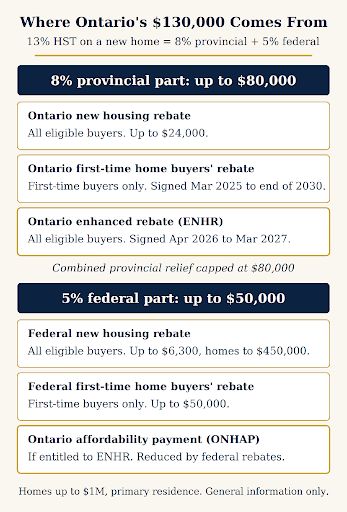
Figure: Where Ontario’s $130,000 comes from: the rebates for the 8% provincial part and the 5% federal part of the HST.
Key Issues and Findings: The Recurring Ways Rebate Claims Get Denied
Nearly every element of the rebate, from who counts as a “particular individual,” to what “primary place of residence” actually requires, to what happens when circumstances change after closing, has produced real disputes. The case law below developed under the standard rebate, but the same eligibility concepts apply to the FTHB rebate, the Ontario first-time home buyers’ rebate and the ENHR, all of which build on the standard rebate’s conditions.
A Co-Signer or Bare Trustee Who Does Not Qualify
Subsection 254(2) requires every individual who signs the purchase agreement as a purchaser, not just the one who intends to live in the home, to independently satisfy the rebate conditions. Adding a friend, relative or bare trustee to the agreement purely to help secure mortgage financing can defeat the entire rebate if that co-signer never intends to occupy the property.
This was the central holding of The Queen v Cheema, 2018 FCA 45, where the Federal Court of Appeal denied the rebate because a bare trustee who signed to help with financing did not himself qualify, and the Supreme Court of Canada later denied leave to appeal. Our case comment on Cheema and the bare trustee problem covers the decision, its aftermath, and how to structure a co-signing arrangement to avoid the same trap.
The same problem defeated the rebate in Reeves v The Queen, 2021 TCC 74, where the purchaser’s aunt signed the agreement. The Tax Court held that an aunt does not fall within the statutory definition of a qualifying “relation,” so her presence on the agreement, without herself qualifying, denied the rebate. Our case comment on Reeves and the co-signing relative problem explains which family relationships do and do not qualify.
Lack of Intent to Occupy the Property First
The purchaser must acquire the home with the intention of using it as a primary place of residence at the time he or she becomes liable under the purchase agreement, not merely at some later point. In Osman v The King, 2025 TCC 65, the purchaser had already been living elsewhere with family, moved only a few items into the new property, and continued to live substantially at her existing residence while tenants occupied the new home. The Tax Court denied the rebate because the evidence did not establish the required intention. Our case comment on Osman and the intention-to-occupy requirement sets out what evidence the Court looked for and found lacking.
House-Flipping Intent
A purchaser who buys intending to resell at a profit, rather than to occupy the property, does not qualify, regardless of how the transaction is documented. In Ram v The King, 2025 TCC 49, the Tax Court confirmed that a purchaser whose real intention was to hold the property as an investment could not claim the rebate. Our case comment on Ram and house-flipping intent covers the factors the Court weighed.
Primary Residence Intent Disputes and Quick Resales
A purchaser who resells shortly after closing does not automatically lose the rebate, provided the original intention to occupy the property as a primary place of residence was genuine at the time of purchase. In Lisi v The King, 2025 TCC 106, the Tax Court accepted that two brothers who each sold within months of closing had intended to live in their homes when they bought them. Life circumstances that change after closing, such as illness, relationship breakdown or an employment change, do not retroactively erase a genuine initial intention. Our case comment on Lisi and primary residence intent sets out the contemporaneous documentation that helps establish intent. For more recent examples of how the Tax Court weighs this evidence, see our commentary on Xian v The King, 2026 TCC 122 and Sharma v The King, 2025 TCC 145.
New Traps Under the 2025 and 2026 Enhancements
The new rebates add timing and anti-avoidance rules that did not matter under the standard rebate alone.
- Amended agreements. If an agreement signed before April 1, 2026 is later varied, altered or assigned, it is deemed for ENHR purposes to have been entered into before April 1, 2026, so the ENHR is not available. The purchaser may still qualify for the standard Ontario rebate or the Ontario first-time home buyers’ rebate.
- Terminating and re-signing. A purchaser who cancels a pre-April 2026 agreement and signs a new one with the same builder, or with a person not dealing at arm’s length with the builder, can be deemed to have signed the new agreement before April 2026, unless it can reasonably be considered to have been entered into primarily for bona fide purposes other than obtaining the ENHR.
- Assignment sales. An assignee qualifies for the ENHR only if both the original agreement and the assignment agreement fall within the April 1, 2026 to March 31, 2027 window.
- Builder credits. Where a builder credits a rebate on closing and knew or ought to have known that the purchaser was not entitled to it, the builder and the purchaser are jointly and severally liable to repay it to the CRA. A credit on the statement of adjustments is not a CRA approval.
- Price cliffs. The FTHB rebate phases out between $1,000,000 and $1,500,000, while the ENHR phases out between $1,500,000 and $1,850,000. Upgrades, lot premiums and change orders count toward the price.
When Purchasers Have Successfully Fought Back
Not every rebate dispute ends in the CRA’s favour. In Simonetta v The King, 2023 TCC 54, the Tax Court found that the vendors had built and sold the home as an adventure in the nature of trade, so the sale was subject to HST included in the price, and that the purchaser’s inability to obtain the vendors’ builder information and signatures for the application did not defeat her claim. Our case comment on Simonetta‘s successful rebate claim is a reminder that a CRA denial, or even resistance from the other side of the transaction, is not necessarily the final word. The builder question also runs the other way: individuals who build and sell a home can themselves be treated as builders who owe HST, as our commentary on Salehi v The King and on building and selling a house explains.
Practical Implications for Ontario Home Buyers and Builders
For a first-time buyer purchasing a new home in Ontario valued at $1,000,000 or less, the federal FTHB rebate and the Ontario first-time home buyers’ rebate together can eliminate the full 13% HST, up to $130,000. That combination is available for agreements signed from March 20, 2025 until the end of 2030, so it does not depend on the ENHR’s one-year window.
For a buyer who is not a first-time buyer, the ENHR and the ONHAP can produce the same $130,000 result, but only for agreements signed between April 1, 2026 and March 31, 2027. After that date, unless the program is extended, a repeat buyer falls back to the standard rebates: up to $24,000 on the provincial part, and a federal rebate only on homes valued at $450,000 or less.
For builders, the ENHR and the ONHAP can now be credited on closing. Builders deduct the 8% provincial portion on their GST/HST return, but must still remit the 5% federal portion and recover the ONHAP separately from Ontario after the CRA assesses the application, which creates a cash-flow gap that should be reflected in pricing and in the agreement’s rebate assignment clauses. Because of the joint and several liability rule, a builder’s eligibility screening also protects the purchaser.
Takeaway: Match the Rebate to the Signing Date, the Price and the Purchasers
The GST/HST New Housing Rebate is now a family of rebates, and in Ontario the largest of them is no longer limited to first-time buyers. The questions that decide the amount are when the agreement was signed, what the home costs including upgrades, whether each person on the agreement independently qualifies, and whether the intention to live in the home can be documented. The recurring litigation traps, a co-signer who does not independently qualify, an intention to occupy that cannot be proven, an underlying intention to flip, and disputes over whether a later resale erases an earlier genuine intent, apply to every one of the new programs. Purchasers who work through these questions before signing and before closing, rather than after a CRA review, are in a far better position to claim the rebate correctly and to defend it if challenged.
Pro Tax Tips: Protecting Your New Housing Rebate Before You Sign
- Before adding anyone to a purchase agreement as a co-signer, confirm whether that person independently satisfies the rebate conditions, or keep him or her off the purchase agreement entirely and limit the involvement to the mortgage documents. This single structuring decision is behind more denied rebates than any other issue in this guide, and it applies equally to the new first-time buyer and enhanced Ontario rebates.
- If you are buying in Ontario and are not a first-time buyer, the date on your agreement of purchase and sale matters more than anything else. The enhanced rebate and the ONHAP require an agreement signed between April 1, 2026 and March 31, 2027. Do not amend, assign or cancel and re-sign an agreement signed before April 1, 2026 in the hope of qualifying without advice from an experienced Canadian tax lawyer, since the deeming rules are designed to catch exactly that.
- If you are a first-time buyer, check the first-time buyer test against your expected closing date, not your signing date, particularly if you sold a home you lived in within the last few years. A delayed closing can move you into or out of the rolling five-year window. And if the home’s price is near $1,000,000, $1,500,000 or $1,850,000, get the purchase price and closing structure reviewed before signing, since an upgrade or lot premium can reduce or eliminate tens of thousands of dollars in relief.
- Document your intention to occupy the property at the time of purchase, not after a CRA review begins: utility hookups, address changes, moving invoices and insurance policies in your name at the property all help substantiate a claim later.
- When you sign the rebate application, complete the ONHAP consent section if it applies to you. If you closed after March 20, 2025 and claimed only the standard rebates, review whether a first-time buyer top-up claim is still available within the two-year filing limit.
- And if the CRA denies a claim you believe was legitimate, do not assume the denial is final; as Simonetta shows, a properly supported objection can succeed.
“Every one of these cases starts the same way: a purchaser genuinely believed he or she qualified, and found out only after closing, or after a CRA review, that the details of how the deal was structured mattered enormously,” says David J. Rotfleisch, founding tax lawyer and CPA at Rotfleisch & Samulovitch, and a Law Society of Ontario Certified Specialist in Taxation. “The rebate rules aren’t actually inconsistent from case to case. They’re just a lot less forgiving of casual assumptions than most purchasers expect, and that’s exactly why it’s worth getting this reviewed before you close, not after the CRA asks questions.”
“The new rebates are genuinely bigger benefits, but they layer new eligibility questions on top of the ones that have been generating litigation for years,” Rotfleisch adds. “Ontario’s enhanced rebate is not a first-time buyer program, so a buyer who has owned homes before should not assume he or she is shut out. But first-time buyer status has its own definition, the price thresholds create real cliff edges worth tens of thousands of dollars, and the enhanced rebate depends on a signing window that closes on March 31, 2027. None of that makes the older co-signer and intention traps go away; it just means there are now more programs to get right instead of one.”
FAQs: GST/HST New Housing Rebate and Ontario HST Rebates
How much is the GST/HST New Housing Rebate worth in 2026?
It depends which programs apply and where the home is. The standard federal rebate is worth up to $6,300 and applies only to homes valued at $450,000 or less. Eligible first-time buyers can instead receive up to $50,000 federally on homes up to $1,000,000, phasing out by $1,500,000. In Ontario, provincial relief ranges from the standard $24,000 up to $80,000 under either the Ontario first-time home buyers’ rebate or the Ontario enhanced new housing rebate, and combined federal-part and provincial-part relief can reach $130,000.
Is Ontario’s enhanced HST rebate only for first-time home buyers?
No. The Ontario enhanced new housing rebate is available to all eligible purchasers who sign an agreement of purchase and sale with a builder between April 1, 2026 and March 31, 2027, whether or not they have owned a home before. The home must still be acquired for use as the purchaser’s or a relation’s primary place of residence, and the other conditions of the Ontario new housing rebate must be met. Ontario’s separate first-time home buyers’ rebate is the program limited to first-time buyers.
How can a buyer who is not a first-time buyer get up to $130,000 in Ontario?
Through two programs working together. The Ontario enhanced new housing rebate provides up to $80,000 for the 8% provincial part of the HST, and the Ontario New Home Affordability Payment provides up to $50,000 corresponding to the 5% federal part. On a qualifying home valued up to $1,000,000 with an agreement signed in the April 1, 2026 to March 31, 2027 window, the two together can cover the full 13% HST.
Can I claim both the Ontario first-time home buyers’ rebate and the enhanced rebate?
You may claim either or both if you qualify for each, but the total of all rebates of the provincial part of the HST cannot exceed the lesser of $80,000 and the provincial HST actually payable. In practice, the two programs overlap rather than stack.
What is the Ontario New Home Affordability Payment (ONHAP)?
It is a payment of up to $50,000, funded and administered by the Province of Ontario, for purchasers who are entitled to the Ontario enhanced new housing rebate. It is reduced by the federal part of any GST/HST new housing rebate or first-time home buyers’ rebate you are entitled to, so first-time buyers must claim the federal FTHB rebate first. No separate application is needed; you complete the ONHAP consent section on your GST/HST new housing rebate application.
I signed my agreement before April 1, 2026. Can I still get the enhanced rebate?
Generally not. An agreement entered into before April 1, 2026 that is later varied, altered or assigned is deemed to have been entered into before that date for enhanced rebate purposes. You may still qualify for the standard Ontario rebate and, if you are a first-time buyer, the Ontario first-time home buyers’ rebate and the federal FTHB rebate.
Can I cancel my agreement and sign a new one to qualify for the enhanced rebate?
This is risky. If you, or someone not dealing at arm’s length with you, sign a new agreement with the same builder or a related party after terminating a pre-April 2026 agreement, the new agreement can be deemed to have been signed before April 2026 unless it was entered into primarily for bona fide reasons other than obtaining the rebate. Get advice before terminating any agreement.
Does the enhanced Ontario rebate apply to assignment sales?
Only if both the original agreement of purchase and sale and the assignment agreement are entered into between April 1, 2026 and March 31, 2027, and all other conditions are met.
What is the new First-Time Home Buyers’ GST Rebate under Bill C-4?
A separate, larger federal rebate that received Royal Assent on March 12, 2026 and is available only to eligible first-time buyers. It eliminates GST on new homes valued up to $1,000,000 and phases out by $1,500,000, for agreements signed on or after March 20, 2025 and before 2031. It operates alongside, and as a top-up to, the standard rebate, which remains available to purchasers who are not first-time buyers.
If I owned a home years ago but no longer do, can I still qualify as a first-time buyer?
Often yes. The test asks whether you lived, as your primary place of residence, in a home you or your spouse or common-law partner owned during the current calendar year or the four preceding calendar years, measured on the date ownership of the new home transfers to you. If your last relevant ownership and occupancy falls outside that window, or if you owned a property during the window but never lived in it yourself, you have not necessarily been disqualified. You also cannot qualify if you or your spouse or partner previously received an FTHB rebate.
Will the builder automatically credit the rebates at closing?
Not always. Builders can credit the federal rebates, the Ontario rebates and the ONHAP on closing, but some builders, particularly on agreements signed before the new rules were finalized, require buyers to apply to the CRA directly after closing. Confirm the builder’s approach, and the rebate clauses in your agreement, before assuming the rebates will reduce your closing costs. If a builder credits a rebate you were not entitled to, you can be required to repay it.
How do I apply to the CRA directly if my builder does not credit the rebate?
For a home purchased from a builder, use Form GST190, GST/HST New Housing Rebate Application for Houses Purchased from a Builder, together with Form RC7190-ON, the Ontario rebate schedule. For an owner-built home, use Form GST191 with Form RC7191-ON. The application is generally supported by the purchase agreement, the statement of adjustments and, for the first-time buyer rebates, documentation of your eligibility. If you are eligible for the ONHAP, complete its consent section on the same form.
How long do I have to apply for the rebate?
Generally, two years from the date ownership of the home transfers to you, under subsection 254(3) of the Excise Tax Act.
Can a Canadian citizen who has become a non-resident still qualify?
Citizenship and tax residence are not the same thing, and the first-time buyer rules turn on citizenship or permanent residence, not on where you currently live for tax purposes. A Canadian citizen who has become a non-resident does not fail the citizenship requirement simply by living abroad. However, every one of these rebates independently requires the home to be acquired for use as the buyer’s primary place of residence, and the first-time buyer rebates require the buyer to be the first to occupy it. A non-resident who buys a qualifying home without actually moving back to Canada to live in it is likely to fail those requirements regardless of citizenship. We have not found this fact pattern addressed directly in CRA guidance, so confirm it with a tax lawyer on the specific facts.
Does the provincial portion of the rebate work the same way outside Ontario?
No. New Brunswick, Newfoundland and Labrador, and Prince Edward Island each have their own provincial rebate rules. Nova Scotia’s provincial rebate is limited to first-time buyers of new homes. British Columbia charges no HST and has no equivalent provincial new housing rebate, though it has a separate property transfer tax exemption. Quebec administers its own parallel QST rebate through Revenu Québec.
Can I add a co-signer to my purchase agreement to help qualify for a mortgage without losing the rebate?
Only if that co-signer also independently satisfies the rebate conditions, or if he or she is kept off the purchase agreement entirely and limited to the mortgage documents. A family relationship does not automatically help: the co-signer must fall within the statutory definition of a qualifying “relation,” and an aunt, for example, does not, as Reeves v The Queen confirms.
If I sell my home shortly after buying it, do I lose the rebate?
Not automatically. What matters is your intention at the time you became liable under the purchase agreement. If that intention was genuinely to occupy the home as your primary place of residence, a later, unrelated life change that forces an earlier-than-planned sale does not retroactively disqualify the claim, as Lisi v The King illustrates.
What evidence helps prove my intention to occupy a home as my primary residence?
Contemporaneous records made at or near the time of purchase and closing: utility account changes, address updates, moving invoices, insurance policies and similar documentation. Evidence created after a CRA review begins is far less persuasive than records that already existed.
Can I still win if the CRA has already denied my rebate claim?
Yes, in appropriate cases. In Simonetta v The King, 2023 TCC 54, a purchaser recovered a rebate after a denial even though the vendors had disputed the property’s eligibility and would not complete their part of the application.
Does Ontario’s enhanced rebate apply to rental properties?
Not the primary-residence rebate discussed in this guide. Ontario has announced a parallel enhanced rebate for new residential rental property, and the CRA expects to publish a separate notice on it by October 2026. Landlords should review that notice before relying on the enhanced rental rebate.
Should I get legal advice before closing if I’m relying on these rebates?
Given how many well-intentioned purchasers have lost the rebate over structuring details, documentation gaps or disputes over intent, and how much more money now turns on signing dates and price thresholds, it is generally worth having the transaction and rebate eligibility reviewed by an experienced Canadian GST/HST lawyer before signing and before closing, not after a CRA denial.
The content of this article is intended to provide a general guide to the subject matter. Specialist advice should be sought about your specific circumstances.
[View Source]