
- within Litigation and Mediation & Arbitration topic(s)
- with Senior Company Executives, HR and Inhouse Counsel
- in China
- with readers working within the Property and Law Firm industries
Article Summary
Commercial disputes do not automatically require court proceedings. In fact, many business disputes are resolved through strategic negotiation, mediation or carefully structured settlement agreements long before a trial becomes necessary. For most businesses, an early commercial resolution is often faster, less expensive and provides greater certainty than prolonged litigation.
The key to a successful settlement is preparation rather than compromise. Businesses that understand their contractual rights, evaluate the strength of their evidence and adopt a well-planned negotiation strategy are generally in a far stronger position to achieve a favourable outcome. Effective early action may include issuing a properly drafted letter of demand, engaging in solicitor-led negotiations, participating in mediation, making a Calderbank or formal settlement offer, or relying on contractual and statutory rights to encourage resolution.
A legally binding settlement is itself a contract (or deed) and, when properly documented, can bring disputes to a final and enforceable conclusion without the cost, delay and uncertainty associated with a contested trial. Even after court proceedings have commenced, settlement remains available and is frequently encouraged by the courts as a practical means of resolving disputes efficiently.
In this guide, our commercial litigation lawyers explain the principal methods of settling commercial disputes without going to court, the legal principles that govern enforceable settlements, the strategic use of negotiation and settlement offers, and the common mistakes that can undermine an otherwise strong commercial position. Whether you are attempting to recover a debt, resolve a contractual disagreement or protect an ongoing business relationship, understanding these principles will help you make informed decisions and maximise the prospects of achieving an effective commercial outcome.
Table of Contents
How to Settle a Commercial Dispute Without Going to Court
Yes. Many commercial disputes can be settled without a final court hearing, and in appropriate cases doing so may produce the most effective commercial outcome. Court proceedings should usually be viewed as one option rather than the starting point, as early legal strategy often preserves business relationships, reduces legal costs and gives the parties greater control over the result. Delaying meaningful negotiations, however, can increase costs, harden positions and reduce settlement opportunities if litigation becomes necessary.
Depending on the circumstances, disputes may be resolved through direct negotiation, solicitor-led discussions, formal settlement offers, mediation or a carefully drafted settlement agreement. When properly documented, a settlement can be legally binding and provide substantial commercial certainty while avoiding much of the expense and disruption of litigation. Unlike a court judgment, however, a private settlement may require separate enforcement proceedings if one party fails to comply, unless its terms have been embodied in enforceable court orders. If you require assistance with these issues, contact one of our experienced commercial litigation professionals today for a free consultation.
Can You Settle a Commercial Dispute Without Going to Court?
Yes. Australian law does not require parties to commence litigation simply because a commercial dispute has arisen.
Subject to any contractual dispute resolution clause, parties generally remain free to negotiate a settlement. Many commercial contracts contain dispute resolution clauses requiring negotiation, mediation, expert determination or another specified process before court proceedings are commenced. Whether such a clause operates as an enforceable condition precedent depends on its wording and construction, and it may preserve a party’s right to seek urgent interlocutory relief. The relevant provisions should therefore be reviewed at the outset of the dispute.
This flexibility reflects the principle of contractual freedom, allowing commercial parties to resolve disputes on mutually acceptable terms rather than leaving the outcome entirely to the court.
In practice, early settlement is often commercially preferable. Resolving a dispute before litigation escalates can reduce legal costs, minimise disruption to day-to-day business, preserve valuable commercial relationships, maintain confidentiality and give the parties greater control over the outcome. Even where proceedings have already commenced, settlement may avoid significant additional costs and uncertainty.
A settlement agreement is itself a contract and must satisfy the ordinary requirements for an enforceable agreement. If there is uncertainty about whether a legally binding contract exists at all, our guide on Enforcing Payment of a Debt Without a Contract explains the contractual and alternative legal principles that may still permit recovery.
Whether parties intended to create legally binding obligations is assessed objectively by reference to what they said and did, viewed in context, rather than merely by reference to their undisclosed intentions. This objective approach was explained by McHugh JA in Air Great Lakes Pty Ltd v KS Easter (Holdings) Pty Ltd [1989] 2 NSWLR 309 at 332:
The proper view is, in my opinion, that the existence of a contract is a consequence which the law imposes upon, or sees as a result of, what the parties have said and done. Actual subjective intention to contract is a factor which the law takes into account in determining whether a contract exists but it is not, or not always, the determining factor…
Equally, the High Court has recognised that whether negotiations result in an immediately binding agreement depends upon the parties’ objectively assessed intention and the language they have used, particularly where they contemplate later formal documentation in Masters v Cameron (1954) 91 CLR 353.
Dixon CJ, McTiernan and Kitto JJ observed at 360-361:
…Where parties who have been in negotiation reach agreement upon terms of a contractual nature and also agree that the matter of their negotiation shall be dealt with by a formal contract, the case may belong to any one of three classes… The question depends upon the intention disclosed by the language the parties have employed, and no special form of words is essential to be used in order that there shall be no contract binding upon the parties before the execution of their agreement in its ultimate shape…
How to Settle a Dispute Before Litigation
Not every commercial dispute should be handled in the same way. Some matters can be resolved through direct discussions, while others require mediation or, ultimately, court proceedings. Understanding the advantages and limitations of each option helps businesses choose the most commercially effective strategy before legal costs escalate. The comparison below provides a practical overview of the most common dispute resolution methods used in Australian commercial disputes.
| Resolution Method | Best Used When | Advantages | Potential Limitations |
| Direct Negotiation | The parties remain willing to communicate | Fast, inexpensive, preserves relationships | May fail where positions are entrenched |
| Solicitor Negotiation | Legal issues require professional guidance | Stronger legal positioning, structured negotiations | Higher upfront legal costs |
| Without Prejudice Discussions | Parties want to negotiate openly | Encourages candid settlement discussions | Privilege is subject to recognised exceptions |
| Mediation | Communication has broken down but settlement remains possible | Independent facilitator, flexible commercial outcomes | Requires both parties to participate genuinely |
| Expert Determination | Technical or specialist issues are in dispute | Fast resolution of technical questions | Usually limited to defined issues |
| Court Proceedings | Judicial determination or urgent relief is required | Binding judicial determination with established enforcement mechanisms | Can be expensive and time-consuming; proceedings are generally public, subject to limited exceptions |
Start With a Clear Assessment of the Dispute
Effective settlement begins with an objective assessment of the dispute rather than an immediate demand for payment or compensation. Where the dispute concerns an unpaid invoice, our guide on Refusing to Pay an Invoice: When a Dispute Justifies Non-Payment explains when withholding payment may be legally justified and when it may expose a business to litigation.
Before entering negotiations, consider the strength of your legal position, the available evidence, the terms of the relevant contract, the likely cost of litigation and your broader commercial objectives. It is also important to identify any applicable limitation periods, as delaying negotiations should never jeopardise your ability to commence proceedings if settlement cannot be achieved.
Can I negotiate before sending a legal demand?
Yes. Parties may negotiate at any stage, but understanding the legal merits of the dispute before making concessions usually leads to stronger and more informed negotiations.
Send a Proper Letter of Demand
A carefully prepared letter of demand often provides the foundation for productive negotiations. For practical guidance on preparing an effective demand before litigation, see our detailed article on Letters of Demand, including common drafting mistakes and strategic considerations before commencing proceedings.
It should clearly identify the relevant facts, contractual or legal basis of the claim, the remedy sought and a realistic timeframe for responding. A well-drafted letter also demonstrates that the sender has acted reasonably if litigation later becomes necessary. If you have received a demand instead of sending one, our article on How to Respond to a Letter of Demand in Queensland explains when a demand should be disputed and how an early response may improve your negotiating position.
In practice, one of the most common mistakes I see is businesses sending emotional or aggressive correspondence that escalates the dispute unnecessarily. Allegations should remain factual, remedies should be clearly expressed and unrealistic deadlines should generally be avoided.
Explore Early Resolution Options
If the dispute is not resolved immediately, parties should consider direct negotiations, solicitor-assisted discussions, without prejudice negotiations, mediation or, where the contract provides, expert determination. Early commercial compromise often produces more flexible outcomes than a court judgment, including revised payment arrangements, contract variations or agreed releases.
Where litigation later becomes necessary, settlement offers and the parties’ conduct may have costs consequences. Chapter 9, part 5 of the Uniform Civil Procedure Rules 1999 (Qld) establishes a formal offer-to-settle regime, and rule 5 states that the purpose of the rules is to facilitate the just and expeditious resolution of the real issues in civil proceedings at a minimum of expense.
For that reason, businesses that engage constructively before proceedings are frequently in a stronger strategic position if court proceedings ultimately cannot be avoided.
How to Pressure the Other Side Without Going to Court
Businesses are often unsure how far they can go when encouraging the other party to settle. While the law permits firm commercial negotiation, it also imposes clear limits on misleading threats, unconscionable conduct and improper pressure. This infographic provides a practical comparison that helps readers distinguish legitimate negotiation tactics from conduct that may create additional legal risks.
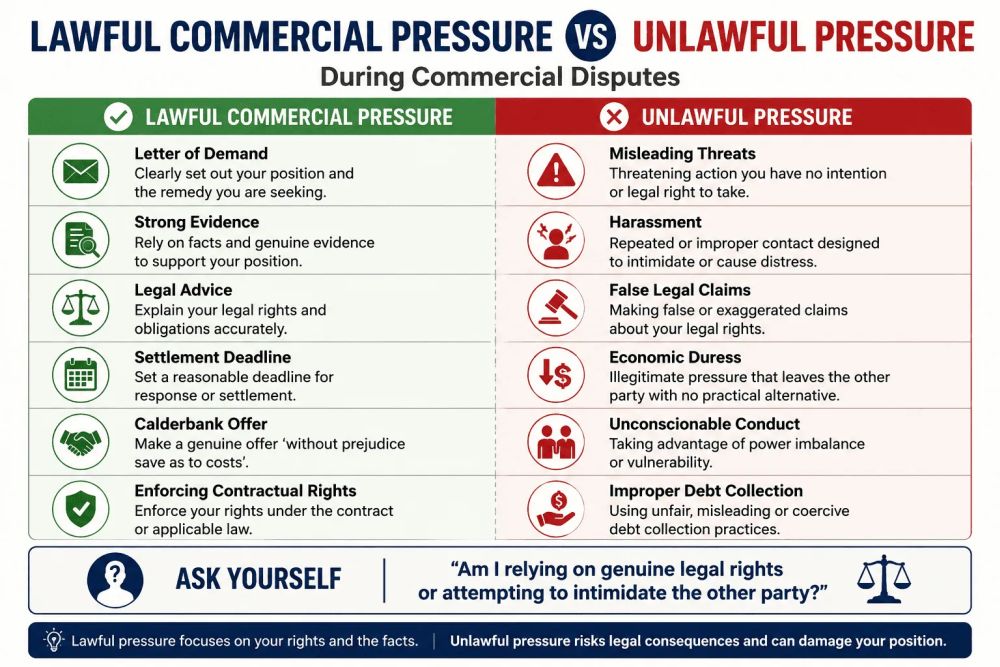
Applying commercial pressure is a legitimate part of resolving business disputes, provided it remains lawful. The objective is not to intimidate the other party but to demonstrate that continuing the dispute carries legal and commercial consequences. Effective pressure may include presenting strong documentary evidence, obtaining legal advice, issuing a well-supported letter of demand, foreshadowing court proceedings where appropriate, imposing reasonable settlement deadlines, making a Calderbank offer, relying on contractual rights or drawing attention to security interests or other statutory rights.
Businesses should avoid tactics that cross the line into misleading threats, harassment, unconscionable conduct, unlawful debt collection practices or economic duress. Conduct that is improper may weaken a party’s negotiating position and, in some cases, expose it to separate legal claims.
The High Court’s decision in Commercial Bank of Australia Ltd v Amadio (1983) 151 CLR 447 illustrates the equitable doctrine of unconscionable dealing, under which relief may be available where one party is subject to a special disadvantage that seriously affects that party’s ability to make a judgment in their own interests, and the other party knowingly takes unconscientious advantage of that disadvantage.
Mason J explained the relevant special disadvantage at 462:
…the disabling condition or circumstance is one which seriously affects the ability of the innocent party to make a judgment as to his own best interests, when the other party knows or ought to know of the existence of that condition or circumstance and of its effect on the innocent party.
In applying the principle to the facts, Mason J stated at 467:
As we have seen, if A having actual knowledge that B occupies a situation of special disadvantage in relation to an intended transaction, so that B cannot make a judgment as to what is in his own interests, takes unfair advantage of his (A’s) superior bargaining power or position by entering into that transaction, his conduct in so doing is unconscionable.
In Australian Competition and Consumer Commission v CG Berbatis Holdings Pty Ltd (2003) 214 CLR 51 at [11], Gleeson CJ explained that inequality of bargaining power does not, by itself, establish the relevant disadvantage required for unconscionable conduct. His Honour distinguished unconscientious exploitation of another party’s inability or diminished ability to protect their own interests from the legitimate use of a superior bargaining position.
In practice, the most persuasive leverage is usually the credibility of your legal position. Businesses that rely on evidence, realistic settlement proposals and clearly identified legal rights are generally far more successful than those that resort to aggressive or inflammatory tactics.
Negotiation Strategies in Contract Disputes
Effective negotiation without going to court requires more than asking the other side to compromise. Businesses should understand their evidence, likely litigation costs, enforcement risks, commercial objectives and fallback options before deciding whether to negotiate, mediate, issue a demand or make a formal settlement offer.
Understand Your Best Alternative
Successful commercial negotiations begin with a realistic assessment of your alternatives if settlement cannot be reached. In practice, experienced litigators assess not only the legal merits of a claim but also whether any negotiated outcome will be enforceable. A favourable settlement has limited commercial value if the other party lacks the capacity to perform its obligations or if security for payment has not been adequately considered.
This includes estimating likely litigation costs, considering whether any judgment could realistically be enforced, assessing insolvency risks and deciding whether preserving the commercial relationship has ongoing value. Understanding these factors helps determine when to compromise and when to pursue stronger enforcement options.
Focus on Commercial Outcomes Rather Than Legal Positions
The most effective settlements often address commercial objectives rather than strict legal rights. Depending on the dispute, parties may agree to payment plans, staged performance of contractual obligations, revised delivery arrangements, contract variations, mutual releases or confidentiality obligations. These practical solutions can preserve business relationships while avoiding the uncertainty and expense of litigation.
Keep Negotiations Protected
Genuine settlement communications are commonly made on a “without prejudice” basis. At common law, the protection generally prevents admissions or concessions genuinely made in an attempt to resolve a dispute from being used as evidence of liability in later proceedings. The protection depends on the substance and purpose of the communication, not merely the use of the words “without prejudice”. Conversely, applying that label to ordinary commercial correspondence will not necessarily make it privileged. The doctrine is also subject to recognised exceptions, including where the communication is relied upon to establish whether a settlement was concluded or to determine questions concerning costs. The High Court considered the basis of the rule in Field v Commissioner for Railways (NSW) (1957) 99 CLR 285.
In practice, I frequently see businesses undermine their position by making unnecessary admissions in communications that are not genuinely directed towards settlement. Simply marking later correspondence “without prejudice” will not retrospectively protect earlier admissions, and the label will not protect communications that are not substantively part of a genuine attempt to resolve the dispute. Careful legal oversight can help preserve both negotiating flexibility and evidentiary protection.
When Should You Make a Settlement Offer Without Going to Court?
The timing of a settlement offer can significantly influence both the prospects of resolving a dispute and the legal costs that follow. This decision tree helps businesses evaluate whether they are in a strong position to negotiate immediately or whether further preparation may improve their bargaining power before making an offer.
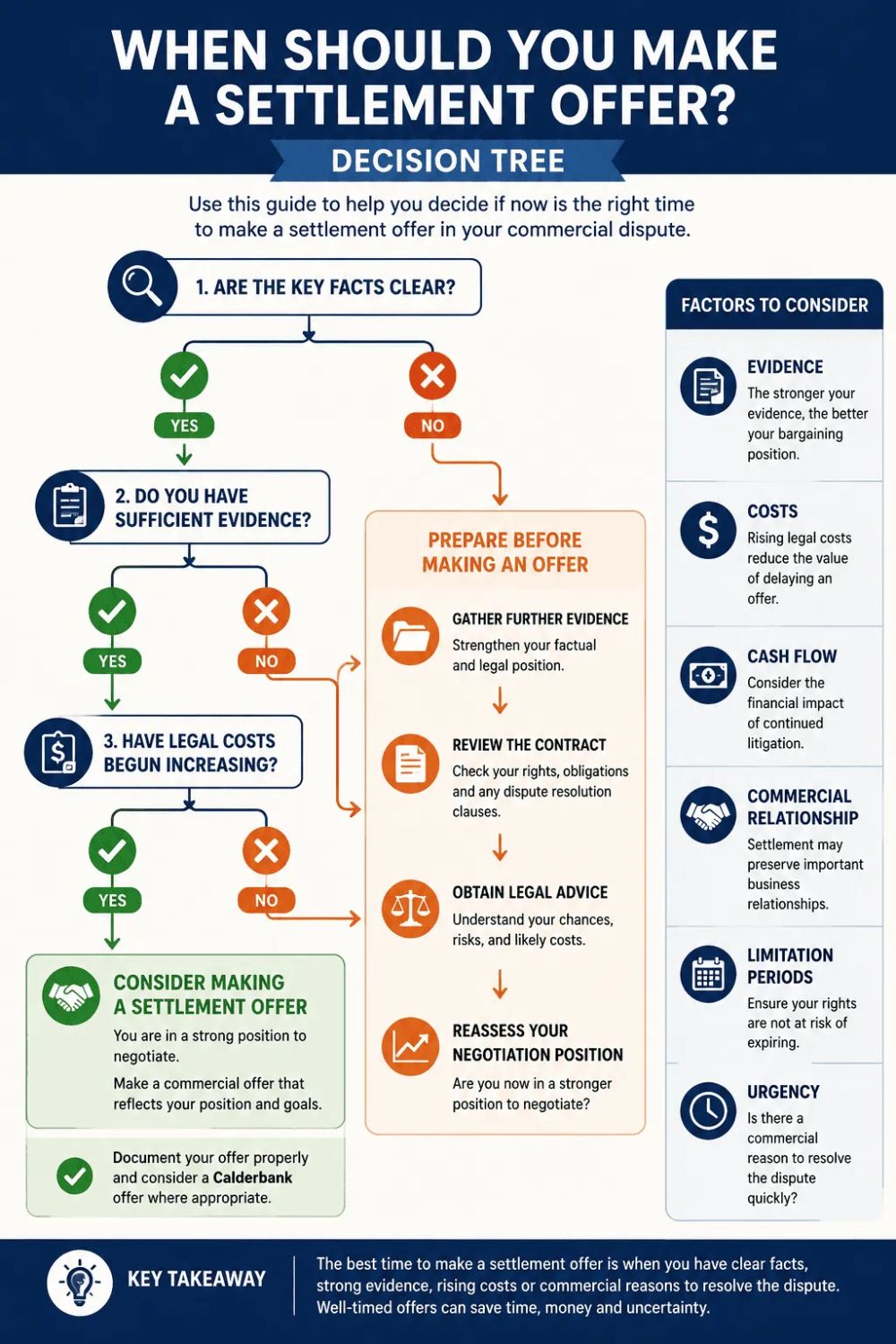
There is no single ideal time to make a settlement offer. The appropriate timing depends on the strength of the available evidence, the parties’ bargaining positions, commercial urgency and the likely cost of continuing the dispute.
Making an offer early, before legal costs escalate, may resolve the matter quickly where liability is reasonably clear. In other cases, waiting until key evidence has been obtained can strengthen a party’s negotiating position and encourage a more realistic response. Even shortly before trial, settlement may remain commercially sensible if it avoids the uncertainty, expense and management time associated with a hearing.
Businesses should also consider limitation periods, cash flow pressures and the practical ability of the other party to satisfy any settlement or judgment. Delaying an offer without a strategic reason may reduce its effectiveness or allow positions to become entrenched.
Where appropriate, parties may make a Calderbank offer or, once proceedings are on foot, a formal offer under chapter 9, part 5 of the Uniform Civil Procedure Rules 1999 (Qld). A compliant formal offer may engage the specific costs consequences prescribed by rules 360 or 361. A Calderbank offer does not produce those consequences automatically, but an unreasonable failure to accept it may be relevant to the court’s discretion concerning costs.
What Makes a Settlement Binding Without Going to Court?
A commercial settlement recorded as a contract becomes legally binding when the ordinary requirements of contract formation are satisfied. These generally include a clear offer, unequivocal acceptance, consideration, an intention to create legal relations, sufficiently certain and complete terms, and authority on the part of any person purporting to bind a business. Where the settlement is validly executed as a deed, consideration is generally unnecessary, although the applicable execution formalities must be satisfied.
The High Court confirmed in Masters v Cameron (1954) 91 CLR 353 that whether parties are immediately bound depends on their objectively assessed intention and the terms of their agreement, particularly where they contemplate later formal documentation.
Settlements are commonly recorded in a deed of settlement, settlement agreement, consent orders or a deed of release, depending on the nature of the dispute. These documents often include entire agreement clauses, confidentiality obligations, mutual releases and enforcement provisions to reduce the risk of future disputes about what was agreed.
Can an oral settlement be legally binding?
Potentially, yes. An oral settlement may be enforceable if the essential elements of a binding contract are established and no applicable law requires the agreement, or a relevant part of it, to be in writing. Proving the existence, completeness and precise terms of an oral agreement can nevertheless be difficult, making a carefully drafted written settlement agreement or deed the safer commercial approach.
One of the most common issues I encounter is parties believing they have reached agreement “in principle” without resolving essential terms. That uncertainty can create fresh disputes and undermine the very certainty the settlement was intended to achieve.
Common Mistakes Seen in Practice When Settling Without Going to Court
Many settlement opportunities are lost because businesses focus on the dispute before understanding their legal position. One of the most common mistakes I see is negotiating without first reviewing the contract, available evidence or potential remedies. This often results in unnecessary concessions or unrealistic demands.
Another frequent problem is sending aggressive letters that inflame the dispute instead of encouraging resolution. Equally, businesses sometimes accept partial payment without clearly recording whether it represents full and final settlement, creating uncertainty and further disagreement.
I also regularly encounter parties who overlook security interests, personal guarantees or other contractual rights that could significantly strengthen their negotiating position. Others make unnecessary admissions during negotiations or allow employees without proper authority to negotiate binding outcomes.
Finally, failing to document a settlement properly is a recurring source of litigation. Agreements reached “in principle” can unravel if key terms, releases, payment obligations or confidentiality provisions are omitted. Careful preparation before negotiations and precise documentation afterwards usually reduce both legal risk and the likelihood of returning to court over the same dispute.
Key Takeaways on Resolving Disputes Without Going to Court
Settling a commercial dispute early is often faster, less expensive and more commercially effective than litigation. Successful negotiation requires legal strategy, not simply compromise. Lawful commercial pressure can encourage settlement, but improper conduct may create additional legal risks. Any settlement should be carefully documented to ensure it is legally enforceable. Obtaining legal advice early can improve decision-making, identify settlement opportunities and help avoid unnecessary procedural or strategic costs.
Frequently Asked Questions About Settling Without Going to Court
The following frequently asked questions address common concerns about resolving disputes without going to court, including negotiation timing, letters of demand, mediation, verbal settlements, Calderbank offers, binding settlement agreements and what happens if the other party breaches the agreed terms.
Can I settle a commercial dispute without going to court?
Yes. A substantial proportion of commercial disputes are resolved without a final court hearing, whether through direct negotiation, solicitor-assisted negotiations, mediation, discontinuance or a binding settlement agreement. Parties can negotiate directly, engage solicitors, attend mediation or enter into a legally binding settlement agreement at almost any stage of the dispute, including after court proceedings have commenced.
What should I do if another business refuses to negotiate?
If the other party refuses to engage, gather your evidence, review your contractual rights and consider sending a professionally drafted letter of demand. If negotiations remain unsuccessful, mediation or court proceedings may become appropriate. Early legal advice can help identify the most effective strategy.
Can I negotiate after court proceedings have started?
Yes. Settlement negotiations can continue before proceedings begin, after they are filed and even during a trial. Courts generally encourage parties to resolve disputes where possible, particularly if settlement avoids unnecessary costs and delays.
Is a verbal settlement agreement legally binding?
Potentially. An oral settlement may be enforceable if the essential elements of a binding contract are established and no applicable law requires the agreement, or a relevant part of it, to be in writing. Because proving the existence and precise terms of an oral agreement is often difficult, commercial settlements should generally be recorded in writing.
What makes commercial settlement legally binding?
A settlement recorded as a contract generally requires a clear offer, acceptance, consideration, an intention to create legal relations and sufficiently certain terms. Where the settlement is executed as a deed, consideration is generally unnecessary. In either case, the person agreeing to the settlement must have authority to bind the business.
Can I make a settlement offer before sending a letter of demand?
Yes. There is no legal requirement to issue a letter of demand before making a settlement offer. However, a well-prepared demand often clarifies the issues, identifies the remedy sought and encourages meaningful negotiations before litigation becomes necessary.
What happens if the other party breaches a settlement agreement?
A settlement agreement is generally enforceable according to ordinary contractual principles. If one party fails to comply, the other party may be entitled to seek debt recovery, damages, specific performance, declaratory relief or another appropriate remedy, depending on the terms and circumstances. If the settlement has been embodied in consent orders, enforcement may instead proceed through the court’s processes for enforcing those orders.
Can I use a letter of demand to pressure the other party?
Yes, provided the letter accurately states your legal position and does not contain misleading threats or improper pressure. A properly drafted letter of demand is a legitimate negotiation tool and often encourages early commercial resolution.
What is a Calderbank offer?
A Calderbank offer is a genuine offer of compromise, ordinarily made in writing on a “without prejudice save as to costs” basis. If the offer is not accepted and the offeror later obtains an outcome more favourable than the offer, the offer may support an application for a different costs order. The result is discretionary rather than automatic, and the court will consider matters including the clarity of the offer, the time allowed for acceptance, the information available to the offeree and whether rejection was unreasonable in the circumstances.
When should I speak to a commercial disputes lawyer?
You should obtain legal advice as early as possible if negotiations have stalled, a significant amount of money is involved, contractual rights are disputed or court proceedings are being threatened. Early advice often improves settlement prospects and helps avoid costly strategic mistakes.
The content of this article is intended to provide a general guide to the subject matter. Specialist advice should be sought about your specific circumstances.
[View Source]