
Article Summary
Default judgment provides creditors with an efficient mechanism for obtaining judgment where a debtor fails to respond to court proceedings. However, judgment is not automatic simply because the response deadline has expired. A creditor must still establish that the defendant was properly served, satisfy the procedural requirements of the Uniform Civil Procedure Rules 1999 (Qld), and provide sufficient evidence to support the amount claimed.
This article explains when default judgment may be available in Queensland, the procedural steps that must be followed, the evidence required before judgment can be entered, and the circumstances in which a debtor may later apply to have the judgment set aside. It also examines the practical realities of debt recovery after judgment, including enforcement options, common procedural mistakes, and the important distinction between default judgment and summary judgment.
Understanding these principles can help creditors avoid costly procedural errors, obtain judgment more efficiently, and improve the prospects of successfully recovering outstanding debts.
Can I Obtain Default Judgment if the Debtor Does Not File a Defence?
Not every debt recovery proceeding in Queensland proceeds to a contested hearing or trial. Where a defendant has been properly served with a claim and fails to file a Notice of Intention to Defend and defence within the time required by the Uniform Civil Procedure Rules 1999 (Qld) (UCPR), a plaintiff may be entitled to obtain default judgment. Default judgment allows the court to enter judgment because the defendant has not responded to the proceeding, rather than because the claim has been determined after a hearing. Procedural deadlines are therefore critical. It is also important to distinguish default judgment from summary judgment, which generally applies where a defence has been filed but has no real prospect of success.
Where a debtor ignores court proceedings, obtaining legal advice from experienced debt recovery lawyers can help ensure procedural requirements are satisfied before default judgment is sought.
What Is Default Judgment?
Default judgment is most commonly relevant where court proceedings have been started, the debtor has been served, and no response has been filed within the required time. For creditors, this can provide a more efficient path through the debt recovery process, but it still requires strict compliance with court rules, service requirements and supporting evidence.
Default Judgment Is Based on Procedural Non-Compliance
Default judgment is a judgment entered because a defendant has failed to comply with procedural requirements after court proceedings have commenced. In a typical debt recovery proceeding, the plaintiff files and serves a Claim and Statement of Claim on the defendant. Under rule 137 of the Uniform Civil Procedure Rules 1999 (Qld), the defendant must ordinarily file a Notice of Intention to Defend within 28 days after the day the Claim is served.
A standard Notice of Intention to Defend must have the defendant’s defence attached. If the defendant does not file the required documents within time, the plaintiff may seek default judgment under Chapter 9, Part 1 of the UCPR, subject to proof of service and the requirements applicable to the particular relief claimed.
Importantly, default judgment is not a determination that the plaintiff’s claim has been proven after a trial. Rather, it reflects the defendant’s failure to participate in the litigation process. The court’s focus is on procedural compliance rather than on determining the merits of the debt claim after a contested hearing.
When Can a Creditor Apply for Default Judgment?
Many creditors are unsure when they become entitled to seek default judgment after commencing court proceedings. This infographic provides a simple visual roadmap of the debt recovery process, showing where default judgment fits within a typical Queensland debt recovery matter and highlighting the procedural steps that must occur before judgment can be obtained.
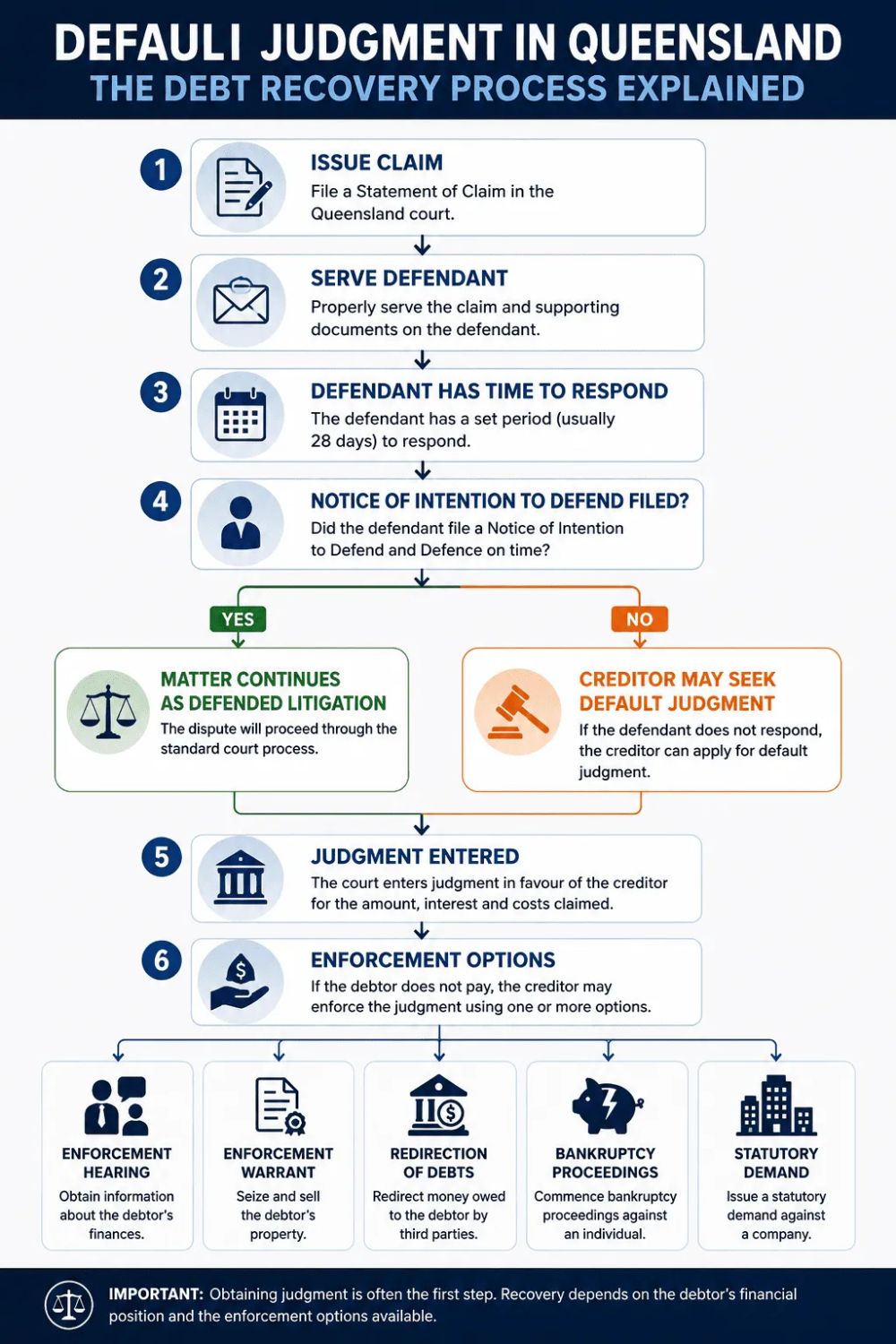
Failure to File a Notice of Intention to Defend
A creditor may become entitled to seek default judgment after properly serving a Claim and Statement of Claim where the defendant fails to file a Notice of Intention to Defend within the time required by the Uniform Civil Procedure Rules 1999 (Qld) (UCPR). If no response is filed within the prescribed period, the defendant risks having judgment entered without the matter proceeding to a contested hearing.
Default Following a Conditional Notice of Intention to Defend
Ordinarily, a Notice of Intention to Defend must have the defendant’s defence attached. A different procedure applies where a defendant files a conditional Notice of Intention to Defend to challenge the court’s jurisdiction or assert an irregularity. If the conditional notice becomes unconditional and the defendant does not file a defence within the time required by Rule 144, the defendant may be in default, and the plaintiff may be entitled to seek default judgment.
Debt Claims Commonly Suitable for Default Judgment
Default judgment frequently arises in claims involving unpaid invoices, loan agreements, guarantees, unpaid professional fees, and business-to-business debts. The availability of default judgment depends upon the defendant’s procedural default and the nature of the relief claimed, rather than upon whether the defendant disputed the debt before proceedings were commenced.
The UCPR imposes specific requirements concerning service, procedural compliance, and the circumstances in which default judgment may be entered. A critical practical requirement is proper service. A creditor will generally be unable to obtain default judgment where service of the originating process was defective or cannot be adequately proven. In most cases, default judgment proceedings are preceded by a formal letter of demand before court proceedings.
What Must the Creditor Prove Before Judgment Can Be Entered?
Before default judgment can be entered, the creditor must show more than the fact that money is allegedly owed. The court will usually need to be satisfied that the defendant was properly served, that the claim is procedurally regular, and that the amount sought is properly supported by the relevant documents.
Proof of Service
Before default judgment can be entered, the creditor must establish that the defendant was validly served in accordance with the Uniform Civil Procedure Rules 1999 (Qld) (UCPR). This is usually done through an affidavit of service identifying when, where, and how service occurred. In practice, service is one of the most common grounds relied upon by defendants seeking to challenge or set aside default judgments.
Service is frequently the central issue in applications to set aside default judgment because a defendant who was not properly served may have been denied a genuine opportunity to participate in the proceeding. Courts generally scrutinise service evidence closely where procedural fairness concerns arise.
Proof of the Debt
A request for default judgment may be delayed or refused where the material does not adequately establish the amount for which judgment is requested, or where the amount sought does not correspond with the pleaded claim. Where invoices, statements of account, contractual terms or guarantee obligations are inconsistent, the registry may require clarification or further evidence before judgment is entered.
Depending on the nature of the debt, supporting documents may include contracts, invoices, statements of account, guarantees, or other records that demonstrate liability and quantify the debt.
Interest and Costs
A creditor may also seek contractual interest where the relevant agreement permits it. In some circumstances, statutory interest may be available. Legal costs may also be recoverable in accordance with the UCPR, applicable legislation, or the terms of the underlying contract. Ensuring that these amounts are properly particularised at the outset can avoid delays in obtaining judgment.
How Quickly Can Default Judgment Be Obtained?
A plaintiff cannot seek default judgment merely because proceedings have been filed. The defendant must first be served, and the applicable response period must expire. In an ordinary proceeding started by Claim, the defendant generally has 28 days after the day of service to file a Notice of Intention to Defend and an attached defence.
Even after that period expires, judgment is not automatic. The defendant may file and serve the Notice of Intention to Defend and defence at any time before default judgment is entered. If the defendant does so, default judgment will no longer be available on the basis of the earlier failure to file within time.
Once the defendant is in default, the time required to obtain judgment will depend upon the nature of the claim, the adequacy of the service evidence and supporting material, and registry processing. Delays may arise where service has not been adequately proved, the amount requested does not correspond with the pleaded claim, interest has not been properly calculated, or further evidence is required.
What Happens After Default Judgment Is Entered?
Obtaining default judgment is a significant step, but it is not the same as recovering the money. Once judgment is entered, the creditor may still need to consider enforcement options if the debtor does not pay voluntarily. Depending on the judgment debtor’s identity and financial position, available steps may include an enforcement hearing, an enforcement warrant, redirection of debts or earnings, a bankruptcy notice against an individual debtor, or a statutory demand against a corporate debtor. Bankruptcy and winding-up procedures are subject to separate statutory requirements, including minimum debt thresholds and strict procedural rules.
Judgment Does Not Automatically Produce Payment
Obtaining default judgment is an important milestone in the debt recovery process, but it does not automatically result in payment. A judgment confirms that the debt is legally owed; however, the creditor may still need to take further steps if the debtor refuses or is unable to pay.
Available Enforcement Options
Obtaining judgment is often only the first step. Creditors may then need to consider available options to enforce a court judgment and recover payment. Depending on the circumstances, a judgment creditor may be able to pursue a range of enforcement mechanisms. These can include an enforcement hearing to obtain information about the debtor’s financial position and enforcement warrants authorising measures such as seizure and sale of non-exempt property or the redirection of debts or earnings. Subject to the applicable Commonwealth legislation and statutory thresholds, a judgment creditor may also consider applying for a bankruptcy notice against an individual debtor or serving a statutory demand on a corporate debtor.
From a practical perspective, many creditors discover that obtaining a judgment is easier than recovering payment. Before commencing proceedings, it is often prudent to consider whether the debtor has sufficient assets, income, or solvency to satisfy a judgment if one is obtained.
Can the Debtor Have Default Judgment Set Aside?
A common misconception is that default judgment is final simply because the defendant failed to respond.
Queensland courts have power under the UCPR to set aside default judgments in appropriate circumstances where procedural fairness, service issues, or the interests of justice require reconsideration.
Courts Have Power to Set Aside Default Judgment
A defendant may apply under rule 290 of the UCPR to set aside or amend a default judgment and any enforcement of it. The applicable approach depends importantly upon whether the judgment was entered regularly or irregularly.
A judgment may be irregular where the procedural requirements for entering it were not satisfied, including where service was defective or judgment was entered before the defendant’s time to respond had expired. An irregular judgment will ordinarily be set aside, subject to matters such as amendment or the futility of setting it aside.
Where judgment was regularly entered, the court has a broad discretion. Relevant considerations commonly include the defendant’s explanation for the default, any delay in applying to set the judgment aside, whether the defendant has demonstrated a prima facie or arguable defence on the merits, prejudice to the plaintiff, and whether appropriate terms as to costs or security should be imposed.
Rule 290 gives the court a broad discretion to set aside or amend a default judgment and any enforcement of it on terms the court considers appropriate, including terms concerning costs and security. In exercising that discretion in relation to a regularly entered judgment, Queensland courts commonly examine the explanation for the default, the promptness of the application, the existence of a genuine defence on the merits, and any prejudice that setting aside the judgment may cause. No single consideration is necessarily decisive, but a defendant should act promptly and place proper evidence before the court addressing both the default and the proposed defence.
Read more here – Setting Aside a Default Judgment in Queensland
Why Creditors Should Avoid Procedural Shortcuts
Creditors should therefore approach default judgment carefully. Judgments obtained through defective service, inadequate evidence, or procedural non-compliance may later be challenged and potentially set aside. In practice, strict compliance with the UCPR is often the best protection against costly delays and avoidable disputes.
Common Mistakes I See in Debt Recovery Matters
In practice, default judgment matters often fail or become more expensive because creditors focus only on getting judgment and not enough on recovery strategy. The main risks usually involve poor evidence of service, weak proof of the debt, delay, or pursuing a debtor who has limited capacity to pay even after judgment is entered.
Assuming Silence Guarantees Recovery
One of the most common issues I see in Queensland debt recovery matters is creditors obtaining judgment only to discover the debtor has already ceased trading, transferred assets, or entered external administration. By that stage, the litigation may have succeeded procedurally while recovery prospects have deteriorated significantly. While a failure to defend may make it easier to obtain judgment, it does not guarantee payment. In many matters, the real challenge begins after judgment has been entered and enforcement action becomes necessary.
Failing to Properly Prove Service
Service issues are among the most frequent procedural problems in debt recovery litigation. Creditors sometimes assume that sending documents is enough. If service cannot be properly established, a default judgment may be vulnerable to being set aside months later, resulting in additional delay and expense.
Waiting Too Long Before Taking Action
Delay often creates practical recovery problems. Over time, debtors may become insolvent, assets may be transferred or dissipated, and enforcement options may become less effective. Early action generally provides more strategic flexibility.
Pursuing Judgment Against an Insolvent Defendant
A judgment is only as valuable as the debtor’s ability to satisfy it. Before investing further time and costs, creditors should consider whether the debtor has assets, income, or a realistic capacity to pay if judgment is obtained.
Default Judgment vs Summary Judgment
Default judgment and summary judgment are often confused, but they address different situations.
| Default Judgment | Summary Judgment |
|---|---|
| Defendant has not filed the required notice of intention to defend and defence | Defendant has filed a Notice of Intention to Defend |
| Based on procedural default | Based on the absence of a real prospect of successfully defending the claim |
| Service and compliance with the default judgment rules must be established | The court must also be satisfied that there is no need for a trial |
| A request may be determined by a registrar for certain categories of claim | Requires an application to the court supported by affidavit evidence and legal submissions |
Default judgment may be available where the defendant has been served but has not filed the documents required to defend the proceeding within the time. Summary judgment, by contrast, is sought after the defendant has filed a Notice of Intention to Defend and requires the plaintiff to establish that the defendant has no real prospect of successfully defending all or part of the claim and that there is no need for a trial.
Conclusion
A default judgment may provide an efficient pathway to judgment when a debtor fails to respond to court proceedings. However, creditors must still comply with service requirements and procedural rules before judgment can be entered. Just as importantly, obtaining judgment does not guarantee recovery of the debt. Enforcement options, the debtor’s financial position, and the possibility of a later application to set aside the judgment should all be considered when developing an effective debt recovery strategy.
Frequently Asked Questions
The following frequently asked questions address common default judgment issues in Queensland, including what happens when a debtor does not file a defence, when judgment can be sought, what evidence is required, whether judgment can be set aside, and what enforcement options may be available after judgment is entered.
What happens if a debtor does not file a defence in Queensland?
If a debtor fails to file a Notice of Intention to Defend and defence within the required time, the creditor may be entitled to seek default judgment. This can allow judgment to be entered without a contested hearing, provided the creditor satisfies the relevant procedural requirements.
Can I obtain default judgment immediately after the response deadline expires?
No. The expiry of the response period does not automatically result in judgment. The creditor must still comply with the Uniform Civil Procedure Rules 1999 (Qld), prove service, and provide the documents required to support the judgment request.
How long does a debtor have to file a Notice of Intention to Defend?
In an ordinary Queensland proceeding started by a claim, a defendant must generally file a Notice of Intention to Defend within 28 days after the day the Claim is served. The defence must ordinarily be attached to the notice. A different period may apply where Commonwealth interstate-service legislation applies or in other particular circumstances.
Can default judgment be entered if the debtor cannot be located?
Not ordinarily. The creditor must prove valid service before default judgment can be entered. If personal or ordinary service cannot practicably be effected, the creditor may need to apply for an order for substituted service or another appropriate order under the UCPR. The court must be satisfied that the method ordered is likely to bring the proceeding to the defendant’s attention.
What evidence is required to obtain default judgment?
The creditor will generally need evidence of service and documents supporting the debt. Depending on the claim, this may include contracts, invoices, statements of account, loan documents, guarantees, and affidavits verifying relevant facts.
Can a debtor have default judgment set aside?
Yes. Courts may set aside default judgment where there has been defective service, a procedural irregularity, an arguable defence, or a reasonable explanation for the failure to respond. Each application is assessed on its particular circumstances.
What happens after default judgment is entered?
A judgment confirms that the debt is legally owed, but it does not automatically produce payment. If the debtor does not pay voluntarily, the creditor may need to commence enforcement action to recover the judgment debt.
Can I recover legal costs after obtaining default judgment?
A creditor obtaining default judgment may ordinarily claim the costs and payments permitted by the UCPR, including prescribed costs associated with issuing the Claim and obtaining judgment and other fees or payments reasonably incurred and paid. These amounts will not necessarily equal the creditor’s actual solicitor-client costs. A contractual entitlement to additional recovery must be properly pleaded, established and permitted by law.
What is the difference between default judgment and summary judgment?
Default judgment arises because the defendant failed to respond to the proceeding. Summary judgment applies where the defendant has filed a Notice of Intention to Defend and the court is satisfied that the defendant has no real prospect of successfully defending all or part of the claim and that there is no need for a trial. The legal tests and procedures for each are different.
What should I do if default judgment has been entered against me?
You should obtain legal advice as soon as possible. Delay can significantly reduce the prospects of successfully applying to set aside the judgment. The court will usually expect a prompt explanation, evidence of an arguable defence, and a reasonable basis for the earlier non-compliance.
The content of this article is intended to provide a general guide to the subject matter. Specialist advice should be sought about your specific circumstances.
[View Source]