

There are few more controversial aspects of corporate governance than executive and director remuneration. Recent press discussion of remuneration practices and pay-outs at AMP, One-Tel and BHP attest to the voracity of that controversy and the depth of feeling in the investment community as well as the community at large.
The recent ASX Corporate Governance Council Guidelines2 have been aimed at providing an initial framework for corporate governance – including the board remuneration committee - which could provide a practical guide for listed companies, their investors, the wider market and the Australian community. While neither final nor complete, the Guidelines are intended to form a substantial prescriptive framework of recommendations for listed companies to achieve best practice3. Richard Humphries, the Managing Director of the ASX, has indicated they "provide a flexible and a non-legislative response to public perceptions of inappropriate behaviour"4.
This article explores just one aspect of the Guidelines – that pertaining to remuneration committees and executive remuneration – in the light of disclosed current practice of the Top 100 Australian companies5 as well as commenting on that practice.
It concludes that whilst these companies are largely observing the structural principles of the Guidelines, there are many questions and issues raised by the broader Guidelines that will still need to be considered by Australian Boards of Directors.
Existence of Remuneration Committees
Recommendation 9.2 of the Guidelines recommends that boards establish a remuneration committee. These committees are seen as a more efficient mechanism – especially for larger companies - to focus on appropriate remuneration policies which are designed to meet the needs of the company and to enhance performance. Acknowledgement is made that for "smaller boards" - not companies – this structure may not be as efficient6.
Our study indicates that 75 of the 100 companies sampled utilised separate committees to oversight remuneration. 58 of these companies (77%) had a dedicated ‘remuneration’ or ‘compensation’ committee that dealt solely with remuneration related issues. The remaining 17 companies utilised a broader ‘human resources’ committee (8) or a combined ‘nominations’/’remuneration’ committee (9) that considered remuneration policies amongst its other functions.
The existence of eight broader human resource committees may well point to a future trend and best practice, where Boards choose to delegate specialist oversight of many people management issues to such a committee. A holistic examination of the Guidelines tends to support this broader scoping as will be discussed later in this article. Our ongoing study intends to explore how different boards choose to handle the broader human resource issues in conjunction with the role of the remuneration committees.
The combining of nominations and remuneration committees makes sense in the context of directors terms and remuneration, but less so in the context of executive terms and remuneration. These are separate and distinct policies and systems and even more so now that the Guidelines recommend against non-executive director participation in executive remuneration schemes, option plans and retirement plans other than statutory superannuation7.
Interestingly, 23 of the sampled companies did not utilise separate committees to oversight remuneration. An analysis shows that two thirds of these companies had less than 500 employees and it could be argued their size did not warrant the board establishing a separate committee. However, one third had over 500 employees and issues are raised by what is the effect of size of the company on efficiencies8.
Aside from size, trends also emerge in the industry pattern of companies without dedicated remuneration committees. Companies involved in the Financial (Diversified Financials, Insurance or Real Estate) industry made up a large proportion of these companies (17/23). It is perhaps important to note here that
- a majority (13/17) are trusts/funds managed by other public-listed or foreign companies – such as Westfield, Commonwealth bank, AMP, Macquarie - with their own remuneration committees
- however, in terms of the size of the Boards of Directors, these financial institutions were comparable in size. The average number of directors on the boards of these financial industry companies was 6.25, ranging from 4 to 10 members. Meanwhile the directorship number average for all the 23 out of 100 companies which did not have remuneration committees was 6.70.
Frequency of Meetings
While the Guidelines do not explicitly address the frequency that remuneration committees should assemble, the purpose and effectiveness of such committees is clearly affected by how often they meet as well as by their agendas. The meeting patterns of the sample are represented in Figure 1.

Figure 1: Frequency of remuneration committee meetings
Of the 53 companies that provided information in their annual reports on the frequency of meetings of the remuneration (or larger) committee, the average was that the committee met 3.8 times a year. Interestingly of the 9 companies whose committees met 6 or more times that year, only two of those committees were joint nominations/remuneration committees. This suggests the relative importance of the remuneration committee to the overall operations of the board for some companies.
Composition of Remuneration Committees
Recommendation 9.2 of the Guidelines prescribes that remuneration committees should consist of a minimum of three members, the majority being independent directors, and that the committee should be chaired by an independent director.
All the committees studied in the sample were chaired by a non-executive, independent director. Furthermore, a review of the sample indicates that, to a large extent, the committees complied with these size and composition requirements. This material is presented in Figures 2 and 3.

Figure 2: Size of committees
The average size of remuneration committees was 3.9 directors across the sample. The size of the committee had no obvious relationship to the size of the company nor to its scope – i.e. purely remuneration versus a broader committee.
Interestingly, a number of companies in the sample have chosen to include all non-executive directors in this committee. This has implications on the efficiency rationale set out in the Guidelines.

Figure 3: Composition of committees
Expectedly, a large majority (70%) of remuneration committees consist solely of non-executive directors. Interestingly, the Chief Executive Officer sits as a member on 23% of committees which places them in some considerable potential conflict of interest in relation to executive remuneration. We suspect the 7% remaining to be the Chief Financial Officer, and again there is the question of potential conflicts.
The Guidelines do not prohibit executive director involvement in these committees. But where they are involved then the charters of the committee may need to specifically address issues of conflict.
Where chairpersons of remuneration committees are nominated in the Annual Reports, all of them are non-executive directors in line with the Guidelines.
An examination of directors sitting on multiple company remuneration committees shows that 26 directors in the sample held two remuneration committee memberships. These directors would be able to share their experience across companies. There were no obvious conflicts of interest in these dual positions
Charters
The Guidelines emphasise the importance of a formal charter for remuneration committees as a guide to membership requirements and responsibilities.
The Annual Reports of the sample do not cover the existence of such charters. Our ongoing study intends to explore the existence and content of these.
Responsibilities of the remuneration committee
The level of detail as to the activities and responsibilities of remuneration committees was highly variable between companies. While some annual reports revealed a significant level of detail as to the functions of such committees within the corporate governance structures of the corporate entity, others merely referenced the existence of such a body.
The Guidelines will now encourage listed companies to cover the full ambit of responsibilities set out in the Guidelines or disclose the contrary in the Annual Report.
A close examination of the Guidelines demonstrates the broadness of the proposed committee’s responsibilities namely –
- focussing on appropriate remuneration policies which are designed to meet the needs of the company and to enhance corporate and individual performance9 – a responsibility that suggests a deep understanding of the business, its drivers and performance measures; what individual and team performance areas to drive to achieve that; as well as how to design remuneration to achieve these outcomes;
- reviewing and recommending to the board the full gamut of "senior management" as well as "executive" remuneration10 - it is believed that the use of the two terms throughout the Guidelines demonstrates the Council’s intentions for boards and committees to oversight both categories of management;
- "review the company’s recruitment, retention and termination policies and procedures for senior management"11 – which borders on a broader human resources oversight role;
- the remuneration frameworks for directors12 - except where they are addressed by a separate nominations committee
- ensuring that the payment of equity based remuneration is made in accordance with thresholds set in plans approved by shareholders13 – i.e. oversight implementation of such plans is now a recommended practice
Remuneration policies14 should be seen to –
- "motivate directors and management to pursue long-term growth and success of the company within an appropriate control framework" – this is a strong test for committees to judge
- "demonstrate a clear relationship between executive performance and remuneration" – which will require the committee to build real pay for performance frameworks both for positive and negative performance results. In the past positive performance was covered but not necessarily negative performance.
- achieve a "balance between fixed and incentive pay, reflecting short and long-term performance objectives appropriate to the companies circumstances and goals"
- link incentive schemes to "relative performance"15– i.e. relative to the company’s industry/business or to a grouping of like-sized/orientated companies.
It is submitted these responsibilities are quite technical and may go well beyond an experienced director’s normal competencies in relation to remuneration matters, especially when combined with the present and future legal requirements in this area.
Other Implications of the Guidelines
The ten principles of the Guidelines are not exclusive of each other. They necessarily intertwine and co-relate. Other principles which touch on and relate to how companies establish and operate their remuneration committees are –
- Skills, experience and expertise of directors (Principle 2)
- Induction and training of directors (Principle 1 and 8)
- Access to independent professional advice (Principles 1 and 8)
- Disclosure (Principle 5)
- Recognising and managing risk (Principle 7)
- Ethical behaviour
- Culture and management beliefs
- Occupation health and safety
- Compliance of statutory requirements
- Executive behaviour and leadership style
- Executive and key-man succession
- Executive contracts
- Broader Stakeholder Interests (Principle 10)
- Setting up such committees;
- Having committees comprised of 3 or more members; and
- The majority of committee members being independent.
- their charters and responsibilities,
- the technical expertise,
- induction and training and, potentially
- a broader people management oversight.
- Jhn Colvin is a senior partner of Freehills, Sydney specialising in Executive Contracts, Remuneration and general governance and has board and executive remuneration experience; Ken Pritchett operates his own management consultancy in strategic human resources and change management and convenes the Human Resources Leadership Forum; Amy Jackson is experienced in industrial relations and an employee of Freehills.
- Principles of Good Corporate Governance and Best Practice released March 2003
- Ibid: Foreword
- LateLine interview : 30 March 2003
- This study was based on a sample being the Top 100 companies as ranked by Business Review Weekly according to profit. The study then looked at the 2002 annual reports of 99 companies. One report was not obtainable.
- The Council appears to waiver between size of company and size of board as the key relativity. The implications of both are considered later in this article.
- Recommendation 9.3
- See above
- Recommendation 9.2 : Purpose of the remuneration committee
- Recommendation 9.2 : Responsibilities
- Ibid
- Ibid
- Recommendation 9.4
- Recommendation 9.2 : Remuneration policies
- Ibid : Box 9.2
- Box 9.1
- Principle 10 : Introduction
- Ibid : Box 10.1
- See 4 above
This principle encourages a thorough evaluation of particular skills, experience and expertise that will best complement board effectiveness. It is submitted one
of those particular competencies should be specific human resources and remuneration competence for the reasons set out above. Alternatively, this expertise may be brought in by the Remuneration Committee or Board to assist in this area.
Interestingly, an examination of the background and expertise of the various committees in this study (see Figure 4) indicates that while a high percentage of committees comprised directors with financial and industry expertise, only a very small percentage of directors possessed human resource or other relevant skills and expertise directly pertaining to remuneration issues.
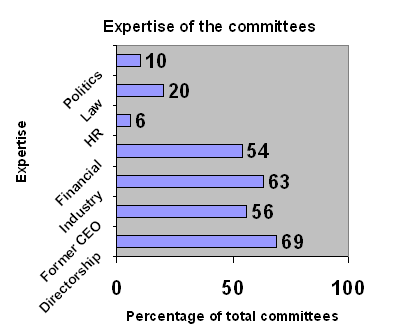
Figure 4: Expertise of remuneration committees
It will be interesting to observe whether the composition of Australian boards over time is adjusted to incorporate such particular skills.
It is also interesting to note that whereas the Guidelines prescribe "financial literacy", a minimum level of financial expertise and an understanding of the industry in relation to the audit committee there is no such prescription of competence for the remuneration committee. This is an area that may well evolve with the development of the Guidelines.
These principles rightly promote director induction and ongoing training and continuing education. In the area of remuneration, there may well be a real need for such induction and ongoing education, especially in view of the perceived lack of technical expertise indicated above.
The induction aspect is particularly important as overseeing the appropriateness of executive remuneration requires the committee to understand the regulatory framework, the present (and future) culture, philosophy and drivers of the business. Remuneration is both a performance and a change management tool – and remuneration committees need to appreciate how to use it for both purposes.
The Guidelines empower directors to seek and obtain independent advice. Such advice can go some way toward compensating for the lack of particular competence in a committee in this area. However, it may not be a total solution.
Independence here needs to also indicate an independence from advice to the executive as well as advice that is tailored to the company, its industry and business. A concern may be to ensure that Boards receive advice that is free of ‘ratchetting up’. Boards must be cautious of remuneration and market data that tends to ‘set’ the market rather than reflect it.
The broad obligation for timely and balanced disclosure may challenge remuneration committees over and above the specific disclosure requirements of Principle 9.1 in relation to any extraordinary provisions of Executive contracts16. This will become particularly relevant for existing and future executive contracts at the "junior" executive level. Although it could cascade to other levels of management if there are, for example, extraordinary bonuses or similar arrangements.
Some of the greatest operational risks can be people related risks covering –
Principle 7 anticipates an appropriate board committee(s) to oversight risk. The question raised here for boards is whether remuneration committees (or the rarer human resource committees) can and should be expanded to cover oversight of the related people risk issues.
Principle 10 has a broad ambit covering legal and other obligations to stakeholders (including employees) as well as creation of value by better managing amongst other things "human…capital"17.
The code of conduct can cover employment practices18 and human capital issues, but it is submitted a focussed and experienced human resources committee would be best placed to oversight the broad human resource thrusts of the company to ensure they set the right "tone and standards " of the company.
Conclusion
Our study of the sample suggests a majority of the top listed companies are already meeting the broad structural challenges of the Guidelines in relation to remuneration committees. That is, the majority comply in terms of:
However, company compliance with the qualitative and aspirational aspects of the Guidelines is less certain. Our study suggests that remuneration committees may need to be strengthened in terms of
Certainly, if the Guidelines are going to adequately address any perceived "inappropriate behaviours" as the Managing Director of the ASX suggests19 then the remuneration committees are likely to become more directly involved in the broader oversight of the executive, its performance and style with the potential to significantly reposition the relationship of the board and the executive.
Footnotes.
The content of this article does not constitute legal advice and should not be relied on in that way. Specific advice should be sought about your specific circumstances.