
- within Corporate/Commercial Law topic(s)
- with Senior Company Executives, HR and Inhouse Counsel
- in Australia
- with readers working within the Banking & Credit, Insurance and Property industries
Article Summary
Whether you should sue for breach of contract depends on more than proving the other party was legally wrong. A successful claim requires a valid contract, evidence of breach, recoverable loss and a commercially sensible recovery strategy, particularly where legal costs, delay and enforcement risks may outweigh the potential benefit.
Many disputes are resolved more effectively through negotiation, mediation or settlement before trial. Obtaining early legal advice helps assess the strength of the claim, preserve important evidence, identify practical alternatives to litigation and maximise the prospects of achieving a commercially favourable outcome.
Should You Sue for Breach of Contract?
It is not always commercially worthwhile to sue for breach of contract. The right decision depends on more than proving the other party was in breach—it also requires strong evidence, recoverable financial loss, and a commercially sensible outcome. Litigation is only one way to enforce your contractual rights, and alternatives such as negotiation or mediation may achieve a faster, more cost-effective resolution. An early legal assessment can identify the strengths, risks, and likely value of your claim before significant costs are incurred.
If you wish to pursue legal action for breach of contract but are unsure of your next steps, contact one of our commercial litigation professionals today for a free 30-minute consultation. Let us help you protect your rights.
When Is It Worth It to Sue for Breach of Contract?
Before commencing legal proceedings, it is important to evaluate more than whether the other party has breached the contract. Successful commercial litigation requires a practical assessment of legal strength, available evidence, likely recovery and the overall commercial benefit of pursuing a claim. The table below provides a quick framework for assessing whether litigation is likely to be worthwhile and highlights issues that experienced commercial litigation solicitors commonly consider before recommending court action.
| Question | Yes | No | Why It Matters |
| Is there a legally enforceable contract? | ✓ | ✗ | Without a legally enforceable contract, a claim for breach of contract will generally not be available, although other causes of action may still arise. |
| Has the other party breached the contract? | ✓ | ✗ | A legal remedy depends on proving a breach. |
| Have you suffered a measurable financial loss? | ✓ | ✗ | Courts generally award compensation for proven loss. |
| Do you have strong supporting evidence? | ✓ | ✗ | Written records often determine the outcome. |
| Can the defendant satisfy a judgment? | ✓ | ✗ | A successful judgment has limited value if it cannot be enforced. |
| Have you considered negotiation or mediation? | ✓ | ✗ | Early settlement may save significant time and legal costs. |
Start with the Four Strategic Questions
Before commencing proceedings, an experienced contract litigation lawyer will usually ask four questions.
- Is there a legally enforceable contract?
- Has there been a breach that gives rise to a legal remedy?
- Can the financial loss be proved with evidence?
- Is there a realistic prospect of recovering any judgment?
If the answer to any one of these questions is doubtful, litigation may not be the most effective strategy.
The final question is often overlooked. Even a strong legal claim may have little commercial value if the defendant is insolvent or lacks assets to satisfy a judgment.
In practice, this assessment may include company and insolvency searches, searches of the Personal Property Securities Register, land-title searches where appropriate, publicly available corporate information and other indicators that enforcement may prove difficult. These preliminary investigations frequently influence whether litigation proceeds at all or whether alternative recovery strategies should instead be pursued.
In practice, I have seen businesses obtain favourable judgments that prove difficult or impossible to enforce because no meaningful assets remain available for recovery.
Is the Breach Serious Enough?
Not every breach justifies litigation. Minor breaches may entitle the innocent party to damages without permitting termination, whereas the breach of an essential term, repudiation, or a sufficiently serious breach of an intermediate term may justify more significant remedies. In Koompahtoo Local Aboriginal Land Council v Sanpine Pty Ltd [2007] HCA 61; (2007) 233 CLR 115, the High Court confirmed that whether a breach of an intermediate term justifies termination depends upon its seriousness and its effect on the benefit of the contract. Likewise, Shevill v Builders Licensing Board [1982] HCA 47; (1982) 149 CLR 620 demonstrates that not every contractual obligation is an essential term.
Wilson J observed:
Clause 9(a) does not achieve the effect for which the Board contends. It does not categorize the covenant to pay rent as an essential term. On the contrary, it treats the due payment of rent in the same way as it deals with the ‘due and punctual observance and performance of any of the covenants obligations and provisions of this lease’. Some of those covenants cover matters of comparatively minor importance such as the maintenance of the lawns or the painting of the premises.
Can You Sue for Breach of Contract if it’s a Minor Breach?
Yes. A minor breach may support a claim for damages even though it does not justify terminating the contract. Whether proceedings are commercially worthwhile depends on the amount and recoverability of the loss, the cost of pursuing the claim, the importance of the obligation, whether breaches are continuing or repeated, and whether another remedy or settlement process would produce a better outcome.
The primary purpose of an award of damages for breach of contract is compensation rather than punishment.
In Robinson v Harman (1848) 1 Exch 850; 154 ER 363, Parke B stated at 855:
The rule of the common law is, that where a party sustains a loss by reason of a breach of contract, he is, so far as money can do it, to be placed in the same situation, with respect to damages, as if the contract had been performed…
That principle remains the starting point when deciding whether litigation is likely to produce a commercially worthwhile outcome.
What Are the Costs and Risks of Litigation?
In practice, one of the earliest strategic discussions with clients is not whether they can sue, but whether the likely recovery justifies the cost and disruption of litigation. Even where liability appears clear, experienced litigators routinely assess proportionality, enforcement prospects and evidentiary strength before recommending that proceedings commence.
Contract litigation involves far more than court filing fees. Businesses should also budget for solicitor costs, barrister fees, expert witnesses where required, document disclosure, management time, and the possibility of an appeal. These indirect costs can quickly exceed the amount originally in dispute, particularly where proceedings become lengthy or factually complex.
A successful party will often recover a contribution towards its legal costs, but ordinarily will not recover every dollar spent. The court has a broad discretion to award costs in civil proceedings. Under rule 681 of the Uniform Civil Procedure Rules 1999 (Qld), the general rule is that costs follow the event unless the court orders otherwise. The final order may therefore be affected by the outcome of the proceeding, the way particular issues were conducted, settlement offers and other circumstances relevant to the proper exercise of the court’s discretion.
Commercially, the key issue is proportionality. Even strong claims may not justify litigation if the likely recovery is outweighed by legal costs, evidentiary uncertainty or the credibility of witnesses. In some cases, the court may order a claimant to provide security for the defendant’s costs before the proceedings continue. The claimant’s financial position may be relevant, but inability to pay an adverse costs order does not automatically result in security being ordered, and the court will consider the applicable statutory or procedural criteria and the circumstances of the case.
Are There Alternatives to Going to Court?
Court proceedings are not the only way to resolve a breach of contract dispute. Many commercial disputes achieve a faster and more cost-effective outcome through negotiation or mediation before litigation becomes necessary. Learn more in our guide on How to Settle a Commercial Dispute Without Going to Court.
In many commercial matters, alternative dispute resolution can achieve a faster, less expensive and more practical outcome while preserving valuable business relationships.
Negotiation is often the first and most effective option. Where preserving the commercial relationship is preferable to litigation, properly renegotiating the agreement may provide a better outcome. Our article on How to Renegotiate a Contract Safely After Signing explains how to vary contractual obligations without creating new legal risks.
A commercial settlement allows the parties to control the outcome, reduce legal costs and avoid the uncertainty of trial. In practice, I regularly see disputes resolve after a carefully prepared solicitor’s letter clearly identifies the contractual breach, the available remedies and the commercial consequences of failing to resolve the matter.
Mediation is another valuable option. Court-referred mediation in Queensland is subject to statutory protections concerning admissibility, privilege and confidentiality. Private mediation will ordinarily be governed by the mediation agreement, the without-prejudice privilege where applicable, contractual confidentiality obligations and other applicable legal principles. Mediation will often involve less time and expense than taking a dispute through trial and allows the parties to explore commercial solutions that a court may not have power to impose. This flexibility can be particularly important where the parties intend to continue doing business together.
Settlement offers can also be powerful strategic tools. A formal offer made under the applicable court rules, or a properly framed Calderbank offer made without prejudice save as to costs, may affect the court’s ultimate costs order if the offer is rejected and the offering party later achieves an outcome that makes the rejection unreasonable. An ordinary without prejudice communication will not necessarily have the same costs consequences.
Expert determination is well suited to disputes involving valuations, construction issues or other technical disagreements where specialist knowledge is more important than extensive legal argument.
Where a contract contains a valid arbitration agreement covering the dispute, the parties may be required to resolve the dispute through arbitration rather than a court trial. Under section 8 of the Commercial Arbitration Act 2013 (Qld), a court dealing with a matter that is the subject of an arbitration agreement must, if a party requests referral no later than when submitting its first statement on the substance of the dispute, refer the parties to arbitration unless the agreement is null and void, inoperative or incapable of being performed. Courts nevertheless retain the supporting and supervisory functions conferred by the Act.
How Long Do Contract Disputes Take?
The length of a contract dispute depends on its complexity rather than any standard timeframe. Matters involving large sums, disputed facts, expert evidence or multiple parties generally take longer than straightforward debt or payment claims. Interlocutory applications, document disclosure and court availability can also affect how quickly proceedings progress.
Importantly, many contract disputes resolve through negotiation or mediation well before reaching trial. As evidence becomes clearer and legal risks are better understood, settlement often becomes the most commercially sensible outcome.
Delay itself carries a cost. Prolonged litigation can increase legal expenses, consume management time, disrupt business operations and create ongoing commercial uncertainty. In my experience, parties that assess settlement opportunities early and maintain a clear litigation strategy are often better positioned to achieve a timely and cost-effective resolution.
What Are Your Chances of Success?
Before proceedings are commenced, the available evidence should be assessed carefully. It must be capable of establishing the contract and its terms, the alleged breach, causation and the loss claimed.
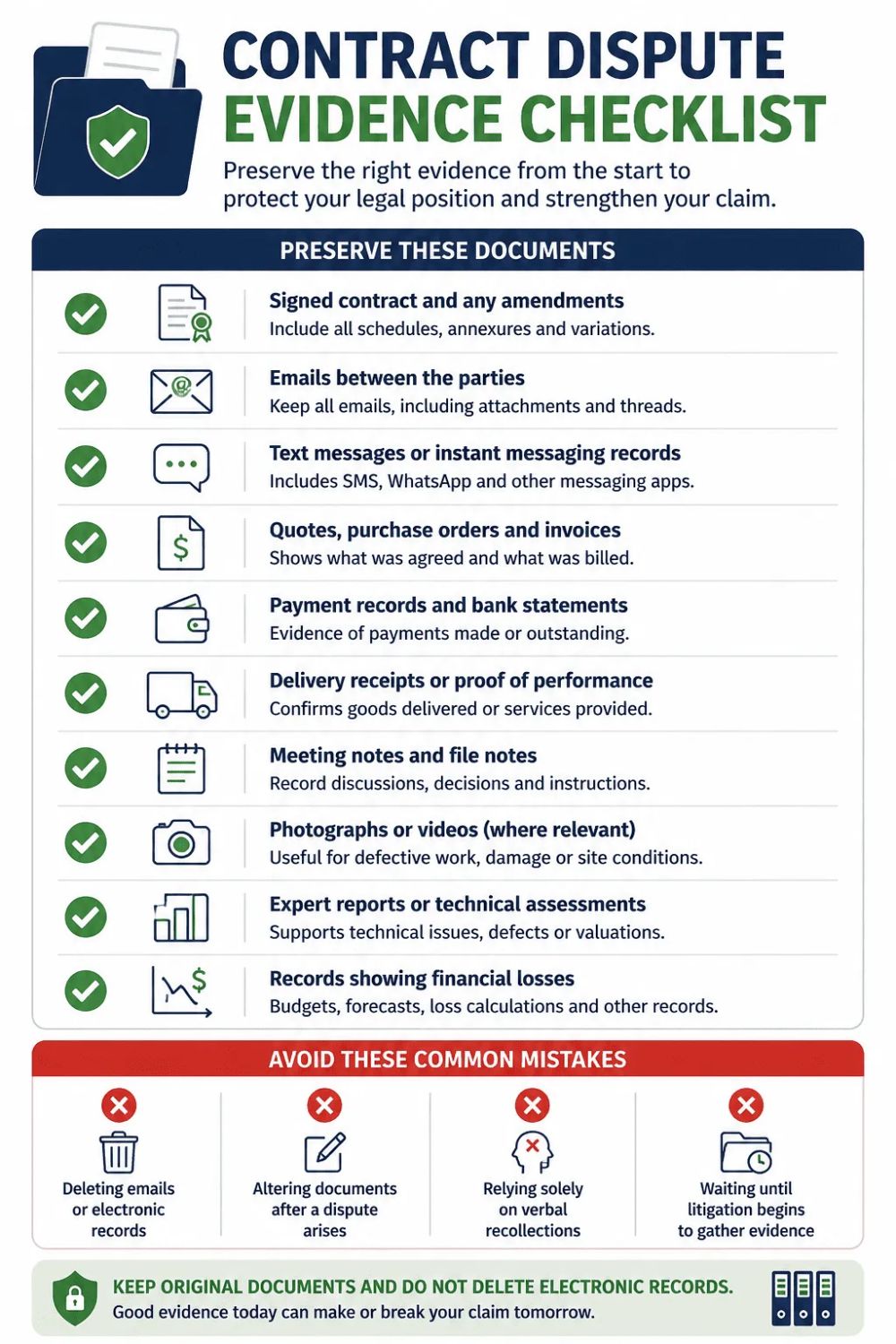
The success of a breach of contract claim depends on the quality of the evidence as much as the legal principles.
For a detailed explanation of what legally constitutes a breach, the immediate steps to take, and how Queensland courts assess contractual disputes, read our guide on Breach of Contract in Queensland. Or, where no formal written contract exists, alternative legal remedies may still be available. Learn more in Enforcing Payment of a Debt Without a Contract.
Courts generally consider whether a valid contract was formed, how its terms should be interpreted, whether a breach occurred, whether the breach caused the claimed loss, whether that loss is recoverable, and whether the innocent party took reasonable steps to mitigate its losses.
Contemporaneous evidence is often decisive. Written contracts, emails, text messages, invoices, meeting notes and other business records frequently carry greater weight than recollections given months or years later.
When interpreting commercial agreements, courts apply an objective approach. In Mount Bruce Mining Pty Ltd v Wright Prospecting Pty Ltd [2015] HCA 37; (2015) 256 CLR 104at [46]–[51], the High Court confirmed that the rights and liabilities of parties under a written contract are determined objectively by reference to the contract’s text, context and purpose.
In Electricity Generation Corporation v Woodside Energy Ltd [2014] HCA 7; (2014) 251 CLR 640 at [35], the High Court reaffirmed that a commercial contract is construed by asking what a reasonable businessperson would have understood its terms to mean, having regard to the language used, the surrounding circumstances known to the parties and the commercial purpose or objects to be secured by the contract.
Importantly, having a strong legal case does not necessarily mean litigation is commercially worthwhile. A claim with excellent legal prospects may still produce little practical benefit if the judgment cannot be effectively enforced.
Common Mistakes Seen in Practice
One of the biggest mistakes businesses make before they sue for breach of contract is focusing only on whether they are right. The better question is whether the claim is provable, proportionate, enforceable and likely to deliver a better result than settlement.
In Queensland, obtaining judgment is only one stage of the recovery process. Before proceedings begin, consideration should be given to the judgment debtor’s likely financial position and the enforcement procedures potentially available under the Uniform Civil Procedure Rules 1999 (Qld), including enforcement warrants, enforcement hearings and, where appropriate, insolvency processes.
A recurring commercial mistake is commencing litigation without first assessing whether a favourable judgment can realistically be enforced. Legal success and financial recovery are separate issues, and both should be investigated before proceedings begin.
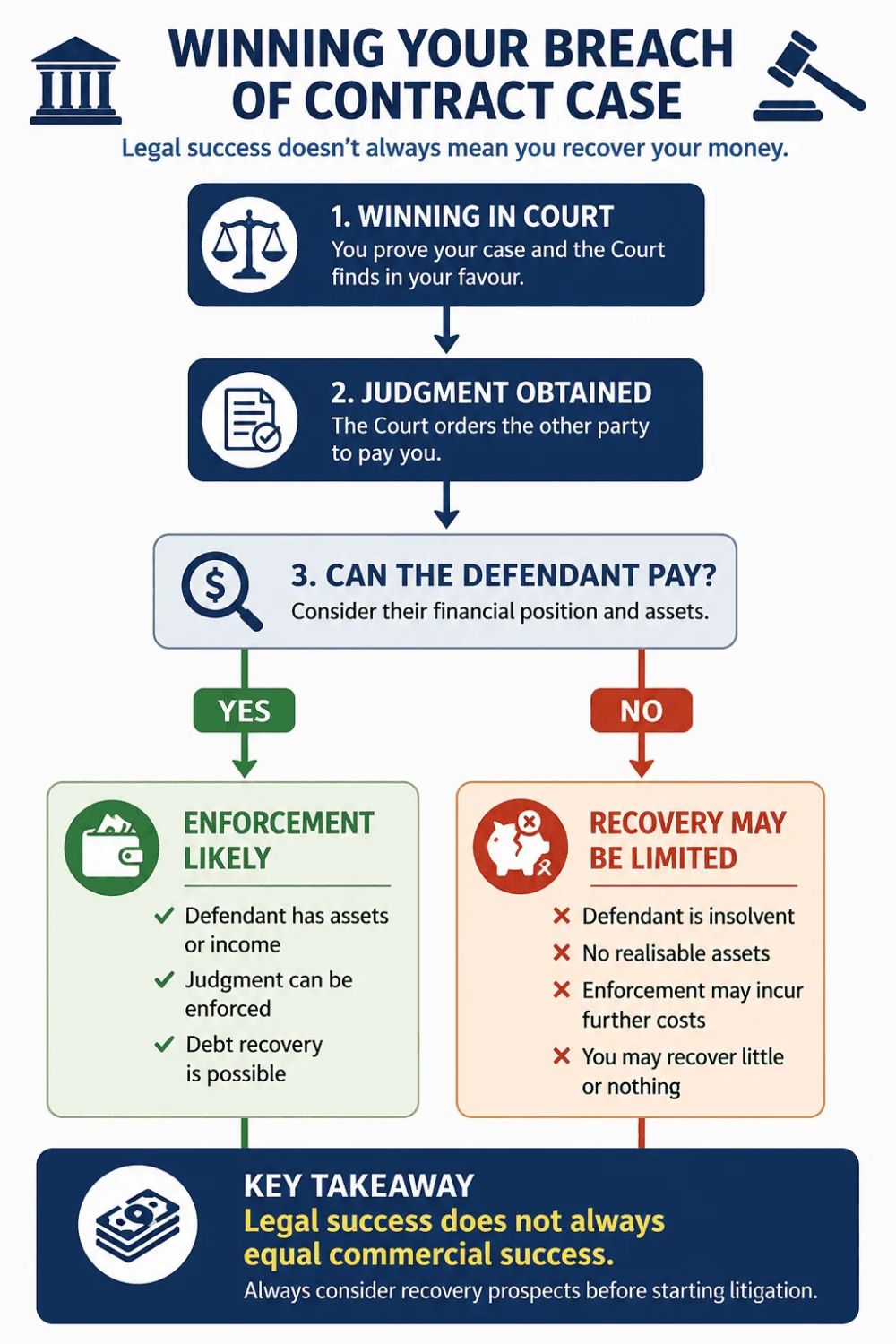
I frequently see businesses commence proceedings against defendants who have no realistic capacity to satisfy a judgment, turning a successful case into an unrecoverable expense. Others wait too long to obtain legal advice, allowing documents to disappear, witnesses’ memories to fade or settlement opportunities to be lost. Poor document preservation, particularly failing to retain emails, text messages and financial records, can also weaken an otherwise strong claim.
Another common mistake is allowing frustration or principle to drive the litigation strategy. Equally, many parties overestimate the damages they can recover or fail to properly quantify their losses before commencing proceedings. The strongest outcomes are usually achieved by objectively assessing legal merit, commercial recovery prospects and realistic settlement opportunities from the outset, rather than focusing solely on winning the dispute.
Key Takeaways When Trying to Sue for Breach of Contract
Whether you should sue for breach of contract is ultimately a commercial decision, not just a legal one. Strong contractual rights do not always justify litigation if recovery is uncertain or costs outweigh the benefit. Obtaining early legal advice can identify stronger recovery strategies, while negotiation and settlement often deliver faster, more cost-effective outcomes than court proceedings.
Frequently Asked Questions
The following questions address common issues that arise before you sue for breach of contract, including whether a written agreement is required, what evidence is needed, how long you have to start proceedings, whether legal costs can be recovered, and what happens if the other party cannot pay a judgment.
Can I sue for breach of contract?
Yes, if a legally enforceable contract exists, the other party has breached its terms, and you have suffered a recoverable loss. Before commencing proceedings, it is also important to consider whether litigation is commercially worthwhile and whether any judgment is likely to be recoverable.
What happens if someone breaches a contract in Australia?
A breach of contract may entitle the affected party to damages and, in sufficiently serious cases, may permit termination. In some circumstances, a court may grant discretionary relief such as specific performance, an injunction or a declaration, but an order compelling performance is not automatically available. The appropriate remedy depends on the contract, the nature and consequences of the breach, the adequacy of damages and the surrounding circumstances.
How long do I have to sue for breach of contract?
In Queensland, an action founded on a simple contract generally must be commenced within six years after the cause of action arises under section 10(1)(a) of the Limitation of Actions Act 1974 (Qld). For an ordinary breach-of-contract claim, time will usually begin to run when the breach occurs, not when the claimant later discovers the full extent of the financial consequences. Actions upon deeds are also now generally subject to a six-year period under section 10(3), although transitional provisions may affect deeds entered into before 1 August 2025. Different limitation periods, contractual provisions, equitable principles or statutory exceptions may apply in particular cases, so the limitation date should be identified promptly.
Can I sue for breach of contract without a written agreement?
Yes. An oral contract may be legally enforceable if the essential elements of contract formation and the alleged terms can be proved. However, legislation requires certain transactions, including some contracts concerning interests in land and some guarantees, to be recorded or evidenced in writing. Other legislation may also impose particular form or disclosure requirements. Even where no statutory writing requirement applies, proving the existence and terms of an oral agreement is usually more difficult, making emails, text messages, invoices, conduct and other contemporaneous records particularly important.
What evidence do I need to prove a breach of contract?
Useful evidence includes the written contract, emails, text messages, invoices, purchase orders, payment records, correspondence and meeting notes. Contemporaneous business records often carry significant weight when establishing what was agreed and whether a breach occurred.
Is it worth it to sue for breach of contract?
Not always. A strong legal claim does not necessarily justify litigation if legal costs, delay or enforcement risks outweigh the likely recovery. Assessing both the legal merits and the commercial outcome before commencing proceedings is often the most effective approach.
Can I recover my legal costs if I win?
In Queensland civil proceedings, costs are in the court’s discretion but ordinarily follow the event unless the court orders otherwise. This commonly means that the unsuccessful party is ordered to pay a contribution towards the successful party’s costs. The amount recovered will not necessarily equal the successful party’s actual legal expenditure, and the court may make a different order because of settlement offers, divided success, party conduct or other relevant circumstances.
Can a breach of contract dispute be resolved without going to court?
Yes. Many commercial disputes resolve through negotiation, mediation, without prejudice settlement discussions or arbitration. Depending on the process and the parties’ agreement, these alternatives may be faster, less expensive and more private than a court trial, while giving the parties greater control over the outcome.
What should I do if I receive a letter alleging breach of contract?
Do not ignore the letter or respond impulsively. Preserve all relevant documents and communications, review the contract carefully and obtain legal advice before admitting liability or making settlement offers. Early advice can significantly improve your negotiating position.
What if the other party cannot pay a judgment?
Even if you succeed in court, recovering the money may be difficult if the defendant is insolvent or has few assets. Before starting litigation, it is sensible to assess the other party’s financial position and whether any judgment is likely to be enforceable.
The content of this article is intended to provide a general guide to the subject matter. Specialist advice should be sought about your specific circumstances.
[View Source]