
- within Corporate/Commercial Law topic(s)
- with Senior Company Executives, HR and Finance and Tax Executives
- in United States
- with readers working within the Banking & Credit, Insurance and Property industries
Article Summary
Frustration of contract is one of the most misunderstood doctrines in Australian contract law. Many people assume that a contract automatically ends if unexpected circumstances make it difficult, expensive or commercially unworkable to perform. In reality, Australian courts apply the doctrine of frustration only in exceptional circumstances. The legal test is whether a supervening event fundamentally changes the contractual obligations so that performance becomes radically different from what the parties originally agreed, not merely more difficult, delayed or less profitable.
This guide explains exactly when frustration of contract applies under Australian law, how it differs from force majeure, and why financial hardship, increased costs, supply chain disruptions and changing commercial circumstances will usually not be enough to discharge a contract. It examines the leading High Court authorities, including Codelfa Construction Pty Ltd v State Rail Authority of NSW and Brisbane City Council v Group Projects Pty Ltd, together with influential English decisions that continue to shape Australian law.
You will learn the legal requirements for establishing frustration, the evidence needed to prove it, the consequences of a contract being frustrated, whether money paid before frustration can be recovered, and the alternative options available where frustration does not apply. The article also explains the risks of incorrectly asserting frustration, including the possibility that refusing to perform a contract may itself amount to repudiation and expose a party to substantial damages.
Whether you are dealing with a construction dispute, commercial lease, supply agreement, business contract or another contractual relationship affected by unexpected events, this guide provides a practical explanation of the law together with real-world examples, leading court decisions and commercially focused guidance to help you understand your legal rights before deciding whether to suspend performance, renegotiate the agreement or terminate the contract.
Frustration of Contract Explained
Frustration of contract may discharge parties from further performance only in limited circumstances where a supervening event fundamentally changes the nature of the contractual obligations, rather than simply making performance more difficult or expensive. Whether the event was foreseeable is relevant, but the central question is whether the contract, properly construed, allocated the risk and whether performance has become radically different from what the parties originally undertook.
The doctrine is applied sparingly by Australian courts, and financial hardship, increased costs or reduced profitability will rarely be enough. Because the legal threshold is high, wrongly treating a contract as frustrated may itself amount to a repudiation of the agreement, exposing a party to damages for breach. Understanding when frustration genuinely applies is therefore critical for businesses and individuals facing unexpected events that disrupt contractual performance, particularly before deciding to stop performing or terminate the contract.
If you are struggling with contract disputes or mediation and require legal assistance, contact us today and get a free 30-minute consultation with one of our commercial litigation professionals, and let us help protect your rights.
What Is Frustration of a Contract?
Many commercial disputes begin because parties confuse force majeure with frustration. Although both deal with unexpected events, they arise from entirely different legal principles and produce different outcomes. Identifying the correct doctrine is important because relying on the wrong legal basis may expose a party to a breach of contract claim.
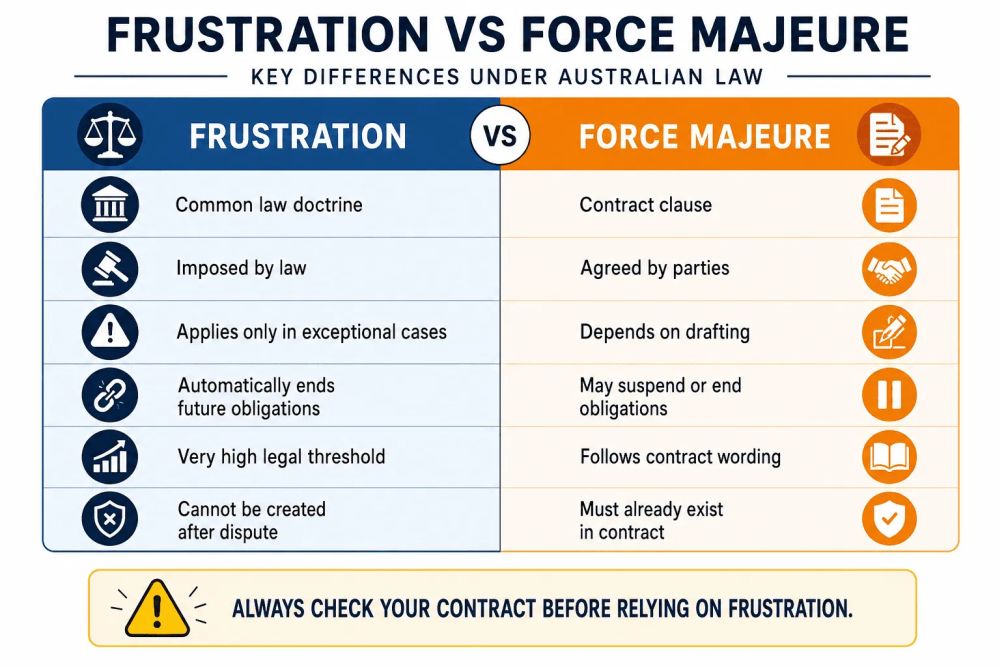
Frustration of contract is a common law doctrine that automatically discharges a contract from further performance where a supervening event, occurring after the contract is formed and not caused by the party seeking to rely on it, makes performance radically different from what the parties originally undertook. The doctrine will not ordinarily apply where the contract has already allocated the relevant risk. Unlike force majeure, frustration does not arise from the parties’ agreement but is imposed by law where the legal requirements are satisfied.
The High Court explained the doctrine in Codelfa Construction Pty Ltd v State Rail Authority of NSW (1982) 149 CLR 337, Mason J adopted the established formulation that frustration occurs where, without default of either party, a contractual obligation has become incapable of being performed because the circumstances in which performance is called for would make it:
a thing radically different from that which was undertaken by the contract.
The relevant discussion appears at 357 of the Commonwealth Law Reports.
Frustration differs from breach of contract because neither party has failed to perform a contractual obligation. It also differs from termination for breach, which depends on one party’s wrongful conduct, and from force majeure, which arises from an express contractual clause allocating risk between the parties. Frustration arises by operation of law rather than from an express contractual term. However, the contract’s wording remains central to the analysis because the court must determine whether the parties have already allocated the relevant risk. A sufficiently comprehensive force majeure or other risk-allocation clause may therefore leave no room for the doctrine to operate in relation to that event.
Can frustration still apply if my contract contains a force majeure clause?
Potentially, although frustration will usually be unavailable to the extent that the force majeure clause comprehensively deals with the event and its consequences. If a force majeure clause already allocates responsibility for the event that has occurred, Australian courts are less likely to find the contract has been frustrated. Whether frustration remains available depends on the wording of the clause and whether it fully addresses the relevant risk.
If your agreement contains a force majeure clause, the contractual allocation of risk should usually be considered before relying on the common law doctrine of frustration. Our detailed guide on Frustration of Contract & Force Majeure Clauses explains the interaction between these two legal concepts.
The same principle was recognised in the persuasive decision of Davis Contractors Ltd v Fareham Urban District Council [1956] AC 696, which confirms that the doctrine does not apply merely because performance becomes more difficult or expensive.
Lord Reid stated:
In a contract of this kind the contractor undertakes to do the work for a definite sum and he takes the risk of the cost being greater or less than he expected… It may be that delay could be of a character so different from anything contemplated that the contract was at an end, but in this case in my opinion the most that could be said is that the delay was greater in degree than was to be expected. It was not caused by any new and unforeseeable factor or event: the job proved to be more onerous but it never became a job of a different kind from that contemplated in the contract.
When Is a Contract Legally Frustrated?
Australian courts apply a narrow legal test before finding that a contract has been frustrated. The party relying on frustration must establish that a supervening event, falling outside the risks allocated by the contract, has made performance radically different from what was originally undertaken rather than merely more difficult, delayed or less profitable.
The Event Must Fall Outside the Contractual Allocation of Risk
The event must occur after the contract is formed and must not have been brought about by the party seeking to rely on frustration. The court will examine whether, on its proper construction, the contract allocated the risk of that event or its consequences to either party. Foreseeability is relevant to that inquiry, but an event is not necessarily incapable of frustrating a contract merely because it was theoretically foreseeable. If the contract expressly addresses the event through a force majeure clause or another risk-allocation provision, frustration is less likely to apply.
Performance Must Become Fundamentally Different
The court then considers whether the supervening event has radically transformed the parties’ obligations. In Codelfa Construction Pty Ltd v State Rail Authority of NSW (1982) 149 CLR 337, Mason J explained that frustration arises where performance would render the obligation “a thing radically different from that which was undertaken by the contract.”
This may occur where the contractual subject matter is destroyed, a change in law makes performance unlawful, an event forming the foundation of the agreement is cancelled, or a delay or other supervening circumstance transforms the obligation into something fundamentally different. Physical or legal impossibility may establish frustration, but impossibility is not essential if the contractual obligation has otherwise become radically different. The High Court has consistently emphasised that frustration depends on the particular contractual obligations and the practical effect of the supervening event.
In Brisbane City Council v Group Projects Pty Ltd (1979) 145 CLR 143, the Court reinforced that frustration is not established merely because contractual performance has become more difficult; the event must fundamentally alter the contractual bargain.
Wilson J explained, at 160–163 of the Commonwealth Law Reports:
…What I understand his Lordship’s approach to involve is, then, a comparison between the contemplated situation, as revealed by the terms of the contract on its true construction, and the situation in fact resulting from the frustrating event. If they be ‘fundamentally different’ the contract is frustrated
The combination of these considerations satisfies me that this is a proper case for the application of the doctrine of frustration.
By contrast, temporary disruption will usually not frustrate a contract unless it destroys its underlying commercial purpose. The persuasive decision in National Carriers Ltd v Panalpina (Northern) Ltd [1981] AC 675 similarly demonstrates that the duration and practical effect of an interruption are critical when assessing whether frustration has occurred.
Lord Wilberforce explained that the interruption was insufficiently serious when considered against the remaining duration of the lease:
So the position is that the parties to the lease contemplated, when Kingston Street was first closed, that the closure would probably last for a year or a little longer. In fact it seems likely to have lasted for just over eighteen months. Assuming that the street is re-opened in January 1981, the lease will have three more years to run.
My Lords, no doubt, even with this limited interruption the appellant’s business will have been severely dislocated… But this does not approach the gravity of a frustrating event. Out of ten years it will have lost under two years of use: there will be nearly three years left after the interruption has ceased. This is a case, similar to others, where the likely continuance of the term after the interruption makes it impossible for the lessee to contend that the lease has been brought to an end.
Can You Get Out of a Contract Due to Frustration?
Yes, but only if the legal requirements for frustration are satisfied. Where a contract is genuinely frustrated, it is automatically discharged by operation of law, meaning the parties are generally released from performing future contractual obligations without either party being in breach.
However, frustration does not erase everything that has already occurred. Rights that accrued before the frustrating event, such as payment obligations that had already fallen due or liability for an earlier breach, will usually remain enforceable. Frustration affects future performance, not obligations that have already crystallised.
Can I simply stop performing if the contract has become difficult?
No. A contract is not frustrated merely because performance has become more expensive, inconvenient or commercially unattractive. Incorrectly asserting frustration and refusing to perform may itself amount to a repudiation of the contract, exposing you to damages or other contractual remedies.
In practice, one of the most common and costly mistakes is treating a significant commercial setback as frustration without first analysing the contract and surrounding circumstances. Obtaining legal advice before suspending performance or attempting to terminate the agreement is often commercially prudent, particularly where substantial financial obligations or ongoing business relationships are involved.
Does Financial Difficulty or Economic Hardship Count?
Generally, no. Australian courts consistently distinguish between genuine frustration and ordinary commercial risk. A contract is not frustrated simply because it has become more expensive, less profitable or more difficult to perform.
Inflation, increased construction or operating costs, labour shortages, reduced profitability and financing difficulties will ordinarily be treated as commercial risks, particularly where performance remains substantially possible. Supply problems may also fall into that category, although a sufficiently severe disruption could potentially frustrate a contract where no reasonable alternative performance is available and the resulting obligation is radically different.
The relevant distinction is between ordinary commercial hardship and a radical change in the contractual obligation. Although frustration commonly involves impossibility or illegality, performance need not become literally impossible before the doctrine can apply, but merely becoming more onerous, expensive or uneconomic will ordinarily be insufficient. The question is whether the supervening circumstances have made the performance required fundamentally different from what the parties originally agreed.
The leading persuasive authority, Davis Contractors Ltd v Fareham Urban District Council [1956] AC 696, rejected a frustration claim where labour shortages and increased costs made the contract substantially more expensive to complete. The High Court adopted the same approach in Codelfa Construction Pty Ltd v State Rail Authority of NSW (1982) 149 CLR 337, confirming that frustration requires a fundamental change in contractual obligations, not merely greater expense or inconvenience.
Can Supply Chain Disruptions Cause Frustration of Contract?
Potentially, but not automatically. Events such as pandemics, import or export restrictions, government shutdowns, destruction of essential goods, natural disasters, war and international sanctions may frustrate a contract if they fundamentally alter the contractual obligations or make performance legally or practically impossible. Whether frustration applies depends on the particular facts rather than the type of event itself.
Courts will consider the duration of the disruption, the nature and purpose of the contract, whether the parties allocated the relevant risk within the contract, whether reasonable alternative methods of performance remained available, and whether a force majeure clause already addresses the event. Where the contract expressly allocates the risk of disruption, frustration is less likely to apply because the parties have already agreed how that risk should be managed.
Did COVID-19 automatically frustrate contracts?
No. The pandemic did not automatically frustrate every contract. Some agreements were frustrated because particular government restrictions made performance impossible or radically different, while others remained capable of performance despite greater cost or inconvenience. Each case turns on the contract’s terms, the nature of the disruption and its practical effect on performance.
When Do Courts Reject Claims of Commercial Impracticality?
Courts commonly reject frustration where the contract can still be substantially performed despite becoming more burdensome or less profitable. Claims based on increased expense, reduced profitability, foreseeable commercial risks, temporary inconvenience, staffing shortages or supply difficulties will usually fail if performance remains possible.
Similarly, frustration is unlikely where alternative methods of performance are reasonably available, even if they are slower, less convenient or more costly. The doctrine is concerned with legal impossibility or a fundamental change in contractual obligations, not ordinary commercial adversity.
In Codelfa Construction Pty Ltd v State Rail Authority of NSW (1982) 149 CLR 337, the High Court confirmed at [20] that frustration only arises where a supervening event renders performance “a thing radically different from that which was undertaken by the contract.”
From a practical perspective, businesses often overestimate the legal significance of commercial hardship. Courts distinguish between an unprofitable or burdensome contract and one whose performance has become impossible, unlawful or radically different from what was undertaken. Only the latter category is capable of giving rise to frustration.
What Evidence Is Needed to Prove Frustration of a Contract?
In commercial disputes, the way frustration is raised can be as important as the underlying legal argument. Before asserting that a contract has ended, parties should carefully consider how correspondence is framed, preserve relevant documents and avoid making admissions that may later undermine their position if litigation becomes necessary.
The burden of proving frustration rests on the party asserting it. Courts determine the issue by examining objective evidence rather than commercial opinion or hindsight.
Relevant evidence commonly includes the executed contract, a clear timeline of events, documents identifying the alleged supervening event, correspondence between the parties, government orders or legislative changes affecting performance, and expert evidence where technical issues arise. Financial records may also assist where they demonstrate the practical impact of the event, although financial loss alone will not establish frustration.
From a litigation perspective, one of the most common problems is inadequate contemporaneous evidence. Delays in obtaining legal advice can result in missing documents, inconsistent communications or avoidable admissions. Seeking advice promptly helps preserve evidence, assess whether frustration is genuinely available and reduce the risk of taking steps that could later be treated as a wrongful repudiation of the contract.
What Happens After a Contract Is Frustrated?
Where a contract is frustrated, it is automatically discharged by operation of law from the time of the frustrating event. The parties are generally released from performing future contractual obligations, but rights and liabilities that accrued beforehand usually remain enforceable.
For example, payment obligations that fell due before frustration are ordinarily still payable, while existing breaches remain actionable. If frustration is unavailable and one party refuses to perform, a breach of contract claim may arise. Our article on Breach of Contract in Australia explains available remedies, damages and termination rights. Some provisions may continue to operate after frustration if, properly construed, they are intended to govern disputes or consequences arising after discharge. Arbitration, jurisdiction and dispute-resolution provisions commonly require separate consideration. The effect of frustration on guarantees, indemnities and security interests will depend on their wording, the nature of the secured or guaranteed obligations and any accrued rights; they should not be assumed automatically to survive in every case.
Does frustration cancel everything?
No. Frustration ends future obligations, not every contractual right or liability that has already arisen.
A practical complication is that Australia has no nationally uniform statutory regime governing the financial consequences of frustrated contracts. New South Wales has the Frustrated Contracts Act 1978 (NSW), while Victoria regulates frustrated contracts through Part 3.2 of the Australian Consumer Law and Fair Trading Act 2012 (Vic). In jurisdictions without a generally applicable statutory adjustment regime, including Queensland, the consequences will ordinarily depend on the contract and applicable common law principles. The governing law of the contract must therefore be identified before conclusions are reached about money paid, expenses incurred or benefits conferred.
Can You Recover Money Paid Before Frustration?
Possibly, but not automatically. At common law, frustration discharges future obligations rather than reversing rights that accrued before the frustrating event. Whether money paid before frustration can be recovered depends on the particular circumstances and the legal basis for the claim.
At common law, money paid in advance may generally be recoverable where the contract has been discharged and there has been a total failure of the consideration for the payment. Recovery will not ordinarily be available on that basis where the payer has received and retained a substantial part of the bargained-for benefit. The contract’s terms, whether the payment was conditional, the nature of any benefit already received and any applicable statutory regime must all be considered.
Australia does not have a single national statute governing the financial consequences of frustration. Some jurisdictions, including New South Wales and Victoria, have statutory adjustment regimes, while other jurisdictions rely principally on the contract and common law. Recovery is therefore jurisdiction-sensitive and requires careful analysis of the governing law, the contractual payment provisions, the performance already received and the basis on which repayment is claimed.
What Are Your Options If Frustration Does Not Apply?
Where performance remains possible, renegotiating the agreement may be a better commercial outcome than attempting to rely on frustration. See our guide on How to Renegotiate a Contract Safely After Signing for practical strategies to document legally effective contract variations.
If frustration is unavailable, parties should consider alternative commercial and contractual solutions before abandoning the agreement. Depending on the circumstances, these may include negotiating a contract variation, executing a deed of variation, agreeing to an extension of time, temporarily suspending performance, or relying on an applicable force majeure clause. Where the contract permits, termination rights may also be available, while negotiated settlement can often preserve commercial relationships and avoid litigation.
If a dispute cannot be resolved commercially, obtaining legal advice early allows parties to assess their contractual position, preserve evidence and develop an appropriate litigation strategy.
Can I terminate the contract if frustration does not apply?
Possibly, but not merely because frustration has failed. A separate right to terminate may arise under an express contractual provision, because of repudiation, breach of an essential term, a sufficiently serious breach of an intermediate term, or another recognised legal basis. Purporting to terminate without a valid right may itself constitute repudiation and expose the terminating party to damages. The contract and the surrounding circumstances should therefore be reviewed carefully before any termination notice is issued.
Common Mistakes Seen in Practice Regarding Frustration of Contract
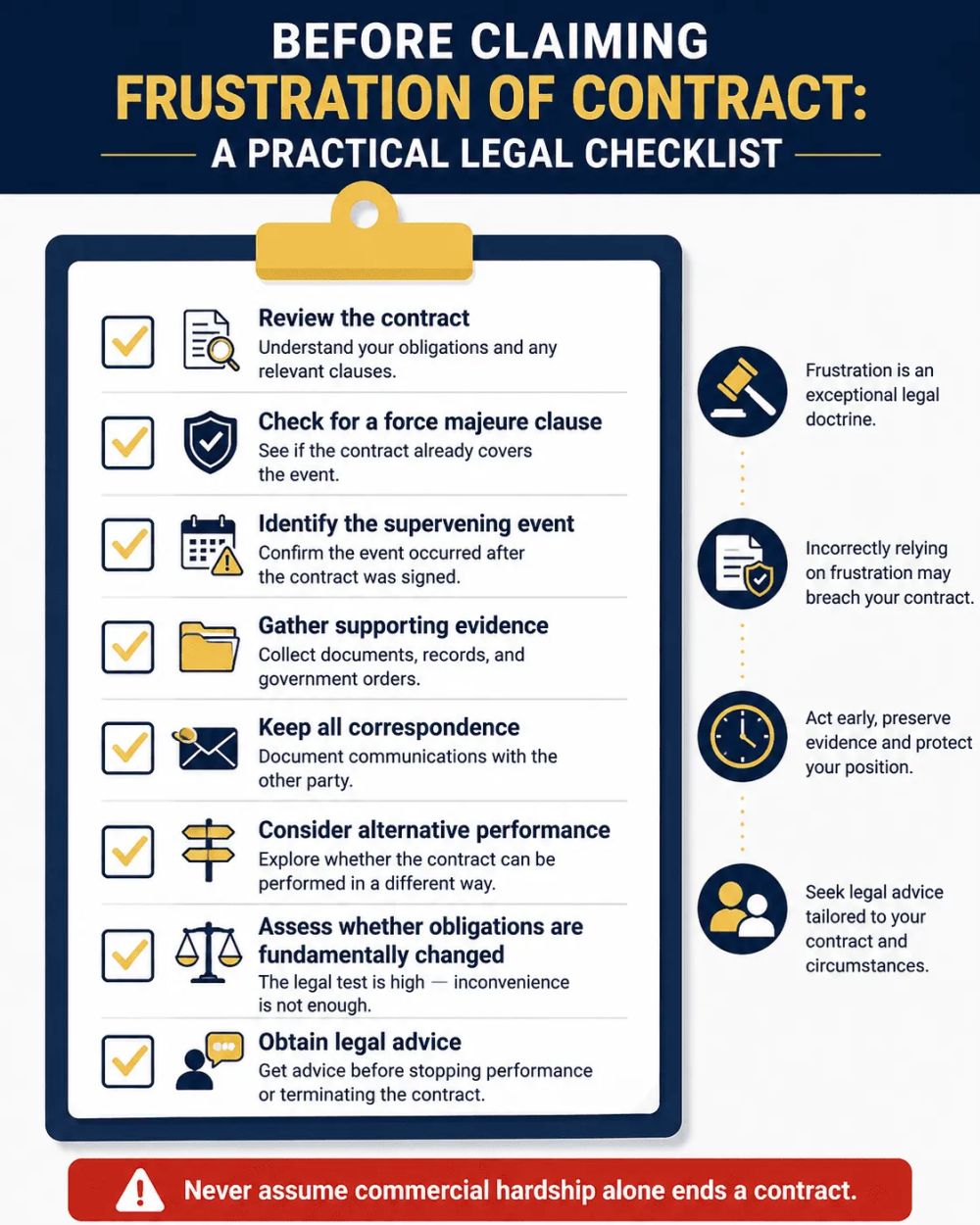
Incorrectly asserting frustration can expose a party to damages for breach of contract, making the first steps after a disruptive event critical. Before suspending performance or attempting to terminate an agreement:
- review the entire contract, including force majeure, notice, variation and termination provisions;
- identify precisely what event has affected performance and when it occurred;
- assess whether performance is impossible or radically different, rather than merely more expensive or inconvenient;
- investigate reasonable alternative methods of performance;
- preserve correspondence, government directions, expert reports and other contemporaneous evidence;
- comply with any contractual notice requirements; and
- obtain legal advice before communicating that the contract has ended or refusing further performance.
Many frustration disputes arise because businesses make commercial decisions before properly assessing their legal position. One of the most common mistakes I see is assuming that financial hardship, rising costs or reduced profitability automatically bring a contract to an end. In reality, Australian courts apply a much narrower doctrine.
Another frequent error is confusing a contractual force majeure clause with the common law doctrine of frustration. They operate differently and may produce very different outcomes. I also regularly see parties stop work, suspend payments or terminate agreements before obtaining legal advice, creating unnecessary exposure to breach of contract claims.
Procedural mistakes are equally common. Businesses often overlook contractual notice requirements, fail to preserve correspondence or government directions supporting the alleged supervening event, or wait until litigation has commenced before reviewing how the contract allocated commercial risk. Since COVID-19, some parties have also assumed that any pandemic-related disruption establishes frustration, despite each case depending on its own facts. Careful legal analysis at an early stage is usually far less expensive than defending avoidable litigation later.
Key Takeaways
Frustration is an exceptional doctrine that Australian courts apply only where a supervening event, falling outside the contractual allocation of risk, fundamentally changes the contractual obligations. Commercial hardship alone is usually insufficient. Incorrectly relying on frustration may itself amount to a breach of contract. If frustration does not apply, you may still have a contractual or common law right to terminate. Our guide on Terminating a Contract Legally: When Can You Walk Away in Queensland? explains when termination is legally available and the risks of getting it wrong. Obtaining early legal advice can help protect contractual rights, manage commercial risk and avoid costly disputes.
Frequently Asked Questions
The following frequently asked questions address common issues involving frustration of contract, including whether changed circumstances are enough, why financial hardship usually fails, how force majeure clauses affect the analysis, what evidence is required, and the risks of wrongly treating a contract as ended.
Can I legally walk away from a contract if circumstances change?
Not merely because circumstances have changed. Frustration applies only where a supervening event, falling outside the contractual allocation of risk, makes the required performance impossible, unlawful or radically different from what was originally undertaken. A contract does not become frustrated simply because it has become more expensive, inconvenient or less profitable to perform.
What happens if I wrongly claim a contract has been frustrated?
If frustration does not legally apply, refusing to perform the contract may amount to repudiation or breach of contract. The other party may accept that breach, terminate the agreement and seek damages or other remedies. Obtaining legal advice before stopping performance can significantly reduce this risk.
Can financial hardship or rising costs frustrate a contract?
Generally, no. Increased costs, inflation, labour shortages, reduced profitability and financing difficulties are usually regarded as ordinary commercial risks. Australian courts require a fundamental change in the contractual obligations, not merely a contract that has become more expensive or commercially unattractive.
Can supply chain disruptions cause frustration of contract?
Possibly, but only in limited circumstances. Supply chain disruptions, import restrictions or government actions may frustrate a contract if they fundamentally alter performance or make it impossible. Temporary delays or alternative methods of performance may prevent frustration from applying.
Does a force majeure clause prevent frustration of contract?
It can. If the contract contains a force majeure clause that allocates the relevant risk, courts are less likely to find the contract has been frustrated. The wording of the clause and the particular circumstances will determine whether the contractual mechanism applies instead of the common law doctrine.
What evidence do I need to prove frustration of contract?
Useful evidence includes the executed contract, a timeline of events, correspondence between the parties, government directions or legislative changes, documents showing the supervening event and, where appropriate, expert evidence. The burden of proving frustration rests on the party relying on it.
Can I recover money already paid if a contract is frustrated?
Possibly. At common law, money paid in advance may be recoverable where the contract has been discharged and there has been a total failure of the consideration for that payment. Recovery may be unavailable where a substantial part of the bargained-for benefit has already been received. The result can also be affected by the contract’s terms and by legislation in jurisdictions such as New South Wales and Victoria.
Does frustration cancel all contractual obligations?
No. Frustration generally releases the parties from future obligations only. Rights and liabilities that accrued before the frustrating event, including payment obligations already due or liability for an earlier breach, will usually remain enforceable.
What should I do before claiming frustration of a contract?
Review the contract carefully, identify any force majeure clause or termination rights, preserve evidence of the supervening event and obtain legal advice before suspending performance. Acting too quickly may expose you to a claim for breach if frustration is later found not to apply.
Can COVID-19 or another government restriction automatically frustrate a contract?
No. Neither COVID-19 nor government restrictions automatically frustrate every contract. Australian courts assess each case individually, considering the contract’s terms, the nature and duration of the disruption, whether performance remained possible and whether the parties had already allocated the relevant risk.
The content of this article is intended to provide a general guide to the subject matter. Specialist advice should be sought about your specific circumstances.
[View Source]