- within Employment and HR and Transport topic(s)
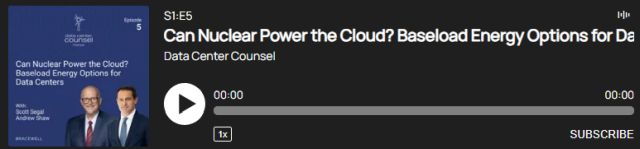
In this episode of Bracewell's Data Center Counsel podcast, Scott Segal and Andrew Shaw explore whether nuclear energy can meet the rapidly growing electricity demands of AI-driven data centers. As hyperscale facilities transform electricity demand into a system-level challenge, the discussion examines why nuclear — both large light water reactors and small modular reactors (SMRs) — is uniquely positioned to provide firm, carbon-free baseload power.
The conversation covers a range of topics, including:
- the operational alignment between nuclear generation and high-load data centers
- emerging partnerships between tech companies and nuclear operators
- Nuclear Regulatory Commission (NRC) licensing reforms
- fuel supply constraints
- safety considerations
Episode Highlights
[3:07] The Power Demand Shift: Why Nuclear Is Back in Conversation: The episode opens with a discussion of how AI and hyperscale data centers are reshaping US electricity demand. Data centers require continuous, high-load power with minimal interruption, making nuclear's high-capacity factor strong operational match. Scott and Andrew emphasize that this renewed interest is driven as much by reliability and grid constraints as by climate goals.
[5:26] Large Reactors Versus SMRs: Matching Scale to Need: Andrew explains the complementary roles of traditional large light water reactors and emerging SMRs. Large reactors can serve massive hyperscale campuses, while SMRs offer modularity, siting flexibility and potential cost efficiencies as deployment scales. The "nth-of-a-kind" cost reductions seen at Georgia's Vogtle project illustrate how standardization and repetition can reduce future build costs.
[10:41] Tech-Nuclear Partnerships Gain Momentum: Scott and Andrew note a surge of power purchase agreements (PPAs) between tech companies and nuclear operators. Examples include Microsoft's agreement tied to the restart of the former Three Mile Island facility, as well as partnerships involving Meta, Google, Amazon and SMR developers. These agreements provide revenue certainty for nuclear projects while helping tech companies meet long-term clean energy commitments.
[14:46] Licensing Reform and Regulatory Streamlining: The discussion turns to the bipartisan ADVANCE Act and subsequent executive actions aimed at modernizing and accelerating NRC licensing. With overwhelming congressional support, reforms focus on efficiency, clearer timelines and support for advanced and small reactors. Andrew and Scott note that predictable licensing timelines are critical to scaling new nuclear deployment for data center demand.
[18:30] Fuel Supply, Safety and Waste: The Long-Term Challenges: The episode concludes with a look at nuclear fuel supply constraints, particularly US reliance on foreign enrichment services and the need to build domestic capacity. On safety, Scott and Andrew underscore nuclear's strong historical safety record and public confidence gains. While waste management remains a policy challenge, industry leaders and policymakers continue advancing practical solutions to address it.
The content of this article is intended to provide a general guide to the subject matter. Specialist advice should be sought about your specific circumstances.