
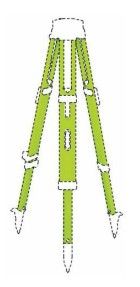
The Trademark Trial and Appeal Board (TTAB) saw green when an applicant tried to register a particular shade of green (Pantone 2297C) on the Supplemental Register (for descriptive marks capable of designating the source of a product or service) as a trademark applied to the legs of a “construction and surveyor tripod.”
The TTAB affirmed the Examining Attorney’s determination that the single color was functional. As such, the proposed mark was not capable of designating source and could not be registered on either the Principal or Supplemental Register even though the Applicant claimed to have used the mark for about 5 years before the filing date of its application.
Background for finding a mark is functional
The U.S. Supreme Court stated that a design feature is functional, and therefore not registrable as a trademark:
“if it is essential to the use or purpose of the article or if it affects the cost or quality of the article,” that is, if exclusive use of the feature would put competitors at a significant non-reputation-related disadvantage. https://supreme.justia.com/cases/federal/us/514/159/
A design mark may be functional if, among other things, it:
- improves the safety or visibility of a product or the product’s user;
- facilitates identification of a particular type of product;
- serves a particular function in the relevant market or industry; or
- simply makes the product more useful to the user.
In determining whether a design mark is functional, evidentiary considerations may include, among others:
- The existence of a utility patent disclosing the utilitarian advantages of the design;
- Advertising materials which tout the design’s utilitarian advantages;
- The availability to competitors of functionally equivalent designs; and
- Facts indicating that the design results in a comparatively simple or cheap method of manufacturing the product.
The color green for tripods
The TTAB applied these considerations in rejecting an application to register the color green as a trademark for tripods on the ground that this proposed mark was functional.
Utility Patent. There was no relevant utility patent.
Advertising. “High visibility” or its equivalent was touted for green tripods on
- Applicant’s own website
- Amazon’s product listing for Applicant’s tripod
- Third-party websites
These references established that the claims for the advantages of the color were more than “mere puffery” but rather fulfilled an essential purpose of the goods affecting their quality and usefulness. The TTAB pointed out that Applicant’s exclusive right to use the color would result in a significant non-reputational disadvantage to competitors since high-visibility colors, including bright green, can provide a safety function in construction environments.
Equivalent Designs. The color claimed as the proposed mark was one of a very few colors that provide high visibility in these environments. Although Applicant and its competitors offered the same products in various other colors, like bright orange or neon yellow, this did not render the claimed bright green color nonfunctional, particularly since it stood out as providing high visibility in daytime or low-light conditions.
Simple or Cheap Manufacturing. There was no evidence that goods in the claimed color were more costly to produce than goods in other colors.
Although Applicant argued that it developed this mark as a distinct product line, the TTAB pointed out that a proposed mark may be functional regardless of an applicant’s intent in adopting it.
Accordingly, the TTAB affirmed the refusal to register this color mark for tripods, even on the Supplemental Register.
In re Dave White’s SitePro, LLC, Application No. 98404066 (August 25, 2026).
Author’s Note:
Not all color marks are functional. This author reported on the requirements for a single color to be registrable as a mark--acquired distinctiveness as a source indicator and non-functionality—in our article Registering Your Brand’s Color as a Mark. One example we showed was the Tiffany blue color on a jewelry box.

Nevertheless, a color mark is very difficult to register. In addition to possibly being functional, it can be hard to prove that it identifies a single source and is not merely ornamental.
At a minimum, you might improve your chances of obtaining trademark protection for a color, and defeating a functionality claim, if you:
- Avoid claiming a functional benefit for the color in a utility patent application.
- Promote the color as a trademark by touting it as a source in “look-for” advertising.
- Avoid claims that your color has a functional advantage.
- Object if a third party refers to the color of your product in a descriptive way.
- Object if a third party starts using the same color or a confusingly similar color.
- For each product displaying the color, maintain a file
- containing information relating to the duration of the use of the color,
- the costs and extent of advertising for the product,
- the unit and dollar sales volume of the product,
- any unsolicited mentions of the color as a mark, and
- samples of your advertising and promotional materials referring to the color as an identification of source.
The content of this article is intended to provide a general guide to the subject matter. Specialist advice should be sought about your specific circumstances.
[View Source]