
In an August 4, 2026 decision, the Ninth Circuit vacated a permanent injunction barring the sale of a Bad Spaniels squeaky dog toy, bringing the long-running dispute in VIP Products, LLC v. Jack Daniel’s Properties, Inc. to a close.
Procedural History
In 2014, VIP Products began selling its Bad Spaniels dog toy—a toy that looked like a Jack Daniel’s bottle. However, as illustrated below, the words “Jack Daniel’s” became “Bad Spaniels”; the descriptive phrase “Old No. 7 Brand Tennessee Sour Mash Whiskey” became “The Old No. 2 On Your Tennessee Carpet”; and “40% alc. by vol. (80 proof)” became “43% poo by vol.” and “100% smelly”.
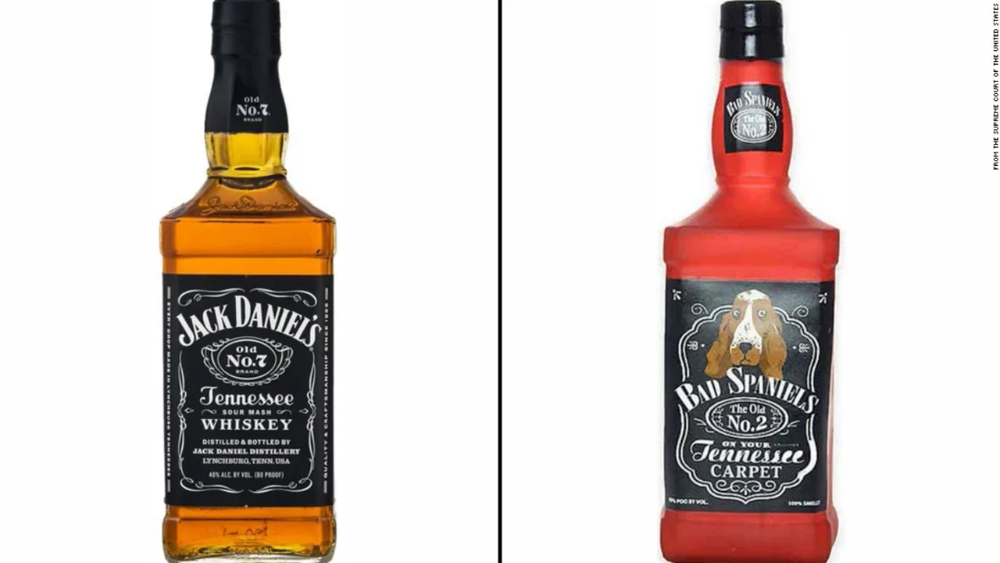
Jack Daniel’s asserted trademark infringement and demanded that VIP Products stop selling its Bad Spaniels toy. In response, VIP Products initiated a declaratory judgment action of non-infringement in district court. Jack Daniel’s counterclaimed for trademark infringement and dilution. VIP Products replied by asserting that use of the “Bad Spaniels” mark is a protected parody under the First Amendment.
After a 4-day bench trial, the district court determined that “Bad Spaniels” infringed and tarnished Jack Daniel’s trademarks and trade dress. As a result, the district court entered a permanent injunction in favor of Jack Daniel’s. VIP Products appealed, and the Ninth Circuit reversed on the issue of dilution and vacated on the issue of infringement. More specifically, the Ninth Circuit found that the Bad Spaniels toy was an expressive work under the Rogers test, and because the toy conveyed a humorous message that was protected by the First Amendment, it did not dilute Jack Daniel’s marks.
On remand, the district court entered summary judgment in favor of VIP Products on both infringement and dilution. Jack Daniel’s appealed this decision, and the Ninth Circuit affirmed. Thereafter, the Supreme Court granted certiorari, where it was tasked with deciding whether allegedly humorous or parodic use of another’s trademark as one’s own on a commercial product is subject to the Lanham Act’s traditional likelihood of confusion analysis or instead receives some sort of heightened First Amendment protection from trademark claims. Additionally, the Supreme Court addressed whether this use falls within the “noncommercial” exception to trademark dilution by tarnishment.
The Supreme Court rejected the Ninth Circuit’s findings, holding that the Rogers test was inapplicable because VIP Products used marks derived from Jack Daniel’s as a source identifier. The Court noted that the Rogers test (and the First Amendment) does not demand an alleged infringer be insulated from “trademark law’s cardinal sin– … when someone uses another’s trademark as a trademark”.1 With regard to dilution by tarnishment, the Court held that the Ninth Circuit’s broad interpretation of the “noncommercial” exemption is in conflict with the fair use exclusion, which expressly protects “parodying, criticizing, or commenting upon” uses, unless the infringing use is “as a designation of source for the person’s own goods or services.” 15 U.S.C. § 1125(c)(3)(A).
The Supreme Court vacated and remanded for further proceedings. On remand from the Supreme Court, the district court concluded that VIP Products was liable for dilution by tarnishment, but that Jack Daniel’s had not shown a likelihood of consumer confusion. Because the district court found that VIP Products was liable for diluting Jack Daniel’s marks, the court entered a permanent injunction in favor of Jack Daniel’s. VIP Products appealed this decision.
The Ninth Circuit’s Decision
On appeal, the Ninth Circuit held that Jack Daniel’s did not meet its burden of showing dilution by tarnishment and vacated the injunction. In reaching its decision, the Ninth Circuit first narrowed the marks at issue. The Ninth Circuit explained that Jack Daniel’s proved fame for the “Jack Daniel’s” word mark and whiskey bottle trade dress, but not for “Old No. 7”. Given this, and since a dilution by tarnishment claim applies only to famous marks, the Ninth Circuit concluded that Jack Daniel’s cannot base a tarnishment claim on “Old No. 7”.
The Ninth Circuit then addressed whether “Bad Spaniels” and the dog toy’s trade dress are likely to harm the reputation of the famous “Jack Daniel’s” and trade dress marks. In determining it did not, the Ninth Circuit explained that Jack Daniel’s relied-upon expert testimony focused on a consumer’s feeling of disgust when defecation is associated with food or beverage products. However, since Bad Spaniels is a dog toy, and not a human consumable, the Ninth Circuit found the evidence of record did not show that scatological references on a dog toy would have the same likelihood of generating disgust as identical references made on a consumable product.
Further, the Ninth Circuit discussed the role parody plays in the instant case. While not a complete defense, the Ninth Circuit explained that parody is, in fact, relevant when assessing a dilution claim. The Ninth Circuit indicated that a successful parody will “convey two simultaneous—and contradictory—messages: that it is the original, but also that it is not the original and is instead a parody.”2 Such “dual messaging” impacts a dilution analysis because consumers are more likely to perceive a successful parody as a joke. In this case, however, the expert testimony did not consider the parodic nature of the dog toy, which the Ninth Circuit determined was a “critical misstep.”3
This recent decision highlights the intricacies of successfully establishing a dilution claim in the context of a parody. Specifically, plaintiffs will face a high burden when attempting to establish that the distinctiveness of their famous mark is likely to be impaired by use of a similar mark in connection with an obviously parodic product. Buchanan’s trademark practice group can assist in understanding the nuances of dilution claims and protecting your brand.
Footnotes
1 Jack Daniel’s Props., Inc. v. VIP Prods. LLC, 599 U.S. 140, 143 (2023).
2 VIP Prods., LLC v. Jack Daniel’s Props., Inc., No. 25-2027 at *26 (9th Cir. 2026) (citation and quotation omitted).
3 See id. at *27.
The content of this article is intended to provide a general guide to the subject matter. Specialist advice should be sought about your specific circumstances.
[View Source]