Talk about a wild ride: In the year since we last calculated AlixPartners’s list of supergrowers, world trade yawed and see-sawed due to U.S. “Liberation Day” tariffs (vacated by the courts after ten months); the Middle East erupted in flames—twice; economic growth slowed to the lowest levels since the height of the Covid-19 pandemic; the increasing use of GLP-1 drugs began to change how much and what kinds of food people buy; artificial intelligence-related capital spending grew to an annual rate of nearly $3 trillion and AI use spread so rapidly that more than 50% of online content is now AI-generated … It is no wonder that in the past year the International Monetary Fund’s World Uncertainty Index reached never-before-seen levels.
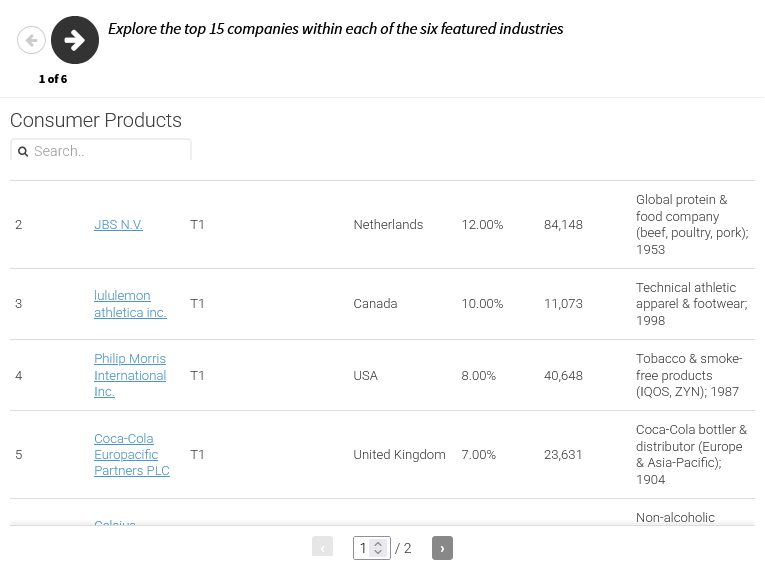
In this disrupted environment, what does it take to grow? To qualify for the supergrowers list, companies had to be the fastest-growing in their industry in the U.S. or Europe. But they couldn’t buy their growth—they had to have achieved it organically. They couldn’t be small outfits going through growth spurts—they had to be leaders in tiers of $10 billion or more (tier 1), $2-$10 billion (tier 2), or $500 million- $2 billion (tier 3) in revenue to begin with, and they had to deliver industry-topping growth over a two-year period.
A company cannot lead its industry in growth unless it can combine the strategic positioning to take advantage of trends in the business environment; the financial, operational, and organizational versatility to exploit disruptive opportunities (including what AI can do) and avoid disruptive threats; and the management skill to deliver growth every day and in detail, through a set of marketing, sales, pricing, and customer retention tools.
While each industry has its own growth story, the supergrowers also have things in common—patterns and mindsets, priorities and methods that every company can learn from. We analyzed their performance, looking within and across industries for commonalities, outliers, and the insights we could glean from individual companies. We also compared them with what we learned from the AlixPartners Disruption Index, an annual survey of 3,200 senior executives worldwide, about one in five of whom say their company sets the pace for growth in its industry. These pacesetters display patterns of investment, decision-making, and behavior that set them apart, in ways exemplified by the 90 supergrowers on this list.
It is not surprising that the AI infrastructure buildout is the primary growth driver in a number of sectors, starting with technology. An extraordinary increase in capital expenditures for data centers is leading to a surge in hardware demand, with projections estimating up to $1.6 trillion in capital expenditures by 2031. These centers require intensive computing power, memory, connectivity, and cooling capabilities, supplied by an ecosystem of hardware suppliers that often bring together multiple growth leaders. Among the tier one tech supergrowers, powerhouse chip manufacturer NVIDIA provides the GPUs and AI accelerator chips used by Super Micro in its server systems, storage clusters, and liquid-cooled data center racks. Chip maker Micron rounds out the top three tier one tech players as a dominant supplier of high-bandwidth memory devices that are critical enablers of the intense processing demands of large language models.
While the tech companies leading the AI charge have become stock market bellwethers, their industrial counterparts that provide the data center infrastructure equipment hum away in the background. Vertiv Holdings, at the top of the industrials list, partnered with NVIDIA to provide power, thermal management, and physical infrastructure equipment to support its ultra-dense, megawatt-scale AI computing clusters. Siemens Energy’s 2025 sales of 194 gas turbines nearly doubled from 2024 levels as data center electricity demand surged. With data center growth comes the call for grid modernization, leading to a surge in Siemens Energy’s Grid Technologies division of nearly 42% in early 2026.
Infrastructure projects extend beyond data centers and the grid, as governments around the world try to keep up with a backlog of civic improvement projects. Heavy civil contractor Tutor Perini’s backlog is approaching $20 billion, including the $16 billion Hudson Tunnel project in New York and segments of California’s high-speed rail network.
While AI and data centers are major drivers of growth in industrials and the hardware side of tech, software companies are growing by leveraging platform business models to create growth through network effects, consumption-based pricing, and upselling/cross-selling sales motions. While others in the software industry have struggled as AI has upended traditional subscription sales, the platforms these companies have created become more valuable as usage increases, driving net retention revenue (NRR) rates of 110-136%. Snowflake's 125% NRR means existing customers expand spending 25% annually beyond new customer acquisition. AppLovin's MAX platform creates bidder network effects—more advertisers increase bid density, improving yields for publishers and attracting more publishers.
Platforms are a path to supergrowth in media as well. Several media companies — Alphabet, Meta, Reddit, Pinterest, Roblox — are not so much creators of content as hosts for it. Some of that content comes from legacy media companies, but much comes from creators who never before were able to find a platform for their work. The result is a fundamentally different growth engine, powered as much by community and creator supply as by corporate production budgets. Reddit's 65% 2-year CAGR to $2.2 billion in revenue is built almost entirely on this model: more than 100,000 active subreddits generate content (some of it very idiosyncratic) that attracts 97 million daily active users. Roblox’s 144 million daily active users can be considered consumers and content co-creators. Another path to supergrowth is expanding monetization models as media companies move beyond a single revenue stream by layering in new adjacent categories without alienating existing users. Netflix’s ad-supported tier accounts for more than 60% of new subscribers. Platform revenue now represents 87% of Roku’s total revenue, marking 2025 as its first year in the black. A scalable platform model capable of generating profits beyond those of a pure content business was undoubtedly attractive to Fox, which recently announced its acquisition of the streamer.
In telecommunications, similar strategies (such as bundling, service revenue growth, and monetization of 5-G infrastructure) are helping big companies like T-Mobile and Orange grow in an otherwise mature market, while around them, small companies open and exploit geographic or other market niches. Convergence is increasingly the price of admission: T-Mobile, for instance, is layering fiber access onto its Fixed Wireless Access network through a series of joint ventures as customers demand “omni-connectivity” that no single technology can deliver alone. Tower companies illustrate another path: Helios Towers, INWIT, and Cellnex have driven organic growth by squeezing more revenue from existing assets rather than building new ones to capitalize on the expanding demand for IoT connectivity and AI processing running on local devices like smartphones.
Taking full advantage of strategic opportunities like these depends on having an organization that’s flexible, versatile, and efficient. For many companies, disruption is a stimulus for growth, not an inhibitor. This counter-intuitive finding suggests that disruption tolerance and transformation capability—not disruption exposure—separate growth pacesetters from laggards globally. Indeed, we consistently find that organizational transformation goes hand in hand with growth. In the United States and Europe, two-thirds of growth pacesetters also say they drive disruption in their industries; less than a third of laggards say the same. Fifty-nine percent of pacesetters say they expect to undertake major business model transformation this year, compared to just 22% of laggards. Put another way, Disruption x Transformation = Growth.
Tariffs are a great example. Fast-growing companies are more likely to say they have been affected by tariffs, but about 70% say the impact has been positive, and only 17% say it has been negative. Consumer product supergrowers like Swiss athletic-wear manufacturer On Holding AG have sidestepped the impact of tariffs (and exploited opportunities at the high end of the market) by reshaping their product portfolios, scaling their brands globally, or focusing more intently on premium segments they can dominate.
The consumer environment is shaped by the barbell economy, rising consumer affordability struggles, shifts in demand driven by wellness trends, the use of GLP-1 weight-loss drugs, and pressure from tariffs and supply chain disruptions. The result is a highly demanding market in which companies cannot rely on broad-based price increases or economic tailwinds to propel topline performance. They need to sell more stuff—which means acquiring new customers or expanding their sales to existing ones. Supergrowers like Vital Farms and Warby Parker stand out because they offer a clear value proposition, create or redefine categories, and align their portfolios to where demand is moving rather than where it used to be.
Growth depends as much on execution as it does on offerings, position, and entry barriers. When macroeconomic growth slows, companies need to find growing niches. When the door to one market closes, companies need to open windows to new ones. Pacesetters in the AlixPartners Disruption Index are more than twice as likely to prioritize share-of-wallet strategies as lagging companies are; they are 50% more likely to prioritize sales effectiveness than laggards are. The laggards focus more on costs. And when new tools and capabilities emerge, companies need to adopt them quickly to improve their ability to identify, win, and retain customers. Sixty-five percent of growth pacesetters say they are at the cutting edge of AI adoption in their industries; among companies with average or below growth, only 21% claim AI leadership. Retailers in particular are demonstrating how adding AI to commercial functions’ toolkits can drive supergrowth; among companies where AI has moved from experimental to operational, customer engagement, loyalty, and personalization have become formidable growth engines.
Amazon’s AI-powered shopping assistant translates AI investment directly into volume at scale. Rufus, used by over 250 million customers in its first full year, increased shoppers' likelihood of making a purchase by 60%. Beyond AI, retailers found other ways to open new market windows. Sprouts Farmers deepened its hold on a specific customer segment – the health-conscious consumer – through a private label range that now accounts for more than 25% of sales and gives value-seeking shoppers a reason to stay rather than trade down. Polish grocer Dino Polska opened 345 stores in 2025 — nearly 40% above its historical pace — by clustering locations in smaller towns and cities underserved by hypermarkets, turning geographic white space into a map of growth opportunities.
Supergrowers know that there is a strategic landscape that can only be shaped so far. In a constantly disrupted business environment, they focus on creating organizations that are resilient enough to absorb shocks and flexible enough to seize opportunities. Their keen eyesight, organizational readiness, and skilled use of growth tools – including AI – enable them to act, execute, and outpace the competition.
No company can be in the right place at the right time all the time. And even when it is, it can’t achieve sustained superior growth without mastering the details of salesforce optimization, pricing, marketing, and customer retention, and without an organization ready to put them to use.
The content of this article is intended to provide a general guide to the subject matter. Specialist advice should be sought about your specific circumstances.
[View Source]