

Executive Summary
Canadian retailers are not short on labor effort — they are short on productive, customer-facing time. The opportunity is not to add hours, but to convert the effort already in stores into visible selling, service, and execution.
Even with continued investment in store labor, execution gaps persist. Associates are increasingly pulled into a growing set of operational exceptions that compress the time available for consistent customer engagement and floor-ready execution.
That pressure is intensifying in a Canadian market where demand, wages, and shopper expectations are all rising at once:
- Monthly retail sales reached $73 billion in April 2026.1
- Retail sales grew 2.1% in Q1 2026 — a seventh consecutive quarter of growth.2
- Average retail wages rose to $23.08 per hour in 2024.3
The implication is clear: every labor hour must work harder — not by asking associates to do more, but by removing the friction that keeps their time from creating value.
The Challenge: Labor Is Being Misallocated
Store operations have absorbed steadily more complexity without redesigning the work around it:
- More frequent price changes and resets
- Greater volatility in deliveries
- Growing omnichannel fulfillment demands
- A rising volume of exception-based work
The result is a structural shift in how store labor is consumed. Associates now spend more of the day reacting to task flow, exceptions, and timing issues — and less of it serving customers, replenishing the floor, and protecting the shopping experience.
This misallocation rarely shows up cleanly in a labor budget. A store can look appropriately staffed on paper yet still struggle when work arrives at the wrong time, in the wrong sequence, or with too many avoidable interruptions.
The Canadian Context
The core issue is global, but several features of the Canadian market sharpen the labor equation:
- Geographic dispersion — longer supply chains and greater operational variability
- Store-as-fulfillment model — a heavier burden carried by store labor
- Regional labor-cost pressure — a rising cost attached to inefficient work
The Core Insight
This is not primarily a staffing problem. It is a process-design problem — one that determines whether labor is spent on planned, customer-relevant work or absorbed by avoidable operational noise.
Most store operating models were never designed to protect customer-facing time. Instead, they let upstream volatility land directly on the floor:
- Work arrives unpredictably
- Tasks are sequenced for upstream convenience
- Stores absorb variability in real time
The Guiding Principle: Design Operations Around Customer Time
Customer-facing time should be treated as a scarce, valuable operational asset — measured, protected, and actively managed with the same discipline as inventory, margin, or payroll.
The strongest operators reframe the management question from volume to timing and impact:
| FROM “How do we get all the work done?” TO “How do we ensure the right work happens at the right time — with minimal disruption to customers?” |
3 Principles of High-Performing Stores
- Proactive Operational Visibility
Advance visibility into deliveries, workload drivers, and exceptions before they disrupt the day — so managers plan labor around customer traffic rather than react to surprises. - Frictionless Product Flow
Faster movement from truck to shelf, with fewer delays between receipt, staging, replenishment, and selling availability — fewer touches and fewer backroom bottlenecks. - Strategic Task Sequencing
Non-customer work deliberately moved outside peak hours wherever possible, reducing congestion when traffic is highest and keeping associates available for customers and priority execution.
Where Labor Is Lost: 6 Critical Store Processes
- Inbound Visibility and Delivery Reliability
Unplanned or unreliable deliveries force real-time labor reallocation, pulling associates off the selling floor.
Canadian Reality: Transportation variability and long-haul logistics raise disruption risk, making advance visibility especially important. - Backroom and Truck-to-Floor Execution
When product lingers in the backroom, stores lose selling time and associates handle the same inventory multiple times. - Merchandising, Pricing, and Change Management
Frequent resets, promotional activity, and price updates pull labor from customers during peak hours when tasks are not sequenced and simplified. - Omnichannel Fulfillment
Buy Online, Pick Up In-Store and ship-from-store expand customer options but compete directly with service when fulfillment work is not clearly prioritized and timed.
Key Insight: Official data shows e-commerce is a meaningful but still-developing share of Canadian retail, so stores must support selling and fulfillment simultaneously. - Front-End and Daily Routines
Opening, closing, and daily service routines carry redundant or low-value steps that accumulate into meaningful lost time across the week. - Enablers: Labor, Tools, and Governance
Sustained improvement requires changing the operating system around store labor, not just the task list: labor aligned to traffic, tools that surface exceptions, and clear store-level decision rights.
The Canadian Retail Market at a Glance
Demand, momentum, and wage pressure are all climbing together — which is exactly why timing and process discipline now carry a higher premium.
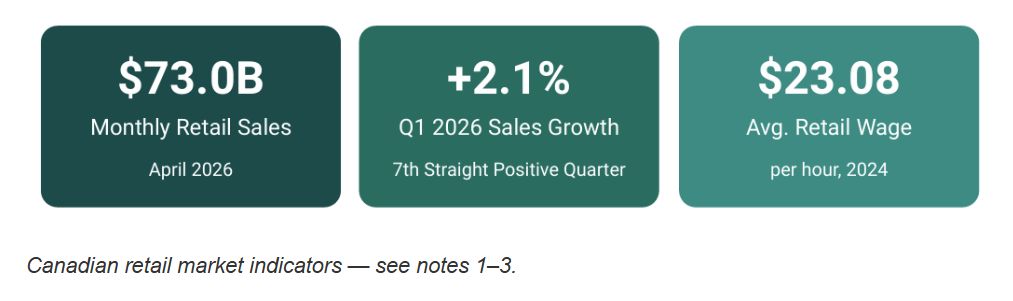
| Labor Cost Reality Average retail wage: $23.08 per hour in Canada (2024).[3] As wage floors rise, every inefficient hour costs more — making process discipline a margin and service imperative, not just an operational preference. |
The Outcome: Reinvesting Time Where It Matters
Reclaiming store labor is not about working associates harder. It is about removing friction so effort converts into customer-facing impact and stronger execution. Retailers that redesign store processes around customer time can turn operational discipline into results visible on the floor:
- More hours on the floor during peak traffic
- Faster, more accurate execution
- Reduced manager overload
- Improved conversion and customer satisfaction
Why This Matters in Canada
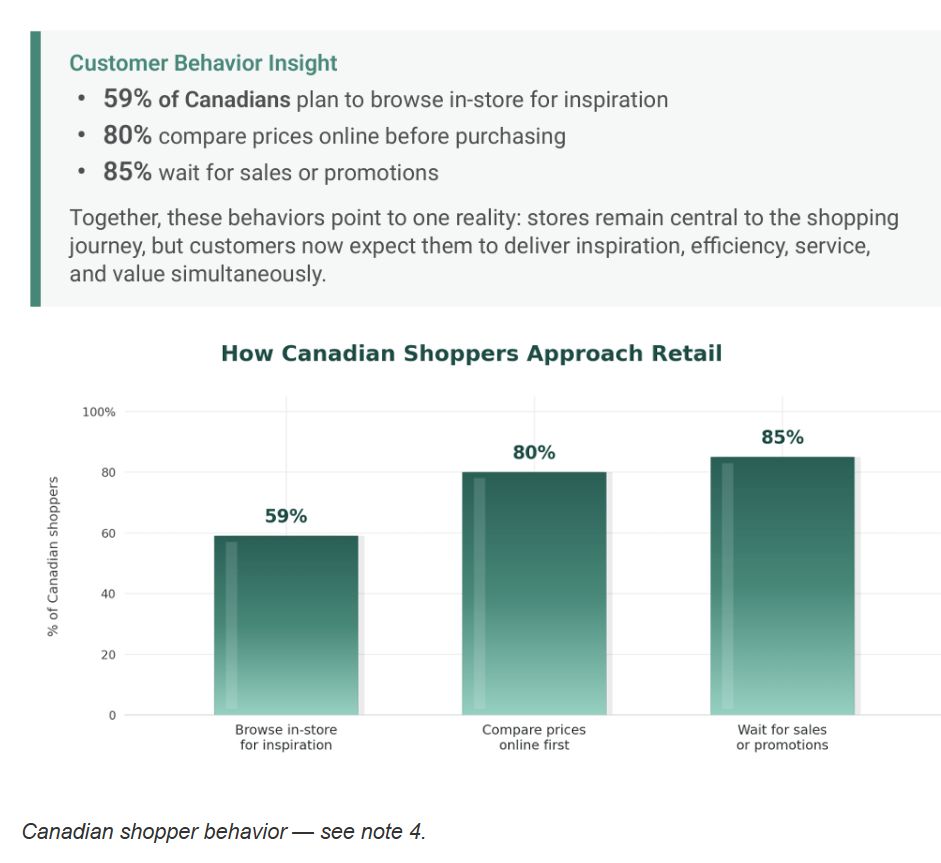
Several forces are converging: Retail demand keeps growing, labor costs keep rising, and customers are more informed and value-focused. The margin for inefficiency has never been smaller. The tolerance for inefficient work has never been lower, and the cost of poorly timed work keeps climbing.
Bottom Line
Canadian retailers do not simply need more labor. They need more intentional use of labor — with store processes designed to protect the moments that matter most to customers. Those who redesign store operations around customer-facing time will be better positioned to:
- Improve service and conversion
- Absorb operational complexity
- Deliver consistent execution across diverse markets
The retailers that win will not be those with the most labor — they will be the ones that use it most deliberately, with operating models that turn store effort into measurable customer and execution impact.
To view the full article please click here.
The content of this article is intended to provide a general guide to the subject matter. Specialist advice should be sought about your specific circumstances.
[View Source]