

With many of HB 2138's provisions becoming operative on January 1, 2027, here's what developers should know about Oregon's latest legislation to expand middle housing and promote housing availability and affordability.
In July 2025, HB 2138 was enacted to help address Oregon's housing shortage. HB 2138 builds on previous housing laws by extending middle housing development requirements to new jurisdictions and removing regulatory restrictions to allow for higher-density development statewide. The bill also sets deadlines for local governments to update their land use regulations to accommodate additional middle housing development.
For developers, the legislation creates new opportunities to scale up and accelerate middle housing projects in more jurisdictions and with fewer regulatory barriers.
What Does HB 2138 Do?
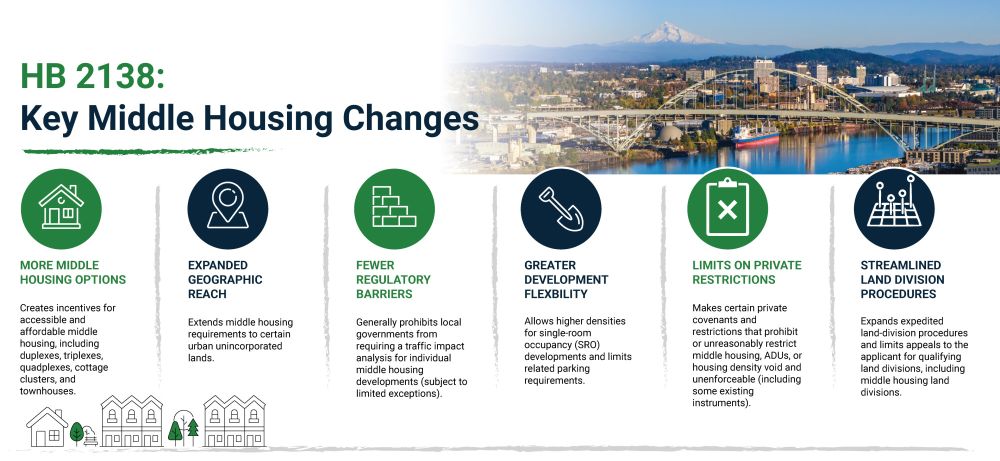
HB 2138 expands and streamlines Oregon's middle housing requirements. Some of its key provisions include:
- Creating Incentives for Accessible and Affordable Middle Housing. Middle housing includes duplexes, triplexes, quadplexes, cottage clusters, and townhouses. HB 2138 creates density bonuses for certain middle housing developments that include at least one qualifying accessible or affordable unit, allowing additional dwelling units beyond what otherwise would be permitted.
- Expanding Middle Housing to New Jurisdictions. Requirements allowing middle housing development are extended to certain urban unincorporated lands, expanding the areas in which middle housing must be permitted.
- Limiting Traffic Impact Analysis Requirements. Subject to limited exceptions, local governments may not require a traffic impact analysis based on the traffic impacts of an individual middle housing development.
- Allowing Higher Densities for Single-Room Occupancy Developments. Local governments must allow single-room occupancy (SRO) development with up to three times the number of units otherwise allowed by maximum density standards on property where multi-unit housing of five or more units is permitted. The law also limits the amount of parking that local governments may require for SRO developments.
- Prohibiting Private Restrictions on Middle Housing Developments. HB 2138 makes certain private covenants and restrictions that prohibit or unreasonably restrict middle housing, accessory dwelling units, or housing density void and unenforceable. Importantly, these provisions apply retroactively to certain existing instruments and planned-community governing documents.
- Streamlining Land Division Procedures. HB 2138 expands and reforms the expedited land-division process. For qualifying land divisions, local governments must use expedited procedures when requested by the applicant, and only the applicant may appeal an expedited land-division decision. The legislation also continues to facilitate the use of expedited procedures for middle housing land divisions.
When Does the Law Take Effect?
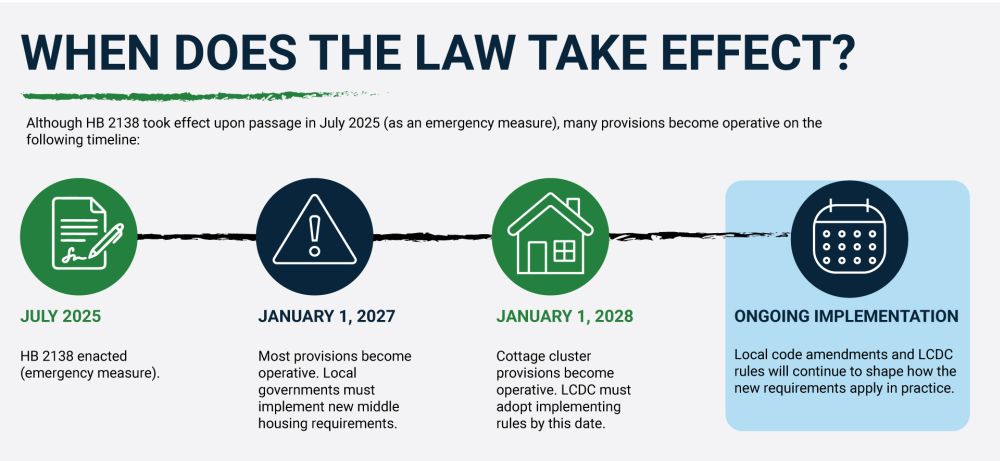
Although HB 2138 took effect upon passage as an emergency measure, many of its provisions become operative January 1, 2027. Local governments generally have until January 1, 2027, to implement the new middle housing requirements, while changes relating to cottage clusters have a later implementation deadline of January 1, 2028.
HB 2138 also directs the Land Conservation and Development Commission (LCDC) to adopt implementing rules by January 1, 2028. Those rules will address several aspects of middle housing development and implementation, meaning that the regulatory framework will continue to develop even after many of HB 2138's provisions become operative in 2027.
What Does This Mean for Developers?
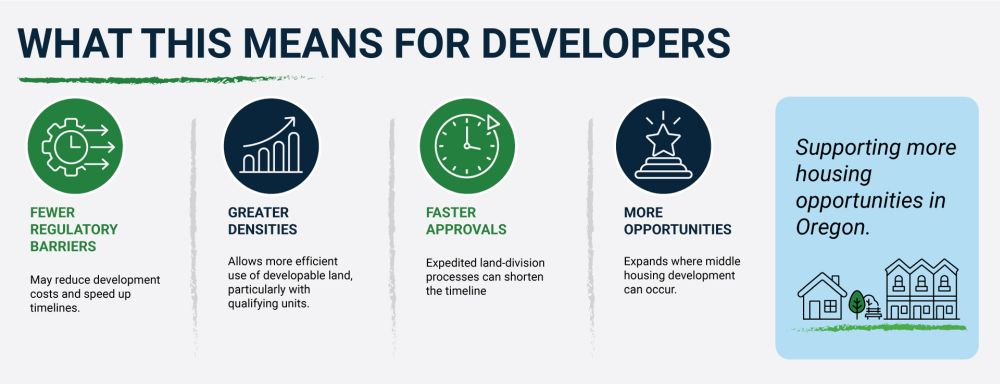
HB 2138 creates additional opportunities for developers pursuing middle housing projects by removing certain local regulatory barriers, allowing greater densities, and expanding where middle housing development can occur.
Limiting requirements such as project-specific traffic impact analyses may reduce upfront development costs and delays, improving project feasibility. Higher-density allowances may also permit developers to make more efficient use of developable land, particularly where projects include qualifying affordable or accessible units.
Development timelines may also be shortened through the expanded use of expedited land-division procedures, including limits on third-party appeals of qualifying expedited land divisions.
At the same time, developers should pay close attention to how individual jurisdictions implement HB 2138. Local code amendments—and the LCDC rules still being developed—will affect how some of these new opportunities operate in practice.
Bottom Line
HB 2138 is another significant step in Oregon's continuing effort to accelerate middle housing development and provide more diverse and affordable housing options. By expanding existing middle housing requirements, reducing certain regulatory barriers, and creating additional development incentives, the legislation may open new opportunities for developers throughout the state.
Developers planning middle housing projects should begin evaluating how HB 2138 may affect their development opportunities now, while continuing to monitor local implementation and the LCDC rulemaking process leading up to the January 1, 2028 deadline.
The content of this article is intended to provide a general guide to the subject matter. Specialist advice should be sought about your specific circumstances.
[View Source]
