
Overview
Disruption is familiar territory for retail, from e-commerce to mobile-first shopping to the influencer economy. AI represents a distinct shift: Discovery, comparison, and purchase are increasingly mediated by conversational AI agents that retailers cannot control and cannot currently buy placement within.
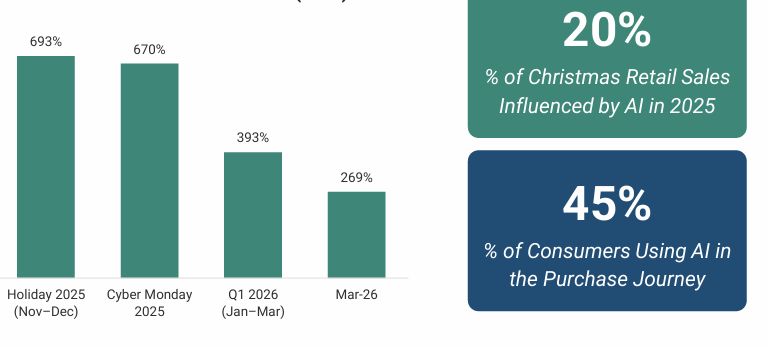
AI-referred traffic to U.S. retail sites grew 693% year-over-year (YOY) during the 2025 holiday season,1 and continued at 393% YOY growth into Q1 2026.2
AI is estimated to have influenced roughly 20% of U.S. Christmas retail sales in 2025.3
At this rate of growth, we predict that more than 50% of 2026 holiday shopping will be influenced by AI search, whether to find that special gift idea for the person who has everything, or to help a parent find where to buy that “must-have toy” for the holidays.
As of today, 45% of consumers already turn to AI for help at some point in their purchase journey, including researching products, interpreting reviews, and hunting for deals.4
This is not a marginal shift in marketing channels; it is a structural change in how shoppers discover, evaluate, and decide. It also fundamentally changes who retailers must now reach to remain in the consideration set.
AI-Referred Traffic Growth (YOY)5
The Shift: AI Is Bypassing the Customer Funnel
For many years, the path from consideration to purchase has followed a predictable sequence: a search query, paid and organic results, a sponsored post, an influencer’s post, and a click-through to the retailer's site. Marketing budgets are built to influence these steps, but AI is changing this sequence.
Traditional consumer research and click-through behaviors are being replaced, with shoppers turning to AI for answers based on content the LLM can access and has deemed credible. In addition, because the content is synthesized from multiple, often competing sources (like retailers, brands, department stores, and marketplaces), there is no loyalty in an AI agent’s answer.
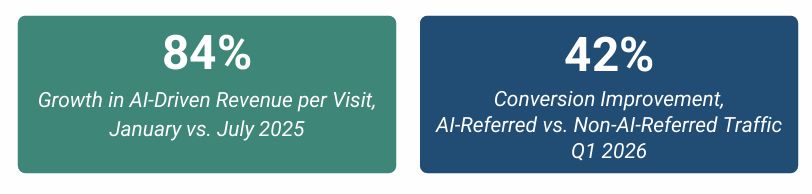
This shift is evident in the data. Revenue per visit from AI traffic was 84% higher than that of non AI traffic between January and July 2025 compared to non-AI sources,6 and by Q1 2026, AI referred visits achieved a 42% higher conversion rate than visits from traditional channels.7
For now, retail sites remain poorly structured for AI, with Adobe finding retail lagging other industries in AI search visibility even as AI traffic to retail surges.8 Generative engine optimization (GEO), which focuses on structuring content for AI readability and credibility, remains an emerging discipline. Retailers investing in structural readiness, rather than continuing to optimize primarily for keyword rankings, are more likely to appear in AI-generated answers.
The New Playbook: AI’s Growing Presence in the Customer Journey
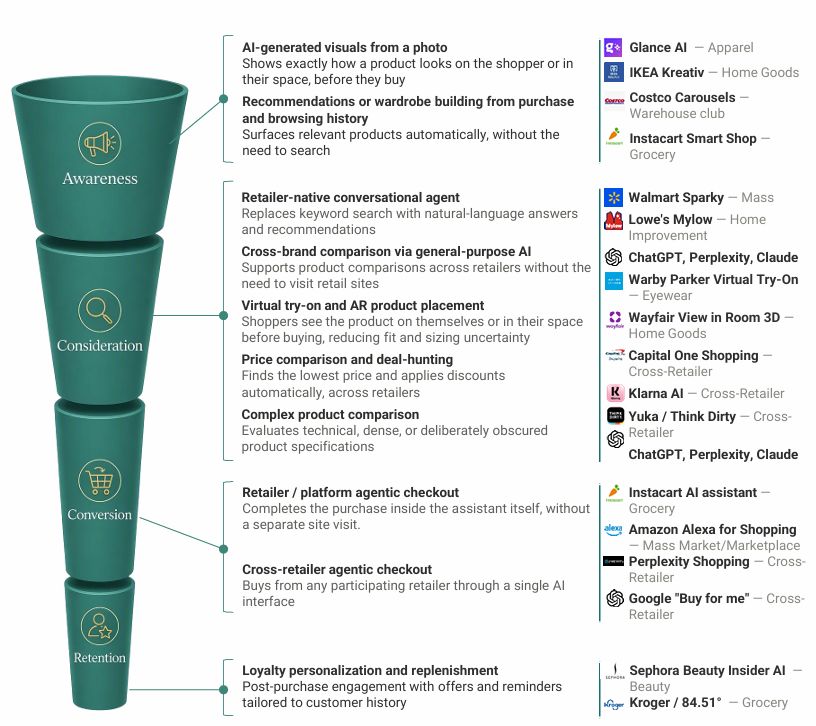
AI now sits in all stages of the customer journey, from first impression to repeat purchase.
- Awareness and consideration increasingly occur outside the retailer’s channels and control.
- Conversion is moving out of the retailer's checkout control to platforms that support multiple retailers, though execution remains uneven.
- Retention is an area retailers still control supported by personalization and communication to maintain loyalty and margin upside.
The Economics: AI’s Impact on the Bottom Line
Retailers leveraging AI to its full potential can expect top-line and gross-margin expansion, as well as working capital benefits.
TOPLINE/REVENUE
- Loyalty Protection: NRF data shows that 71% of consumers are less likely to shop with a retailer again after a poor returns experience, up from 67% the year prior.9 Improved pre purchase fit and personalization protect the customer relationship beyond the individual sale.
- Wallet-Share Capture: Costco's personalized recommendation carousels alone drove nearly $500 million in incremental e-commerce sales in a single quarter.10
- Expanded Consideration Set: AI recommendations are driven by the consumer’s specific requirements rather than brand recognition, giving lesser-known retailers a path to the shopper's consideration set that may have been overlooked through traditional browsing. This is a double-edged sword: The same mechanism can also redirect demand and dilute loyalty away from more established brands.
GROSS MARGIN EXPANSION
- Reduced Reverse-Logistics Costs: Retail returns are estimated at $849.9 billion industry-wide in 2025, with 19.3% of online sales returned.11 Enhancing pre-purchase personalization and improving fit recommendations directly address this friction point. In addition, AI intervention could move even closer to the point of purchase by flagging a poor fit or suggesting a better match as a shopper adds an item to their cart, catching the mistake before the order is placed, rather than after the item has been tried on and then returned.
- Decreased Markdown Reliance: Lower return rates minimize the need to move excess inventory through broad discounting.
- Lower Price Sensitivity at the Point of Purchase: When AI demonstrates a product's value by styling it with items a shopper already owns or visualizing it on the shopper, it makes a strong ROI case for the shopper to buy now rather than waiting for a discount.
- Leaner Content and Creative Production Costs: Tools such as Nines Style and Glance AI generate shoppable imagery in place of traditional photo shoots and catalog production.
BALANCE SHEET / WORKING CAPITAL
- Faster Inventory Turns: Personalization refines demand signals used in buying and inventory decisions, improving sell-through accuracy and the cash conversion cycle.
The Strategic Imperative
AI's influence on retail discovery is measurable and growing. To win in an environment that is changing faster than most planning cycles, retailers must position themselves to be deemed credible by an intermediary they do not control, or risk being unseen by shoppers who rely on AI.
The approach going forward must be to reframe from "get found by AI" to "run the business for AI mediated demand." Marketing visibility is only the entry point; winning requires rebuilding the operating model around returns, merchandising, pricing, data governance, and AI risk.
The capability map below outlines how Ankura positions retailers to win amid this shift.
Footnotes
1 Adobe Analytics, Jan 2026
2 Adobe Digital Insights, April 2026
3 Salesforce, Jan 2026
4 IBM Institute for Business Value and the National Retail Federation, Jan 2026
5 Adobe, Dec 2025, Jan 2026 and April 2026
6 Adobe Analytics, Aug 2025
7 Adobe Digital Insights, April 2026
8 Adobe Digital Insights, April 2026
9 NRF / Happy Returns, 2025
10 Costco, Q3 FY26 earnings call
11 NRF / Happy Returns, 2025
The content of this article is intended to provide a general guide to the subject matter. Specialist advice should be sought about your specific circumstances.
[View Source]