On August 28, UPS announced the 2025 peak season surcharges effective from September 28, 2025 to January 17, 2025, raising Additional Handling, Large Package, and Over Maximum fees to their highest levels during the holiday period.
Besides the peak surcharge, many shippers have seen small parcel delivery costs continue to climb. In Q2 2025, the average ground parcel cost per package was reported at its highest level in recent years. This increase occurred despite competitive discounts extended by UPS and FedEx to large accounts, reflecting the carriers' broader use of surcharges, fees, and structural adjustments that affect overall cost profiles.
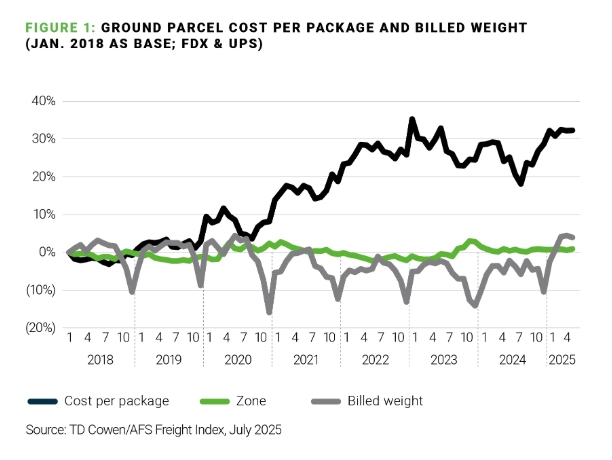
This article will explore the less visible cost drivers in parcel shipping and explain how they can influence a company's overall spend.
Peak Surcharge
Peak surcharges typically cover the period from October through mid-January and subsidize the extra hours that parcel carriers need to operate around the holidays.
Earlier in July, FedEx already announced its 2025 peak season surcharge, with fees effective from September 29, 2025 through January 18, 2026.
While an increase in rates from year to year can be expected, the peak surcharge rates FedEx has announced this year show a larger percentage increase in the highest volume modes: Ground, Home Delivery, and Ground Economy. While the absolute increase is measured in cents per package, this surcharge will apply to the vast majority of e-commerce volume.
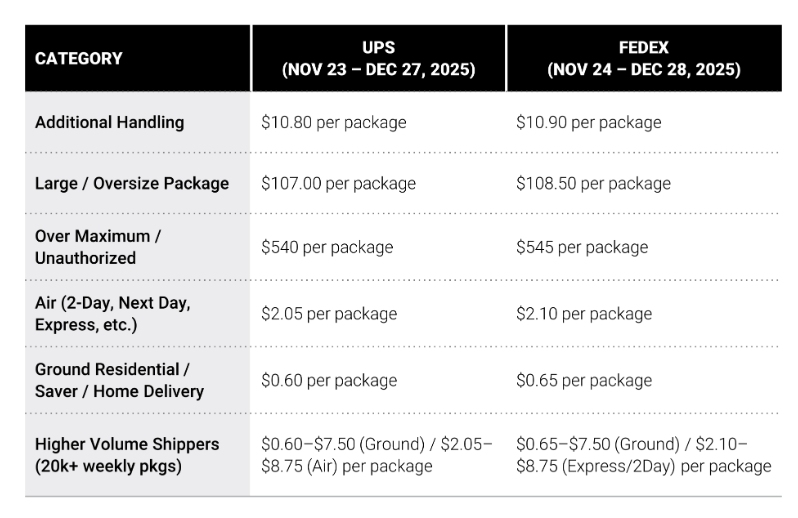
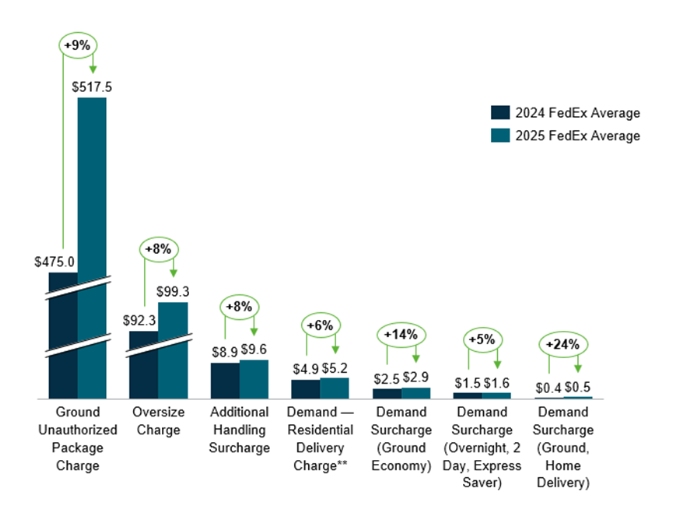
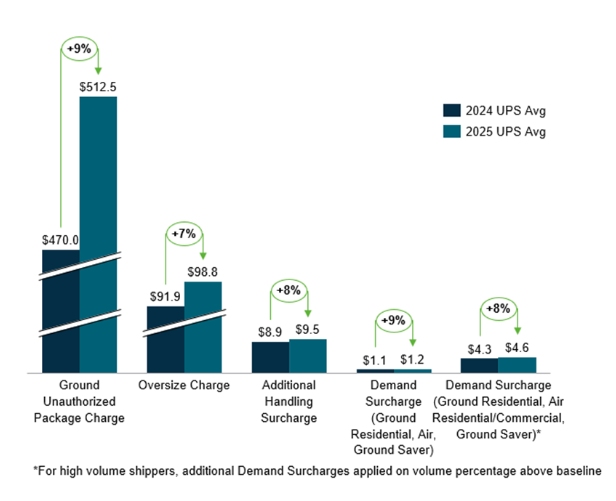
Similarly, UPS has also announced increases in peak surcharges, with increases in the 7-9% range. Residential and Air packages increase by $0.40–$2.05 per package, but large shippers face up to $7.50 (Ground) and $8.75 (Air) per package during peak weeks.
Fuel Surcharges
FedEx and UPS have pushed fuel surcharges to ~20.5% on ground services, while the U.S. diesel prices held steady near $3.10–$3.20/gal. Between May and August 2025, FedEx raised its surcharge nearly 300 bps, with UPS matching soon after.
Dimensional Measurement
FedEx and UPS both rolled out changes to the way dimensional weight is calculated on August 18th. FedEx announced the change in July and UPS matched it a few weeks later.
Dimensional weight is a factor for determining the billed weight of a parcel. The cubic inches of the parcel are divided by a divisor, typically 139 or 166, and the shipper is charged based on the greater of the dimensional weight or the actual weight. This is the carriers' way of ensuring they are compensated for large but low-density shipments.
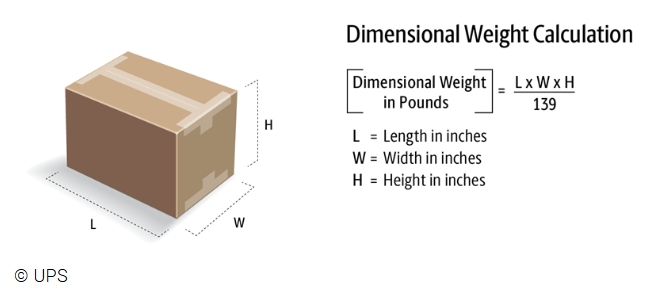
Previously, the dimensional measurements would be rounded to the nearest inch by standard rules i.e. 9.4" = 9" and 9.5" = 10". However, FedEx and UPS both changed their calculation to always round up i.e. 9.1" = 10" and 9.5" = 10".
This change means low density parcels will begin being charged at higher weights, while high density parcels should mostly be unaffected. Parcels at the margins of the maximum size limits or additional handling surcharge limits could also be pushed over the edge.
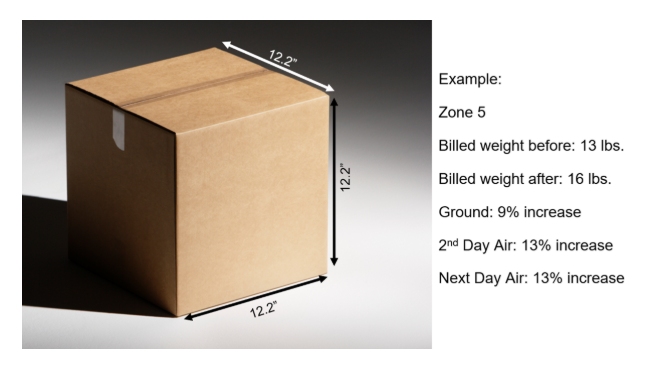
UPS will also levy a Shipping Charge Correction Audit Fee for packages shipped at lower rates, so shippers should ensure that they update their internal logic for dimensional rounding of their parcels.
Additional Handling Surcharge
UPS has changed how Additional Handling and Large Package Surcharges are applied, increasing the number of packages impacted.
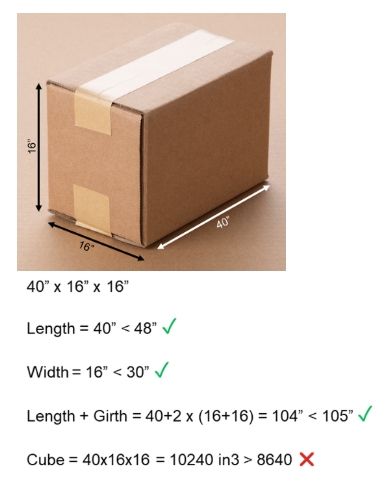
The Additional Handling and Large Package Surcharges are meant to cover bulky packages. Additional Handling was defined as Length greater than 48", Width greater than 30", or Length + Girth greater than 105", where Girth equals 2 x (Width + Height). Large Package was defined as Length greater than 48", Width greater than 30", or Length + Girth greater than 130. FedEx has the same definitions for Additional Handling and their Oversize Charge.
On August 17, UPS replaced the Length + Girth limit with a cubic inch limit of 8640 in3 for Additional Handling and 17280 in3 for Large Packages. They also added the Large Package Surcharge to any package over 110 lbs.
For example, a 40"x16"x16" box would not have incurred an Additional Handling Surcharge before but will now.
FedEx has not yet followed in implementing this change.
image
Delivery Area Surcharges
In 2025, both FedEx and UPS have introduced updates to their Delivery Area Surcharges (DAS). These changes expand the scope of DAS well beyond remote ZIP codes, bringing higher costs to suburban and even metro areas.
In June 2025, FedEx expanded Delivery Area Surcharges (DAS) by adding 136 ZIP codes across 20 states. It also reclassified 88 ZIP codes to DAS Extended and 101 to DAS Remote, pushing many shipments into higher surcharge tiers.
UPS has taken a similar path. The 2025 General Rate Increase incorporated 82 new metro ZIP codes, pushing UPS DAS up 5–9%. In January 2025, it also ended SurePost, launched Ground Saver, and raised DAS by 62% (standard) and 69% (Extended) to match Ground levels.
Other misc. cost increases
Beyond the major surcharges previously discussed, carriers also apply a range of smaller fees such as residential delivery charges, address correction fees, re-delivery surcharges, weekend delivery fees, signature confirmation costs, and overweight or oversize penalties. While each may seem minor on its own, the cumulative effect can significantly increase total shipping spend if not actively managed.
Summary and actions shipper should take
Beyond awareness of how carriers structure cost increases, there are practical steps shippers can take to mitigate incremental charges and manage spend more effectively:
- Optimize Packaging and DIM Weight: Redesign boxes to better fit products and reduce dimensional weight charges
- Review and Negotiate Surcharges: Track surcharge spend regularly and negotiate caps or waivers on the most frequent fees, using alternative carriers where appropriate
- Improve Address Quality and Delivery Data: Implement validation tools to prevent correction charges and flag residential versus commercial addresses up front to avoid misclassification fees
- Optimize Service Level Mix: Align service speed to actual customer needs and route non-urgent shipments through ground or deferred services when possible
The bottom line: Carriers will continue to refine their pricing structures, but shippers can take a proactive, data-driven approach to manage the details. By addressing packaging, surcharges, data quality, and service mix, companies can limit avoidable costs and maintain stronger control over parcel spend.
Reference:
AFS, "AFS Freight Index Q3 2025," July 2025, https://www2.afs.net/hubfs/AFS/AFS_Website%20Assets%20(live)/AFS-Freight-Index-Q3-2025.pdf
June 2025 UPS and FedEx Shipping Update, https://fulfillmentwarehouse.com/june-2025-ups-fedex-shipping-updates-rate-increases-new-surcharges-zip-code-adjustments/
FedEx rate changes, https://www.fedex.com/en-us/shipping/rate-changes.html
UPS Ground Saver, https://www.ups.com/us/en/support/shipping-support/shipping-costs-rates/ups-ground-saver
UPS SurePost Rate, https://www.ups.com/assets/resources/webcontent/en_US/2025_SurePost_media_preview.pdf
UPS, "UPS Shipping Costs and Rates," https://www.ups.com/us/en/support/shipping-support/shipping-costs-rates
FedEx, "Additional shipping fees," https://www.fedex.com/en-us/shipping/rate-changes/additional-shipping-fees.html
Max Garland, "FedEx plans dimensional weight tweaks that could impact pricing," Supply Chain Dive, 25 Jul 2025, https://www.supplychaindive.com/news/fedex-dimensional-weight-calculation-changes/753938/
Max Garland, "UPS matches FedEx with dimensional weight change," Supply Chain Dive, 6 Aug 2025, https://www.supplychaindive.com/news/ups-dimensional-weight-rounding-change/756929/
FedEx, "What is dimensional weight?", https://www.fedex.com/en-us/shipping/packaging/what-is-dimensional-weight.html
FedEx, "Service Guide," Updated August 18, 2025, https://www.fedex.com/content/dam/fedex/us-united-states/services/Service_Guide_2025.pdf
UPS, "2025 UPS Rate & Service Guide," Updated August 18, 2025, https://delivery-p55671-e392469.adobeaemcloud.com/adobe/assets/urn:aaid:aem:356d938a-4f0a-4c71-b50e-bdd890f50b47/original/as/daily-rates-us-en.pdf
Max Garland, "FedEx rolls out pricier surcharges, new fees for 2024 peak season," 15 Aug 2025, https://www.supplychaindive.com/news/fedex-2024-peak-season-holiday-surcharges-price/724385/
Max Garland, "FedEx's 2025 peak season surcharges higher than last year," 10 July 2025, https://www.supplychaindive.com/news/fedexs-2025-holiday-demand-surcharge-prices/752664/
US Energy Information Administration, "Gasoline and Diesel Fuel Update," 26 August 2025, https://www.eia.gov/petroleum/gasdiesel/
UPS, "UPS Demand Surcharges," 28 August 2025, https://www.ups.com/assets/resources/webcontent/en_US/PeakDemandSurcharges_US.pdf
UPS, "UPS Adds Peak-Season Fees on Air and Ground Shipments", https://www.supplychain247.com/article/ups-2025-peak-season-surcharges/
The content of this article is intended to provide a general guide to the subject matter. Specialist advice should be sought about your specific circumstances.