
| NORTH AMERICA CAN NO LONGER BE TREATED AS A LOW-RISK DEFAULT Integrated regional supply chains now require the same exposure mapping, scenario planning, and commercial discipline historically applied to overseas sourcing. |
Executive Premise
For more than three decades, companies designed North American supply chains around geographic proximity, favorable trade rules, and predictable cross-border movement. The United States, Canada, and Mexico increasingly operated as an integrated production platform rather than three separate markets.
That operating assumption is under pressure. The U.S. declined to renew the United States-Mexico-Canada Agreement (USMCA) at its July 1 joint review, moving the agreement into annual reviews. On August 22, a 50% Section 338 duty took effect on roughly US$20 billion of Canadian goods, and unlike earlier measures, USMCA qualification does not exempt them. Canada answered with matching counter-tariffs on Sept. 8, and Washington has announced import bans on certain Canadian products from Sept. 29. The result is not simply a higher duty rate. It is a more complex planning environment in which product classification, country of origin, contract language, border crossings, and inventory strategy can materially affect landed cost and cash flow.
The management question is no longer, “Is our supply chain in North America?” It is, “Where does value cross a border, how often, under which trade authority, and who ultimately bears the cost?”
The Executive Takeaway
- North American proximity does not eliminate trade-policy risk. It can concentrate it in tightly integrated, multi-border production flows.
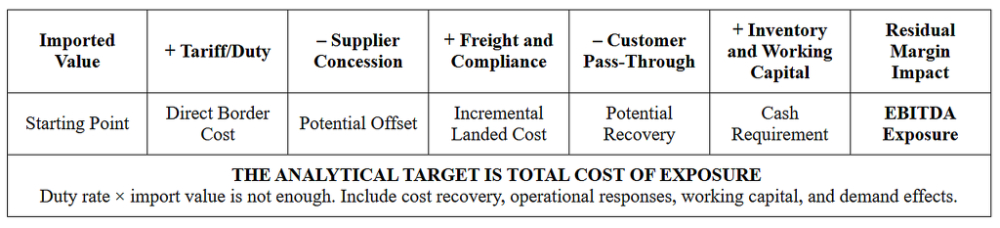
- The direct tariff is only the visible cost. Supplier pricing, freight, customs administration, inventory, working capital, and customer pass-through contribute to the full financial impact.
- Companies should move from country-level screening to product-, supplier-, facility-, and customer-level exposure analysis.
- Resilience will come from pre-defined actions and commercial flexibility, not from attempting to predict each policy outcome.
| THE WINNERS WILL NOT BE THE BEST FORECASTERS They will be the companies with enough visibility and flexibility to act before tariff effects compound across the network. |
An Integrated Network Creates Cumulative Exposure
A component can originate in one country, undergo processing in a second, be incorporated into a subassembly in a third, and return across the border as part of a finished product. Each movement can change origin analysis, tariff treatment, logistics cost, lead time, and the party responsible for duties.
Exhibit 1 | Illustrative North American Supply Chain Flow
| CANADA | UNITED STATES | MEXICO |
| Raw materials • metals • energy inputs | Engineering • final assembly • distribution | Labor-intensive assembly • fabrication |
| Processing and specialized components | Customer demand and commercial control | Automotive, electronics, and industrial production |
CANADA ⇄ UNITED STATES ⇄ MEXICO
Components, subassemblies, and finished goods may cross multiple times before final sale.
| ONE POLICY CHANGE CAN REPRICE MULTIPLE STEPS A duty introduced at one stage can cascade through supplier pricing, transportation, inventory, production planning, and customer economics. |
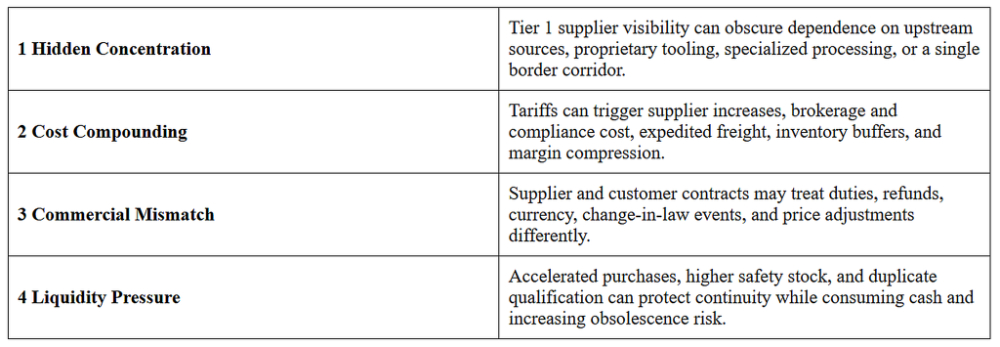
4 Risks That Require Executive Attention
Exposure Should Be Measured at the Decision Level
Country-level import totals are useful for screening, but they are often too broad for action. A management-ready view connects tariff exposure to the specific decisions procurement, operations, finance, sales, and legal teams can take.
Exhibit 2 | Illustrative Tariff Exposure Heat Map
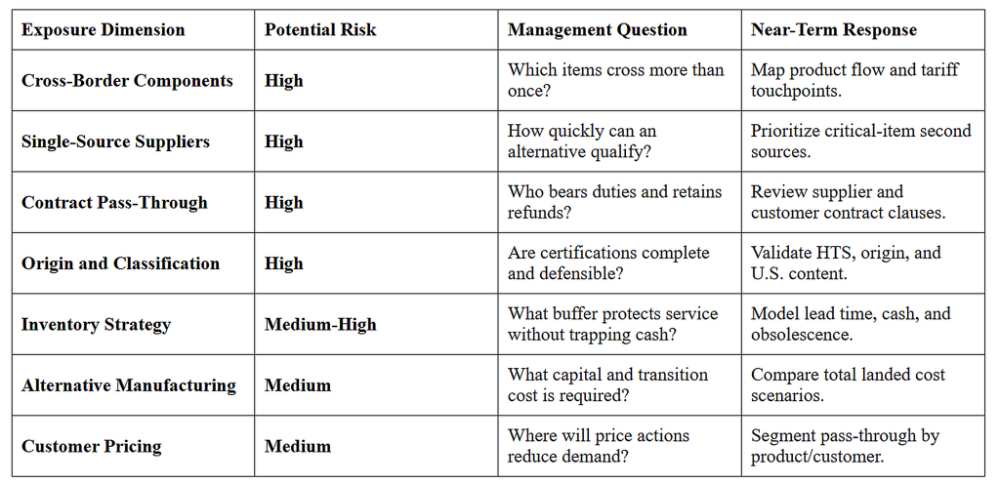
The risk levels above are illustrative. A company-specific assessment should reflect actual transaction data, tariff classifications, country-of-origin support, contracts, inventory policies, and customer economics.
5 Actions Leading Organizations Are Taking
| 1 | Establish the Baseline — Connect purchase orders, invoices, HTS Codes, customs entries, bills of material, and supplier locations to quantify exposure. |
| 2 | Model the Scenarios — Evaluate current policy, escalation, retaliation, exemption loss, and sourcing alternatives at the SKU and facility level. |
| 3 | Stress-Test Contracts — Determine who pays, who can reprice, who retains refunds, and how quickly commercial terms can change. |
| 4 | Protect Cash — Balance pre-buys and safety stock against working capital, storage, obsolescence, and demand uncertainty. |
| 5 | Activate a Roadmap — Sequence classification, sourcing, network, supplier, pricing, and duty-mitigation actions by value and speed. |
From Policy Event to P&L and Cash Flow
The direct duty is only the first-order impact. Management teams should follow the cost through procurement, operations, pricing, and cash flow to understand where value is absorbed, transferred, or recovered.
Illustrative Tariff Impact Waterfall
Tariff Refunds Create a Second Wave of Complexity
Refunds are not simply the reversal of a duty payment. Ankura’s analysis notes that more than $166 billion in previously collected International Emergency Economic Powers Act (IEEPA) tariffs are eligible for refund across more than 330,000 importers. Companies must reconcile customs entries, payment records, product and customer data, contract terms, accounting treatment, and prior pricing decisions before determining the economic benefit or any related exposure.
| THE MAGNITUDE IEEPA refunds span hundreds of thousands of importers and more than $166 billion of previously collected duties. The required analysis can extend across large entry populations, multiple business units, products, customers, and accounting periods. |
THE NEXT POTENTIAL REFUND POOL The 10% Section 122 surcharge was collected during its 2026 statutory window and was later ruled unlawful by the Court of International Trade. That decision is stayed on appeal, and broader refunds are not automatic or assured. Companies should quantify potential exposure and obtain trade counsel on preserving any rights before entry-specific deadlines expire. |
Management Implications
- Claim Validation: Determine which entries, tariff authorities, and exemptions apply, without commingling IEEPA, Section 122, Section 301, Section 338, or Section 232 amounts.
- Commercial Attribution: Assess whether tariff costs were absorbed, shared with suppliers, or passed through to customers, and whether contracts address refunds.
- Financial Reporting: Evaluate receivable recognition, contingent obligations, tax effects, and disclosure considerations.
- Execution Risk: Coordinate customs, finance, legal, sales, data, and communications teams around a defensible, auditable methodology.
| REFUND VALUE CANNOT BE ASSESSED IN ISOLATION The cash receipt may be substantial, but the net economic value depends on eligibility, timing, interest, accounting, customer and supplier claims, litigation risk, and the cost of administration. |
Questions Every Executive Team Should Ask
- Which products, suppliers, and facilities are most exposed under current and plausible alternative scenarios?
- Which items cross a North American border multiple times before final sale?
- Where do supplier or customer contracts leave duty ownership, refund rights, or repricing unclear?
- How much EBITDA and cash flow are at risk before and after realistic mitigation actions?
- Which actions can be executed in 30, 60, and 90 days, and which require structural network changes?
Ankura Perspective
Trade-policy volatility is no longer solely a customs or compliance matter. It is an enterprise performance issue linking procurement, supply chain, finance, commercial strategy, tax, legal, and operations.
Companies cannot eliminate policy uncertainty, but they can reduce the cost of surprise. The practical objective is to develop an exposure baseline that is specific enough to act on, a set of scenarios that management can monitor, and a prioritized roadmap balancing savings, continuity, cash, and implementation risk.
The strongest organizations will not redesign their networks around a single forecast. They will create options, embed clear decision triggers, and preserve the ability to shift sourcing, inventory, production, and pricing as conditions change.
How Ankura Can Help
Ankura brings an integrated, implementation-oriented approach to tariff and supply chain volatility. Our work connects policy intelligence and customs considerations with procurement, supply chain, finance, and performance improvement so that exposure analysis translates into executable value-creation actions.
| Rapid Tariff Vulnerability Assessment A focused diagnostic to map material exposure by product, supplier, and geography; model financial impact; and identify the fastest mitigation opportunities. |
| Product and Transaction Analytics Integration of purchasing, customs, item master, bills of material, supplier, and customer data to create a decision-ready exposure baseline. |
| Scenario and Financial Modeling SKU-, facility-, and customer-level analysis of landed cost, pricing, EBITDA, working-capital, and liquidity implications. |
| Sourcing and Network Alternatives Supplier diversification, make-versus-buy analysis, nearshoring/reshoring economics, footprint strategy, and transition planning. |
| Commercial and Implementation Support Supplier negotiation, customer pass-through strategy, governance, workplan ownership, and benefit tracking. |
| FROM EXPOSURE CLARITY TO EXECUTED VALUE Prioritize actions by financial impact, feasibility, time to value, and resilience benefit. |
The content of this article is intended to provide a general guide to the subject matter. Specialist advice should be sought about your specific circumstances.
[View Source]