
- in Canada
- with readers working within the Business & Consumer Services industries
Short summary: On June 9, 2026, CBP issued new guidance supplementing its 2022 UFLPA guidance and other resources with a single document covering every forced-labor authority it enforces. The new guidance outlines CBP’s detention and exclusion processes and gives practical guidance on how to respond.
On June 9, 2026, U.S. Customs and Border Protection (CBP) published its new Forced Labor Enforcement Operational Guidance for Importers (Publication No. 5560-0526). It is not a refresh. It updates the June 13, 2022, UFLPA Operational Guidance for Importers and, for the first time, consolidates all forced-labor enforcement authorities CBP wields into a single 89-page reference.
That consolidation is the story. Until now, importers had to stitch together separate sources to understand how the Uyghur Forced Labor Prevention Act (UFLPA), Withhold Release Orders and Findings under 19 U.S.C. § 1307, and the Countering America’s Adversaries Through Sanctions Act (CAATSA) actually differ in practice. CBP has now mapped all of them — including the exact timelines, the review paths, and the documentation bar — in one place. The practical effect: ignorance of the process is no longer a defensible position.
The one-line summary every importer needs
CBP detains or excludes goods it suspects were made, wholly or in part, with forced labor — and the burden is on you to prove they weren’t, on a clock that can be as short as 30 days. The new guidance makes the timelines and the consequences of missing them unmistakable.
Four enforcement tracks, four very different clocks
The most important thing the guidance clarifies is that not all forced-labor detentions work the same way. The response window depends entirely on which authority CBP invokes, and the gap between them is wide enough to cost an importer its cargo.
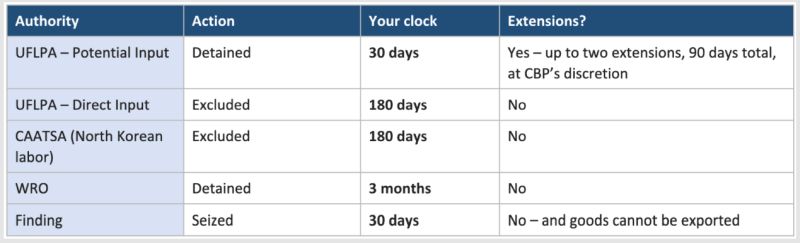
Note the trap: a UFLPA potential input detention gives you only 30 days, while a WRO detention gives you three months for substantially the same evidentiary task. Same factory, same documents — wildly different timelines depending on how CBP codes the stop. And a Finding is the worst case: goods are seized, cannot be exported, and head toward forfeiture unless you affirmatively prove they were not made with forced labor.
The cost of a detention starts before you win or lose
Two financial details in the guidance deserve attention because they hit your balance sheet the moment goods are stopped, regardless of the eventual outcome:
- You pay for storage the entire time. Any importer challenging a detention is usually responsible for all storage costs until CBP issues its final determination. A slow document package is an expensive one.
- CBP can demand a bond at three times the value of the goods. When forced labor is suspected, CBP may require a single-transaction importation bond for three times the value of the detained merchandise (19 C.F.R. § 113.62). That is real, immediate working capital tied up on top of the cargo itself.
“Clear and convincing” — and the single-supplier trap
For some enforcement actions, the evidentiary standard is high, and the guidance is blunt about it. To win a UFLPA exception, you must demonstrate by clear and convincing evidence that the goods were not produced with forced labor, fully comply with the UFLPA Strategy, and respond completely to every CBP request for information.
The detail that ends cases: CBP states that if an importer fails to provide information for even a single supplier anywhere in the chain, the entire submission is insufficient and the shipment is denied entry. One unresponsive sub-tier vendor — not a finding of forced labor, just a documentation gap — is enough to lose the goods. The guidance is also explicit that affidavits alone, and redacted or untranslated documents, will not carry a review.
High-priority sectors: CBP told you exactly what it wants
Appendix A is, in effect, CBP’s answer key. It lists sector-specific supply-chain tracing documentation for twelve high-priority commodities. If you import any of these, the time to assemble this package is before a detention, not in the 30 days after one:
Aluminum · Apparel · Caustic Soda · Copper · Cotton & Cotton Products · Lithium · PVC · Red Dates (Jujubes) · Seafood · Silica-Based Products (incl. Polysilicon) · Steel · Tomatoes & Downstream Products
For each, CBP wants the chain traced to the raw-material stage — flowcharts of every manufacturing step, certificates of origin or manufacturer’s affidavits naming the entity and location for each input, purchase orders, proof of payment, production records, and transport documents. CBP also encourages isotopic testing (Appendix D) to verify claimed origin, and warns that commingling non- Xinjiang Uyghur Autonomous Region and XUAR inputs — polysilicon is the prime example — invites detention on its own.
What CTPAT membership now buys you
The guidance spells out concrete forced-labor benefits for CTPAT Trade Compliance partners that are worth a hard ROI look if you have recurring exposure:
- Front-of-the-line review of your admissibility package when goods are detained;
- Hold-in-place on redelivery — keep goods at your facility rather than returning them to CBP pending a determination;
- Preliminary hold notifications and 48-hour advance notice of new WROs or Findings.
For an importer in a high-priority sector with steady volume, those four benefits can change the economics of detention. That is a membership-versus-exposure calculation worth running deliberately, not by default.
Found a problem yourself? Prior disclosure is the lever.
The guidance reaffirms that prior disclosure under 19 U.S.C. § 1592 remains available for forced-labor issues: if you identify a violation and notify CBP before the agency discovers it, you may substantially reduce — or in some cases eliminate — the associated penalty. If you suspect a problem in a shipment, the disclosure goes to the industry Center of Excellence and Expertise or CBP’s Forced Labor Division. Timing is everything; the benefit disappears the moment the importer becomes aware of a CBP or HSI investigation.
What we recommend you do now
In priority order:
- Map your imports against Appendix A today. If any product touches the twelve high-priority sectors, treat a detention as a when, not an if.
- Build the response package in advance, to the raw-material stage. Pre-assembled, English-translated, indexed documentation is the difference between a release inside 30 days and an exclusion.
- Pressure-test your weakest supplier link. Identify any tier where you could not produce records on demand. That is your exposure — one gap denies the whole shipment.
- Run the CTPAT Trade Compliance math. If you have recurring forced-labor risk, the prioritized review and hold-in-place benefits may pay for the program.
- Know your clock before the notice arrives. Decide now who responds, and how fast, the day a detention or exclusion notice lands.
How Diaz Trade Law Can Help
Diaz Trade Law builds forced-labor due diligence programs before goods move, and defends detentions, exclusions, seizures, and protests across UFLPA, WRO, Finding, and CAATSA enforcement. If you import in a high-priority sector — or have already received a detention or exclusion notice and the clock is running — the time to act is now, not after the deadline passes.
The content of this article is intended to provide a general guide to the subject matter. Specialist advice should be sought about your specific circumstances.
[View Source]