

What's in this issue?
- Understanding the "Farm-Product Purchaser Problem"
- UCC filings vs. EFSs: what's the difference?
- When an EFS makes sense and when it may not
- A practical checklist for Farm Credit lenders
The Farm Product Purchaser Problem
In a typical secured finance transaction, a Farm Credit System lender will require its agricultural borrower and other loan parties to execute a security agreement and file UCC-1 financing statements covering the applicable personal property collateral. At that point, a Farm Credit lender may reasonably believe that its perfected security interests are protected. But when the collateral consists of “farm products,” the Food Security Act of 1985 (FSA) introduces a separate consideration: whether a perfected security interest will remain effective against certain buyers of pledged farm products.1
The FSA establishes a federal “Farm Products Rule” that operates alongside state-level Uniform Commercial Code (UCC) Article 9 rules. Under Article 9, a security interest can generally follow collateral after a debtor sells it, potentially exposing a buyer of such collateral to the risk of paying twice (once to the seller-loan party and again to the secured lender). However, the FSA changes that result for qualifying purchases of farm products in order to help buyers evade the risk of double payment and to avoid inhibiting competition and free markets. Under the FSA, a buyer in the ordinary course who purchases farm products from a person engaged in farming operations generally takes those products free of a security interest created by the seller, even if that interest is perfected and even if the buyer has actual knowledge of the UCC-1 financing statement, unless a FSA exception applies. One of the primary exceptions available to a secured lender to counter application of the Farm Products Rule is to put a buyer on notice of the lender’s interest through the FSA’s notice mechanisms, including, where applicable, filing an Effective Financing Statement (EFS) or sending a written notice directly to the buyer.
Accordingly, in secured finance transactions where farm products are a part of the overall collateral package, Farm Credit lenders should assess two separate questions: (1) have they properly created and perfected their security interests under applicable state UCC law; and (2) have they taken the steps necessary to protect those interests against purchasers of farm product collateral under the FSA? The second question is the focus of what we will call the “Farm-Product Purchaser Problem.”
UCC Filings vs. EFSs: What’s the Difference?
Since EFSs have the ability to play such a crucial role in a Farm Credit lender’s collateral strategy involving farm products, it is important for lenders to understand what an EFS is (and what it is not). An EFS is a filing by a secured lender that identifies the farm products subject to its security interest and serves as part of the statutory notice system for the Farm Products Rule. When one learns about EFSs, a logical next question may be “what is the difference between a UCC financing statement and an EFS filing?”
In practical terms, Farm Credit lenders should think of the documents as serving different functions: (i) a security agreement establishes the contractual grant of a security interest in personal property collateral by the loan parties in favor of the lender; (ii) a UCC financing statement is the filing used under applicable state law to perfect the lender’s Article 9 security interest; and (iii) an EFS is the filing used in states with a certified central filing system to notify certain purchasers of farm products of the lender’s rights under the FSA.
Since an EFS does not create or perfect the underlying security interest, it should not be viewed as a substitute for a UCC-1, and, similarly, a UCC-1 should not be assumed to resolve the Farm-Product Purchaser Problem. The two filing regimes address different legal questions, and the two types of filings embody different characteristics. The following summarizes some of the key differences:
|
Typical Characteristics |
||
|
UCC Filing |
EFS |
|
|
Primary purpose |
Perfection of a security interest under applicable Article 9 law |
Notice mechanism under the Food Security Act relevant to purchasers of farm products |
|
Governing framework |
State UCC / Article 9 and applicable state filing law |
Food Security Act, 7 U.S.C. § 1631 |
|
Filing Location |
Filed with Secretary of State (in state of formation of Debtor) |
Filed with Secretary of State (in the state where the farm products are produced or located, if the applicable state has a certified central filing system) |
|
Collateral description |
May be broad (“All assets of the Debtor”), subject to applicable Article 9 requirements |
Must specify the farm products, including name, amount (where applicable), crop year and the name of each county or parish in which the products are produced or located |
|
Duration |
Typically five years, with continuation requirements |
Typically five years, with continuation requirements |
|
Amendments and Terminations |
May be amended or terminated at any time |
Material amendments generally must be reflected within three months of filing, but terminations may occur at any time |
When Does an EFS Make Sense?
Filing an EFS is particularly relevant when a Farm Credit lender has a security interest in farm products and the loan party owner of such farm products is likely to sell to third-party purchasers. The first step, however, is determining whether the collateral falls within the FSA’s definition of “farm product.” Therefore, the statutory definition of “farm products” is critical here, as the FSA’s purchaser protections apply only when the collateral falls within that definition. Under 7 U.S.C. § 1631(c)(5), a farm product includes (i) an agricultural commodity such as wheat, corn, or soybeans, (ii) livestock such as cattle, hogs, sheep, horses, or poultry, or (iii) an unmanufactured product of such crops or livestock, such as ginned cotton, wool clip, maple syrup, milk, or eggs, in each case, when in the possession of a person engaged in farming operations.
Further, an EFS is applicable only if the state where the farm products are produced or located has a central filing system certified by the United States Department of Agriculture (USDA) and covering the relevant farm products. Central filing systems are intended to provide registered buyers with a means of determining whether farm products are subject to security interests while still giving secured lenders a way to protect their security interests. The USDA currently identifies 19 states with certified central filing systems, including Nebraska, Colorado and Oregon to name a few. Coverage varies by state and, in some states, by specific product category. Because of this variation, Farm Credit lenders should not assume that an EFS operates identically in every jurisdiction.
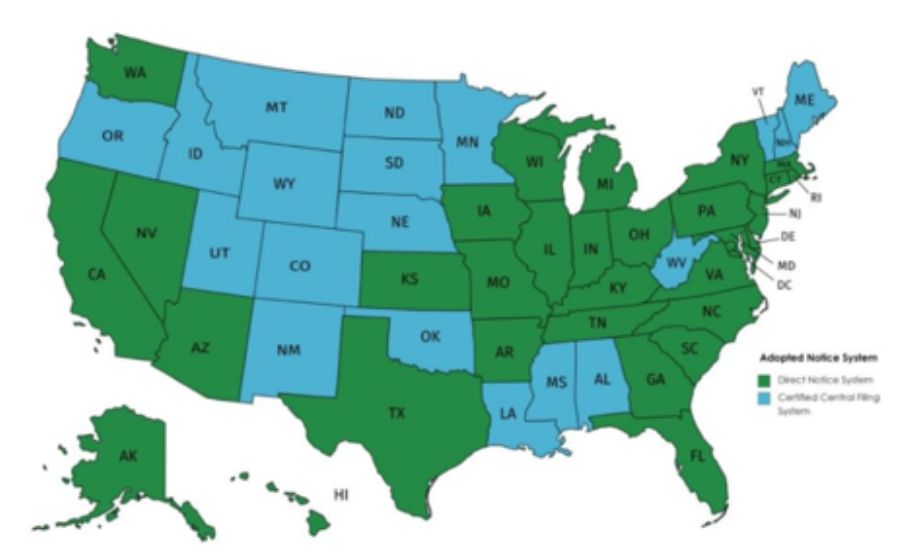
If a Farm Credit lender’s collateral does in fact consist of “farm products” as defined by the FSA, an EFS may be appropriate where:
- Routine Sales and High Risk Exposure. The borrower (or another loan party) routinely sells farm products to third-party purchasers, and the lender faces conversion risk (the danger that purchasers will acquire the lender’s collateral free of the security interest).
- Central Filing System Availability. The applicable state has a certified central filing system (rather than a direct notice system) that covers the relevant farm products, and the Farm Credit lender wants to use the statutory central-filing notice mechanism as part of its broader collateral and proceeds-monitoring practices.
In practice, if a Farm Credit lender (a) has a perfected security interest in a loan party’s farm products, (b) files an EFS against such loan party’s farm products and (c) has not consented to such loan party’s sale of its farm products, the Farm Credit lender may demand payment from not only the loan party but also from the buyer of those farm products. The Farm Credit lender can pursue remedies against the buyer to recover if necessary, but, in order to prevail, the EFS must have been properly prepared and filed, and the applicable statutory conditions must be satisfied. On the other hand, if a Farm Credit lender has filed an EFS, but authorizes a sale of covered farm products, the Farm Credit lender should provide the buyer with the appropriate waiver, release or other written authorization necessary under the FSA for the buyer to take the farm products free of the Farm Credit lender’s security interest.
When Might a Farm Credit Lender Forgo an EFS?
Although there are circumstances in which a Farm Credit lender should file an EFS when farm products are part of the collateral pool, there are also some legitimate reasons why a Farm Credit lender might decide to forgo filing an EFS in these situations, such as:
- Lack of Exposure. A Farm Credit lender may have relatively small exposure to purchaser risk where the loan parties rarely sell the relevant collateral or where the portion of collateral consisting of farm products is minimal in relation to the entire collateral package.
- Collateral Specificity. Because an EFS must identify the relevant farm products and the counties or parishes where those products are produced or located, maintaining this information may create operational challenges for Farm Credit lenders with loan parties operating across multiple counties, producing multiple commodities and/or changing production locations.
- Other Available Protections. The FSA also provides a direct written notice mechanism. In both direct-notice filing states and central-notice filing states, a secured lender may send written notice directly to known buyers of the farm products. A buyer who receives such qualifying notice within one year before the sale and fails to satisfy the payment obligations imposed by the secured party takes subject to the lender’s security interest. This direct written notice mechanism may provide an alternative to reliance on a central filing system in circumstances where the lender knows the relevant buyers and can satisfy the statutory notice requirements.
The Practical Checklist
Therefore, before deciding whether an EFS or another FSA notice mechanism is appropriate, a Farm Credit lender should begin its assessment with five questions:
- Is any portion of the collateral considered a “farm product” under the FSA?
- Is the loan party selling the farm products engaged in farming operations with respect to that collateral?
- How likely is the collateral to be sold to third-party purchasers?
- Does the applicable state use a certified central filing system, and does it cover the products at issue?
- What protection does the Farm Credit lender have if it chooses not to file an EFS?
Conclusion
Farm Credit lenders should understand that they can have a properly created and perfected security interest under the UCC, and still need to separately consider how the FSA affects purchasers of their farm product collateral.
Unlike a UCC-1, an EFS is viewed as a risk-management tool for addressing the Farm-Product Purchaser Problem. Whether filing an EFS makes sense depends on the nature of the collateral; the loan parties’ production and marketing practices; the likelihood of third-party sales; the applicable state’s filing system; the Farm Credit lender’s existing controls over collateral and proceeds; the loan parties’ overall creditworthiness; and the associated costs and administrative burden of compliance. For Farm Credit lenders operating nationwide, the analysis should begin with reviewing each particular transaction and jurisdiction rather than with a presumption that an EFS is always required or, on the contrary, never necessary. Moreover, a decision not to file an EFS at the outset of a transaction need not end the analysis. If a deal deteriorates or enters workout, a Farm Credit lender may want to reassess its exposure to purchasers of farm products and consider whether filing an EFS at that time would provide additional protection.
In sum, UCC perfection answers one question - whether a Farm Credit lender has perfected its security interest under applicable state law; while the FSA raises a separate question - whether that security interest will remain effective against purchasers of farm products. That distinction is the key to understanding why filing a UCC-1 may not be the end of the analysis, and why filing an EFS, where appropriate, can be an important part of a Farm Credit lender’s collateral strategy.
Sources and Further Reading
- 7 U.S.C. § 1631 (Protection for purchasers of farm products)
- 9 C.F.R. Part 205 (Clear Title – Protection for Purchasers of Farm Products)
- 9 C.F.R. § 205.202 (“Effective financing statement” or EFS.)
- 9 C.F.R. § 205.206 (Farm products)
- 9 C.F.R. § 205.209 (Amendment or continuation of EFS)
- "Figuring the Federal Farm Products Rule" by Micah Brown (National Agricultural Law Center)
- “Protection for Buyers of Farm Products: A Primer on the Federal Farm Products Rule (National Agricultural Law Center)
- “Liens and Security Interests in Farm Products” (Webinar) (CSC Global)
- “A Quick Guide to Understanding ‘Farm Filings’” (CSC Global)
Footnote
1. The potential application of other federal statutes, including Perishable Agricultural Commodities Act and the Packers and Stockyards Act, is beyond the scope of this article.
The content of this article is intended to provide a general guide to the subject matter. Specialist advice should be sought about your specific circumstances.
[View Source]

