TL;DR: If you are a lender or investor holding enterprise software debt, this article identifies four early warning signals of coming distress and a decision framework for when to move from passive monitoring to active portfolio management.
In Q1 2026, business development company (BDC) investment funds, a publicly regulated form of private credit, saw a historic inversion: Redemptions totaled approximately $7 billion while inflows totaled approximately $5 billion. This, combined with an increased reliance on paid-in-kind (PIK) interest in the private credit market that allows borrowers to retain more cash on their balance sheet, makes it clear that lenders and their investors are getting concerned about the health of the borrowers in their portfolios.
When we see patterns like the above arise at an aggregate level, it is very likely that they are present within the enterprise software industry, given private credit’s high exposure to the sector. While private credit fundamentals for enterprise tech companies still appear stable on the surface, cracks are beginning to emerge.
Four questions will determine whether the cracks remain hairline fractures that eventually subside or open into a deep chasm:
- How significant will the disruption from AI be in sectors in which private credit is heavily exposed?
- What are the early signs that there will be disruption in a particular technology subsector?
- In those disrupted sectors, can an operating model redesign plan be developed in a rapid manner, particularly for companies in the middle market?
- Will redemptions and income distributions constrain liquidity at private credit funds, particularly for investments in technology, at a time when new liquidity is needed to support troubled investments?
Our research adds an additional wrinkle to the analysis. Within the enterprise software industry, strategic posture towards AI may matter as much as sector exposure. Lenders can still generate outsized returns by picking the businesses with the right protective moats, which we covered in our previous article. However, there will certainly be losers, and lenders that end up in a credit that is heavily disrupted may need to take control of a company to mitigate disaster.
In some instances where they take control, these lenders will need to quickly pivot towards a strategy that maximizes their recoveries. Developing the right playbook now to navigate these situations will be critical to protecting enterprise value. Additionally, by identifying the market signals early, lenders can prioritize companies facing the most immediate threats of disruption, getting ahead of situations while there is still time to effect change.
Four cracks signaling impending distress
- Borrower credit health is deteriorating, with loans in non-accrual status ticking up
Since 2020, common credit metrics of U.S. BDC borrowers have moved in the opposite direction of what investors like to see; for example, median-interest coverage ratio is down by multiple turns compared to an immediately post-pandemic “baseline.” The deteriorating credit health in private credit portfolios is evident when looking at the percentage of loans that are in non-accrual status (i.e., interest payments overdue by at least 90 days). As of the end of Q1 ’26, ~4.8% of total assets in publicly traded BDCs are now classified as “non-performing,” causing the uptick in last-twelve-month (LTM) average seen in the exhibit below.
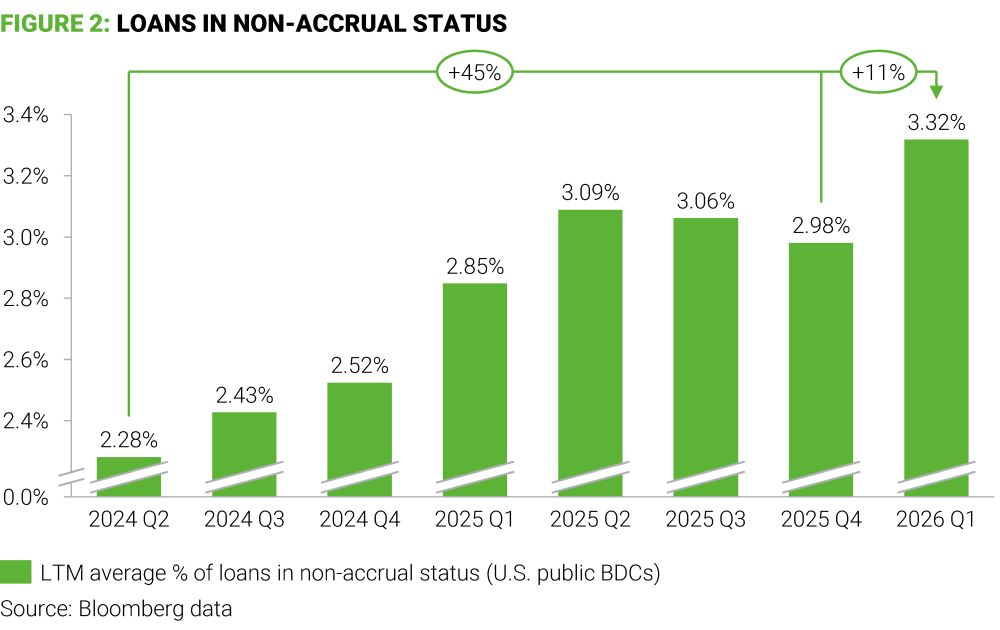
Additionally, new factors have arisen to worsen the situation. The market has seen a wave of liability management transactions over the last few years, with companies increasing the amount of leverage on their books through complicated structures that help raise the liquidity needed to cover obligations. This likely could further decrease the credit health of underlying assets and create even more distress within the BDC portfolios.
- Lenders are accepting IOUs in place of cash
As mentioned in crack one, interest rates have increased and private credit lenders have passed those costs along to their borrowers. When these borrowers either cannot or prefer not to pay interest in cash, lenders can agree instead to add interest to the principal, which is known as PIK. While PIK negotiated at a deal’s origin isn’t necessarily noteworthy, PIK that emerges after closing is often a signal that cash is tight.
PIK interest as a % of total investment income is up materially since the end of 2023, as evidenced in the data below. These persistent increases historically coincide with borrowers exhibiting signs of cash constraints.
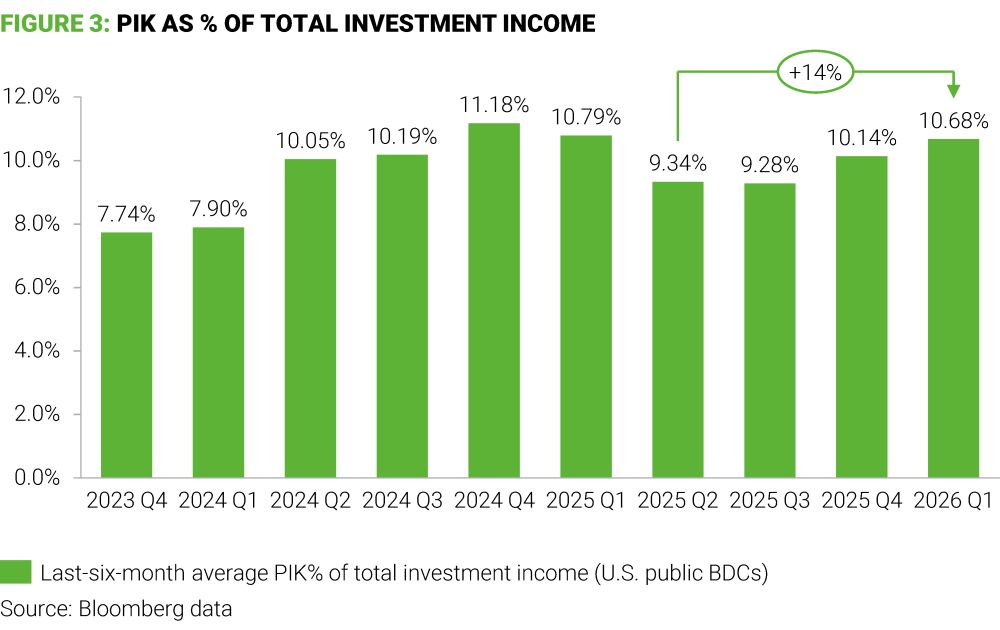
Unfortunately, this can create constraints for private credit lenders as well. Regulated investment company (RIC) tax status requires BDCs to distribute around 90% of their taxable income, and PIK is taxable income even though it generates no cash. As long as money flows into BDCs through new investment, the math works out. If the net outflow of Q1 becomes an ongoing trend, this becomes a major structural problem which could constrain lending for these vehicles at a time when companies in their portfolios need additional capital.
- Trouble in the mid market
While aggregate default rates remain in line with historical trends, not all segments of the market have gone unaffected. Recent trends have shown stress concentrated in mid-sized borrowers: As seen in J.P. Morgan data, those with $25-50M EBITDA have seen defaults nearly triple since 2021.
The reason? Small borrowers tend to have deep-pocketed sponsor equity holders that are more patient and willing to inject capital, and less leverage given their profile. Large borrowers can access public high-yield, leveraged loans and other markets to raise capital. Mid-sized borrowers, however, often have neither, and without access to liquidity they often quickly find themselves in default and coming to the table to negotiate with their lenders
- Software struggles with its strategic posture
Private credit’s tech exposure dwarfs that of other credit markets. More than 95% of software companies are privately held, and the segment is typically asset light, making it disproportionately reliant on borrowing from private credit funds. As seen in J.P. Morgan / Goldman Sachs data, private credit vehicles have a disproportionately high level of software exposure even compared to other higher-risk fixed income asset classes.
AlixPartners scored 10 software sub-sectors (more than 500 companies total) on AI disruption risk. Four of the five sub-sectors facing the highest degree of disruption (productivity & workflow, CRM & sales, coding & development, and analytics & BI) are common BDC borrowers in the horizontal SaaS category.
The question is no longer which software company you lent to; it’s whether those borrowers can re-engineer their operating model fast enough to stay relevant.
What happens next?
Within the 21% of public BDC portfolios that encompass software borrowers, we will see a dispersion of outcomes sharply separated by management response to the shifting landscape.
The dispersion is not yet visible. But refinancing windows that appear as debt matures or new liquidity needs that arise in the years to come will make the spread abundantly clear. There are three variables that will determine what happens next:
- The pace at which sponsors recognize decline in the performance of their businesses and resulting valuation decline.
- The speed at which software borrowers redesign their operating models.
- The amount of liquidity available in the market to fund the obligations of these businesses while they implement the transformations.
The old framework for handing over equity to lenders no longer works in an AI world—prior performance isn’t an indicator of future trends. All parties will need to create new options that improve the cash flow of their companies and investments.
On the PE side:
- Discern which products will continue to drive growth and which are worth harvesting for cash.
- Focus investment on the products that will remain most critical to future company positioning; this will separate leaders as liquidity tightens.
- Proactively engage with lenders on the transformation plan; negotiations are most efficient with more cash runway.
For lenders:
- Identify which enterprise software sectors face the highest level of disruption.
- Develop contingency plans for any companies in your portfolio with liquidity issues or heavy incoming disruption. This will allow for productive conversations with sponsors on how to most effectively transform the business and maximize recovery value.
The software industry is facing a $40 billion debt wall that matures in 2028. The vast majority of these loans are rated B- or lower. The time is now to enact a framework that provides multiple pathways to future success, and AlixPartners can help.
The content of this article is intended to provide a general guide to the subject matter. Specialist advice should be sought about your specific circumstances.
[View Source]