

Child sex abuse is one of the most pernicious crimes imaginable. Perpetrators prey on children precisely because children are vulnerable, easily manipulated and less likely to report. Lawyers representing child sex abuse victims often have their work cut out for them in establishing the abuse. Lawyers comb for evidence in photographs, recordings, eyewitness accounts, text messages, expert reports, medical records, etc. But many child sexual abuse victims do not exhibit physical symptoms that are easily verifiable in photographs or by a doctor in a medical examination.1 The reality is that child sexual abuse often happens in secret, where the only evidence available is the conflicting testimonies of the adult abuser and child victim. Therefore, child sexual abuse cases can turn on the credibility of the perpetrator versus the child.
What is child sexual abuse?
Child sexual abuse occurs when an adult engages in sexual activity with a person under the age of majority (18 in most states). Sexual activity can involve touching, non-touching, or both. Touching activity includes, but is not limited to, touching a child’s genitals for sexual pleasure or other unnecessary reasons, playing sexual games, or forcing the child to touch someone else’s genitals. Non-touching activity includes, but is not limited to, exposing an adult’s genitals to a child, watching a child undress or use the bathroom, or performing sexual acts in a child’s presence.
How does a child prove sexual abuse?
An attorney can only submit evidence of sexual abuse if it complies with the state or federal rules of evidence. In New York, lawyers review a hodge-podge of precedential state court decisions (“judge-made law”) and criminal and civil procedural rules to determine what types of evidence to submit in a trial.2 This method is used for both civil and criminal cases involving child sex abuse.3 New York family courts, which handle matters of child sex abuse in the context of custody petitions and restraining orders, use these guidelines as well. However, children face a steep battle proving their sexual abuse in court with these guidelines. New York could help them if it modernized its thinking about sexual abuse disclosures and adopted the most recent version of the U.S. Federal Rules of Evidence.4
Proving the credibility of a child is legally challenging. In New York, the law presumes a child under the age of nine years old is incompetent (i.e. unable to differentiate between the truth and a lie) to testify, unless proven otherwise.5 Even when a child can demonstrate her competence, defense counsel might poke holes in the child’s testimony by accusing a child victim of misremembering the facts or being unable to understand what really happened. E.g., “I’m not saying you’re lying; you’re just confused!”
Such accusations undermine the credibility of a child. The child’s lawyer may try to rehabilitate the child’s credibility by pointing to prior statements the child made about the person who sexually abused her, such as disclosures to a teacher, a babysitter, a school nurse, or a friend.
However, courts in nearly half the country do not allow the use of prior consistent statements for witness rehabilitation unless the child witness is explicitly accused of lying. And New York is one of them.
This practice has its origins in the U.S. Supreme Court’s 1995 case of Tome v. United States. There, the Supreme Court interpreted the Federal Rules of Evidence to mean that the only time a child’s prior consistent statements could be admitted to the record was when defense counsel expressly or impliedly called the child a liar. And even then, the child’s statements could only be admitted to rebut the charge of lying if the child made the statements before she developed a “motive for lying.”6 The statements could not be used as substantive evidence of the abuser’s guilt.
Tome addressed the question of when the timing of a “motive for lying” develops. There, Colorado prosecutors brought a federal felony charge7 against Mr. Tome for sexually abusing his four-year-old daughter. Defense counsel claimed the daughter fabricated sexual abuse allegations because she wanted to reunite with her mother. The Court determined that the daughter developed the motive to lie on the day of her parents’ divorce, meaning that all her subsequent consistent statements to the babysitter, social worker and other pediatricians were made after her motive to lie developed. Thus, the Court did not allow the child’s disclosures into evidence to rehabilitate her credibility after the defense accused her of lying.
The Tome case applied to the Federal Rules of Evidence, but states typically prosecute sex abuse crimes under state laws, governed by a particular state’s rules of evidence. Different states permit prior consistent statements for rehabilitative purposes in varying degrees:
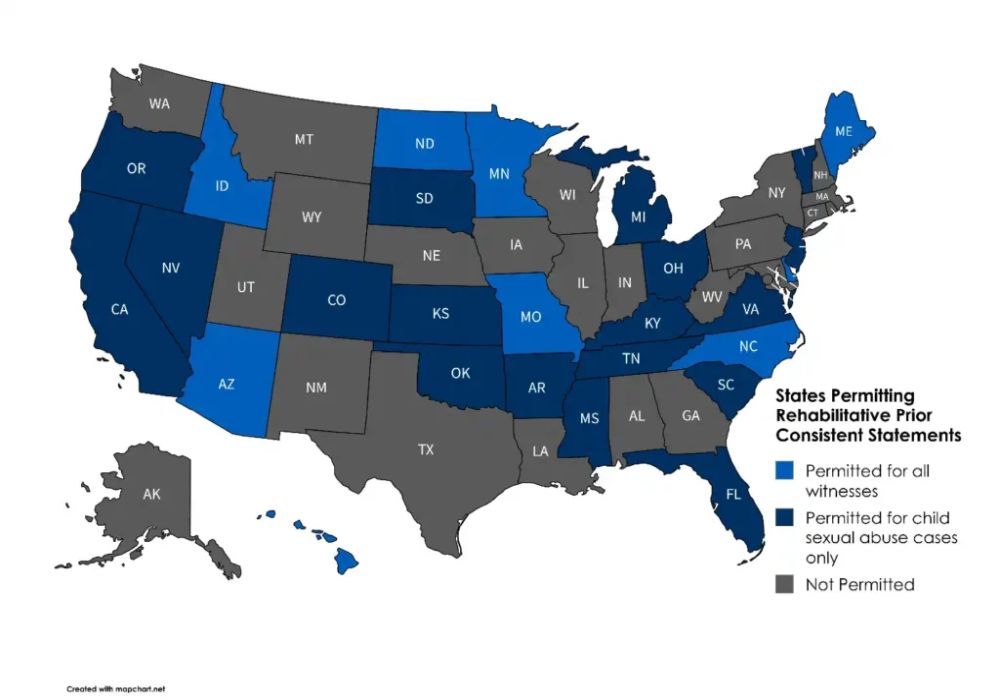
Seeking to legislate around the harsh rule established in Tome, in 2014, the U.S. Congress reformed the Federal Rules of Evidence expanding the use of prior consistent statements. If a prior consistent statement is used to rehabilitate a witness whose credibility has been attacked for reasons of faulty memory or misperception, it is now admissible both to repair credibility and as substantive evidence for the truth of the matter asserted.8 In addition, stepping further away from the Tome rule, when the child’s credibility is attacked for reasons of faulty memory of misperception, it is not necessary for the child’s prior consistent statements to be made prior to the motive to lie. The temporal restriction of Tome applies only to instances where the child has been explicitly attacked for dishonesty or bias9. Thus, Federal courts now recognize that the use of a prior consistent statement “provides a gateway to across-the-board admissibility, both as a response to a general credibility attack and as substantive evidence of guilt.”10
How does New York treat a child’s prior consistent statements for rehabilitative purposes?
In New York, prosecutors are still stuck with the same limitations present in Tome. In New York, prosecutors still cannot offer a child’s prior consistent statements for the substantive truth of the matter. Even for strictly rehabilitative purposes, the prosecutor can offer the prior consistent statements only if defense counsel explicitly accuses the child of lying AND the statements were made before the victim developed the motive to lie.11 New York courts have ruled that to otherwise allow such statements into the record would constitute “improper bolstering.”12
In addition to the limited rehabilitation exception, New York prosecutors can also offer prior consistent statements under narrow exceptions, including the prompt outcry exception,13 for limited identification purposes, or some other relevant purpose (e.g., such as explaining what a child said to trigger an investigation.14)
But even these exceptions can prove useless. For example, the prompt outcry exception—rooted in the myth that an outraged victim will report her abuse as soon as possible—runs afoul of everything we now understand about delayed disclosures by victims.15 In People v. Rosario, the sexually abused teenager waited five months to report the abuse, and the highest court in the state of New York determined this outcry was not prompt enough and thus the prior consistent statement was inadmissible.16 Four years was certainly too long in People v. Stone, where the victim testified that she waited to disclose the abuse because the perpetrator had threatened to kill her if she told anyone.17 The Third Department court determined that since those threats were made two years prior, the victim had no reason to delay her outcry.18
Over seventy percent of child sexual abuse victims do not disclose their abuse within five years of their experience.19 New York state lawmakers realized this and passed the Child Victims Act in 2019 to allow child sex abuse survivors to bring a civil lawsuit against abusers (and institutions that protected them) all the way up to the age of fifty-five20.
—
New York courts must approach cases with a modern understanding of when and how survivors disclose evidence of sex abuse. New York must further align its evidence law to federal standards to give survivors’ attorneys a fair fight in the courtroom. Without these reforms, justice will continue to elude certain survivors of childhood sexual abuse. New York can and must do better.
Footnotes
1. Nancy D. Kellogg, Genital Anatomy in Pregnant Adolescents: “Normal” Does Not Mean “Nothing Happened”, American Academy of Pediatrics (January 2004), https://doi.org/10.1542/peds.113.1.e67
2. A group of twenty-nine current and retired judges form an advisory committee to publish guidelines on evidentiary questions: https://www.nycourts.gov/guide-new-york-evidence
3. Unless specifically noted, the federal and state rules of evidence apply to both criminal and civil cases. In a criminal case, the government charges the perpetrator with a crime (the victim is a witness, but not a party). Punishment can include both fines and incarceration. In a civil case, an individual brings a claim against the perpetrator, or the institution that failed to protect the individual from the perpetrator and sues for financial damages. Many victims bring their civil claims against their abusers in parallel to or in lieu of criminal charges.
4. https://www.uscourts.gov/forms-rules/current-rules-practice-procedure/federal-rules-evidence
5. NY CRIM PRO § 60.20
6. Tome v. United States, 513 U.S. 150 (1995)
7. Since the case arose out of events on a Navajo Indian Reservation, and Native American reservations are subject to federal law, prosecutors brought federal charges.
8. See FRE 801(d)(1)(B)
9. Cf. United States v. Flores, 945 F.3d 687, 705–06 (2d Cir. 2019)
10. United States v. Begay, 116 F.4th 795, 800 (8th Cir. 2024), cert. denied, 145 S. Ct. 1933, 221 L. Ed. 2d 669 (2025)
11. New York’s Guideline Rule of Evidence 8.31(4) https://www.nycourts.gov/judges/evidence/8-HEARSAY/8.31_PRIOR_CONSISTENT_STATEMENT.pdf
12. People v. McClean, 69 N.Y.2d 426 (1987)
13. https://www.nycourts.gov/judges/evidence/8-HEARSAY/8.37_PROMPT%20OUTCRY.pdf
14. People v. Gross, 26 N.Y.3d 689 (2016)
16. People v. Rosario, 17 N.Y.3d 501 (2011)
17. People v. Stone, 133 A.D.3d 982 (2015) Note that more recently in the Second Department, 4.5 years was permissibly prompt under different circumstances: People v. Robertson, 240 A.D.3d 617 (2025). Absent consistent guidelines, a survivor’s chances to hold her perpetrator accountable may simply depend on the court where she files.
18. And even if they had been admissible, prosecutors could only offer the fact of the outcry statements – not the content of the statements.
19. https://childusa.org/wp-content/uploads/2025/11/Delayed-Disclosure-2024.pdf
The content of this article is intended to provide a general guide to the subject matter. Specialist advice should be sought about your specific circumstances.
[View Source]
