
This guide covers key legal and practical steps that sponsors and corporates should consider when planning a hedging strategy with respect to debt financing (e.g., when entering into loan-linked interest rate or cross-currency swaps), together with commentary reflecting recent market practice. The commentary also includes points of comparison in the London vs. New York markets, as many sponsors and corporates operate on a cross-jurisdictional basis and a large majority of debt financing arrangements are governed by English or New York law. This guide is intended as a reference point for treasury, in-house legal, compliance, and other professionals navigating the hedging process.
TRANSACTION DOCUMENTATION AND NEGOTIATION
Overview of ISDA Documentation Architecture
Ordinary course hedging transactions form part of a bilateral ISDA Master Agreement 1, which is universally accepted as the industry-standard agreement governing derivatives transactions. “ISDA” is the acronym for the principal derivatives industry trade association, International Swaps and Derivatives Association, Inc., which was created in 1985 to develop standardized legal documentation and best practices for a growing over-the-counter derivatives market.2 However, market participants generally refer to “ISDA Master Agreement” and “ISDA” interchangeably.
While the first 14 Sections (or the “front-end”) of an ISDA Master Agreement is in a standard, pre-printed form which sets out the parties’ key legal rights and obligations (including default termination provisions), the deal- and relationship-specific elections and modifications will be made in the Schedule to the ISDA Master Agreement (or the “back-end”). Individual transactions are typically entered into over the phone on a recorded line and evidenced by transaction confirmations which will be generated by the hedge provider’s back office and delivered to the company for review and signature. The confirmation will set out the economic terms of the trade and incorporate applicable product-specific definitions, e.g., the 2021 ISDA Interest Rate Derivatives Definitions for interest rate hedges and/or the 1998 FX and Currency Option Definitions for FX hedges.3 The ISDA Master Agreement (including the Schedule) and the individual transactions all form a single agreement governing the contractual relationship between the parties.
ISDA Master Agreement – 2002 vs. 1992 Form
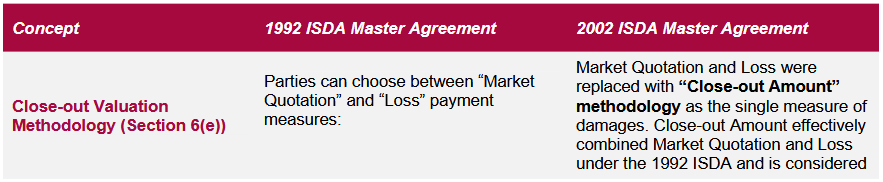
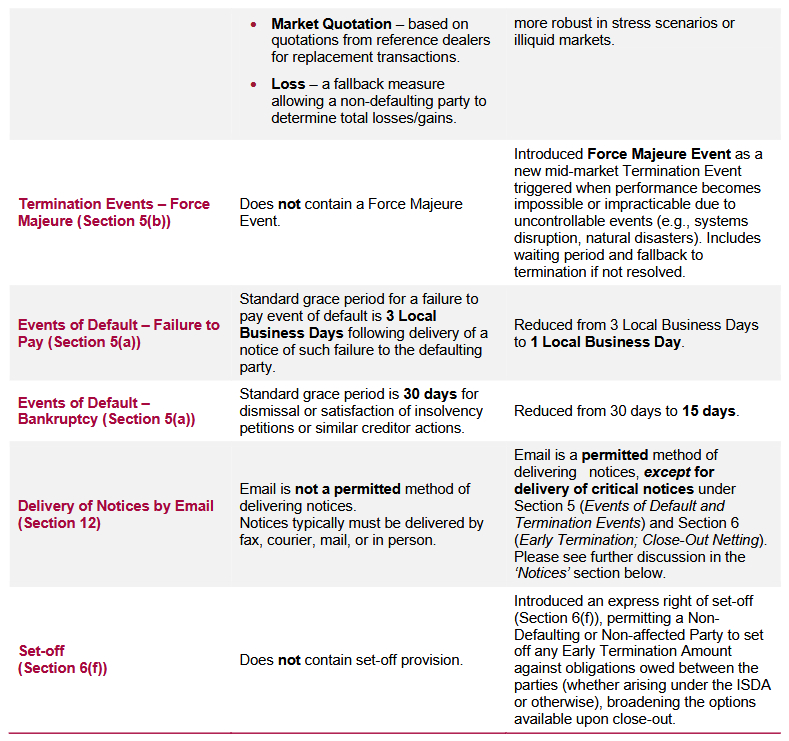
The two most widely used derivatives master agreements are the 1992 ISDA Master Agreement and the 2002 ISDA Master Agreement. 4 There are multiple factors to consider when deciding whether the 1992 or 2002 form is more appropriate for your transaction needs. We have listed a few distinguishing features between the two forms below. While each of these may be modified in the ISDA Schedule, it is helpful to be aware of the differences, particularly when a counterparty suggests transacting under the 1992 form. The 2002 form is commonly used in the loan-linked hedging context, given favorable industry-wide updates compared to its predecessor.5
ISDA Schedule – Drafting & Negotiation Process
In financing transactions, hedge providers typically benefit from the same security package and rank pari passu with senior lenders.6 As such, hedge providers’ default and termination rights in the ISDA may be modified or limited to align with those of the lenders to avoid the borrower being subject to different standards in the loan-linked hedge transaction. In the majority of English law-governed financings, the first stage of the negotiation is to agree hedge providers’ default and termination rights and related hedging provisions in the financing documents (e.g., the intercreditor agreement or common terms agreement), which are then reflected in the ISDA, with the terms of the financing documents prevailing over the terms of the ISDA in the event of inconsistency. By contrast, in the majority of New York law-governed financings, the financing documents are less prescriptive with respect to hedging arrangements and therefore the bulk of the commercial negotiation occurs when drafting the ISDA.
In a syndicated deal, drafting counsel typically holds the pen on preparing a “template” ISDA Schedule, which aligns with the requirements of the financing documents. The template is then negotiated among the borrower’s counsel and the banks’ counsel (the latter usually taking instructions on behalf of the whole syndicate but periodically working with each bank on a bilateral basis), with the goal of agreeing a template ISDA Schedule with substantively identical terms (principally regarding default rights and termination rights) for all hedge providers. Once the template is agreed, the hedge providers separately provide bank-specific details and regulatory provisions, which are used to break out the bank-specific ISDA Schedules from the agreed template.
Commonly Negotiated Provisions: Overhedging, Orphan Hedge Providers, Lender Replacement & Refinancing
Overhedging: In most debt financing transactions (in particular in the project and infrastructure financing space, where borrowings have long tenors), the floating interest rate payable on the loan(s) is subject to a minimum hedging requirement and often a maximum hedging requirement. The minimum (and if applicable, maximum) hedging requirements are documented in the financing documents (e.g., by way of a hedging covenant in the credit agreement or hedging policy in the common terms agreement) or a separate hedging strategy letter. From the sponsor’s perspective, it is desirable to have as much flexibility in the management of the hedging levels as possible, for example by:
- setting a band within which the outstanding hedge notional can fluctuate at the sponsor’s discretion (e.g., 50% to 110% of loan profile);
- providing for an extended grace period within which to eliminate hedging excess when it occurs (e.g., due to partial prepayments);
- permitting overhedging reductions on a non-pro rata basis across hedge providers, either generally or specifically where the reduction is below a certain (often de minimis) threshold (e.g., less than 10% of outstanding loan principal); and/or
- allowing for overhedging reductions through discretionary offsetting transactions (i.e., equal and opposite trades) pursuant to which the borrower’s exposure to the hedged risk is reduced by such offsetting transactions. This can be an appealing alternative to reduction of overhedging by partial termination of excess hedging transaction(s) because the latter can result in termination amount(s) becoming payable by the borrower.
There are multiple variables and industry-specific conventions that impact whether the foregoing options are included in a particular financing structure. Optionality regarding overhedging continues to evolve in light of the introduction of new players and capital structures.
Orphan Hedge Providers: The same is true with regard to the position of ‘orphan’ hedge providers. Hedge providers are generally lenders (or lender affiliates) which adds a layer of comfort for them as far as voting rights and accessibility of information is concerned. However, increasingly (particularly in private credit transactions), hedge providers are not otherwise participating in the related debt financing, which is referred to as holding an “orphan” hedge. In order to avoid information asymmetry, an orphan hedge provider may expect additional information and voting rights as the lenders or creditors in the related debt financing. These additional information needs must be operationalized by the borrower and built into the financing documents and/or the ISDA.
Lender Replacement: Where a hedge provider is both a lender (or lender affiliate) and hedge provider on day one, whether and when a hedge provider can terminate (or would be required to novate) its outstanding hedge transactions if it (or its affiliate) ceases to be a lender is often a point of negotiation. A hedge provider that ceases to be a lender due to a voluntary transfer of its loan position is often restricted from terminating its hedge transactions in order to avoid the borrower potentially having to make a termination payment and being under-hedged solely as a result of a decision by the hedge provider (or its affiliate) to voluntarily transfer its loans. However, sometimes the loan and hedge are required to be “stapled.” Many financial institutions have strict policies on their ability to hold an orphan hedge should they cease to be a lender, so this should be discussed at the onset of the transaction.
Refinancing: Another often negotiated scenario is whether a hedge provider can terminate its hedge transactions upon a refinancing of the loans. Often the borrower would not want its hedges to terminate upon a refinancing, particularly where the financing is long-dated, to avoid a resulting termination payment in case of any adverse movement in rates at the time of the refinancing. The hedge providers, on the other hand, are concerned about the robustness of the refinanced collateral arrangements and the borrower’s ongoing creditworthiness and therefore want the flexibility to terminate and reprice the hedges in this scenario. While we see varying solutions to address these concerns, a common compromise is that the hedge provider will waive its termination right if it or its affiliate participates in the refinancing as a lender.
Footnotes
1 Typically in the form of a 1992 ISDA Master Agreement or the 2002 ISDA Master Agreement, as discussed below.
2 ISDA continues to actively engage with market participants and policymakers to make the global derivatives markets safer and more efficient. Today, ISDA has over 1,000 member institutions from 78 countries. See https://www.isda.org/ for further details.
3 ISDA and the Emerging Markets Traders Association have recently published the new 2026 FX Definitions. The implementation date for the new definitions is November 22, 2027, after which Swift will no longer support the 1998 FX Definitions
4 For the purposes of this guide, we focus on the English and New York law-governed ISDA Master Agreements; however, ISDA has also published amendment agreements to change the governing law to Irish or French law. In the German market, parties often use the German law governed master agreement “Deutscher Rahmenvertrag für Finanztermingeschäfte.”
5 The 2002 form was developed in response to certain perceived deficiencies in the 1992 form by market participants. For example, the dual valuation methodology (“Market Quotation” vs. “Loss”) proved impractical during market distress when reference-dealer polling broke down or quotes were otherwise unavailable or meaningless.
6 Certain structures have super senior hedge providers, e.g., in respect of long-dated inflation hedges or treasury locks.
To view the full article click here
The content of this article is intended to provide a general guide to the subject matter. Specialist advice should be sought about your specific circumstances.
[View Source]