- with readers working within the Construction & Engineering industries
- within Strategy, Intellectual Property and Criminal Law topic(s)
Networked organizations are the future, part 3
In today’s business landscape, the greatest threat to innovation isn’t a lack of ideas; it’s organizations shackled by their own complexity. Over time, growth and scale often lead to rigid silos and sluggish response times. For technology-driven enterprises, this problem is especially acute: a structure designed for control in one era can easily become an anchor when market dynamics shift. But what if the solution is not another sweeping reorg, but a fundamentally different way of working?
When scale breeds complexity and stalls innovation
One global technology enterprise found itself at this crossroads. Decades of expansion had created highly specialized departments, each mastering its own domain: engineering, product, marketing, sales, operations. On paper, each function was a model of operational efficiency. In practice, these silos made it nearly impossible to innovate quickly or offer customers what they wanted, when they wanted it.
Small tweaks to a product required weeks of cross-departmental wrangling. Customer feedback was lost in translation between functions. Decision-making stuttered through layers of approvals, and nobody, it seemed, truly “owned” the end-to-end outcome for the client. While every group was busy excelling in its silo, the business as a whole was losing momentum. Senior leaders recognized that their legacy operating model simply couldn’t keep pace with either the market or the customer. A new approach was needed: one that favored speed, collaboration, and true accountability for results.
Experimenting with networked teams, not top-down mandates
Rather than attempting a full-scale reorganization, the company opted for a focused experiment: what would happen if they empowered a cross-functional, agile team with real autonomy to reimagine just one critical product development process?
The pilot was distinctly different from prior initiatives. Instead of reorganizing boxes on a chart, the organization assembled a diverse team, including sales, engineering, product, user experience, and corporate support, each member committing a significant share of their workweek to the effort. Leadership didn’t just sanction this team; they backed it up with changes to incentive structures, making participation a sought-after opportunity.
Crucially, the team was granted clear decision rights within their scope. C-suite sponsors didn’t interfere in day-to-day efforts, but they did provide regular feedback, challenge assumptions, and ensure strategic alignment through showcases and rapid feedback loops.
As external agile coaches, the AlixPartners role was to guide, not to dictate. We provided tools: daily standups, sprint planning, backlog management, and continuous retrospectives. But the real aim was to embed new habits to help the organization internalize agile ways of working, not merely “do agile” in name. The backlog became a dynamic record not just of technical requirements, but of business priorities and customer needs. As momentum grew, the client began hiring its own agile coaches and scrum masters, building muscle to sustain the approach long after the pilot.
From pilot to new operating model
The impact of this experiment was visible within weeks: the pace of development quickened, and cross-team friction melted away. Because the pilot team included all the required expertise, business, product, technology, and support, decisions could be made rapidly, and course corrections came from real-time feedback instead of after-the-fact blame.
Frequent retrospectives allowed the team to identify and fix bottlenecks as they emerged. Over time, more advanced agile practices took root: backlog grooming, velocity tracking, and definition-of-done agreements. What began as an experiment soon became a working proof of concept for transforming how the company got things done.
At the end of just sixteen weeks, the pilot team not only delivered a viable product iteration but also provided a playbook for scaling this new, networked approach. Leadership saw the benefits and green-lit further cross-functional teams. While some participants returned to their day jobs, the majority continued in networked teams focused on the next set of priorities. The program as a whole was in high demand and seen as a valuable opportunity to fundamentally change and evolve the business. Crucially, the model spread not by top-down fiat, but by success: teams volunteered to adopt the model, adapting it to their own needs, guided by core principles rather than rigid directives.
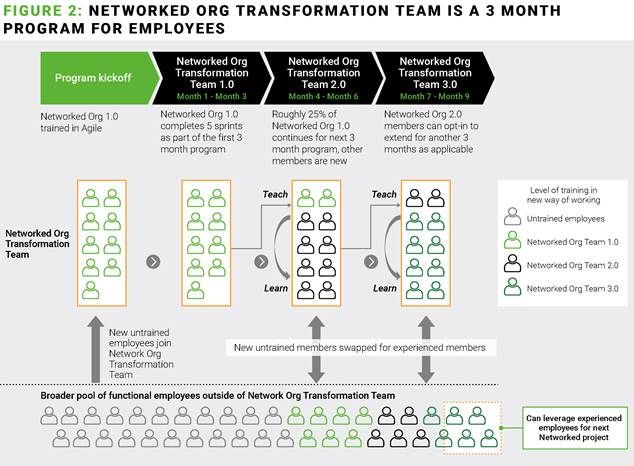
Figure 2 illustrates how a networked organization can be scaled as a capability within the organization, both to train employees in this new way of working and to continue deploying transformation across different value chains. More than one networked org team can be run in parallel as well.
The Results: Faster, Leaner, More Customer-Focused
The numbers tell the story:
- 30–50% faster time-to-market: Product launches sped up dramatically.
- 20–40% boost in productivity: Fewer handoffs and more empowered teams led to greater value and less rework.
- 25–45% cost reduction: Streamlined collaboration reduced unnecessary overhead.
- Rising customer satisfaction: Shorter development cycles and closer alignment with user needs led to happier clients.
- Beyond the metrics, the company saw a culture shift. Teams collaborated more, leaders prioritized outcomes over process, and innovation became the norm. Perhaps most importantly, the organization gained confidence: agile, networked teams weren’t just “possible”, they were essential for scaling innovation.
Key takeaway: Simplicity scales, complexity doesn’t
In a world where complexity is the enemy of progress, networked organizations complement traditional hierarchies and prove that speed and agility are not the result of tearing things apart, but building together in new, smarter ways.
Call to action: Is your organization built for speed or stuck in its own structure?
Many organizations sense that something is slowing them down, but struggle to pinpoint whether the issue lies in strategy, talent, technology, or the operating model itself. Hierarchies aren’t the problem. But when they’re asked to do everything, innovation, speed, and accountability suffer.
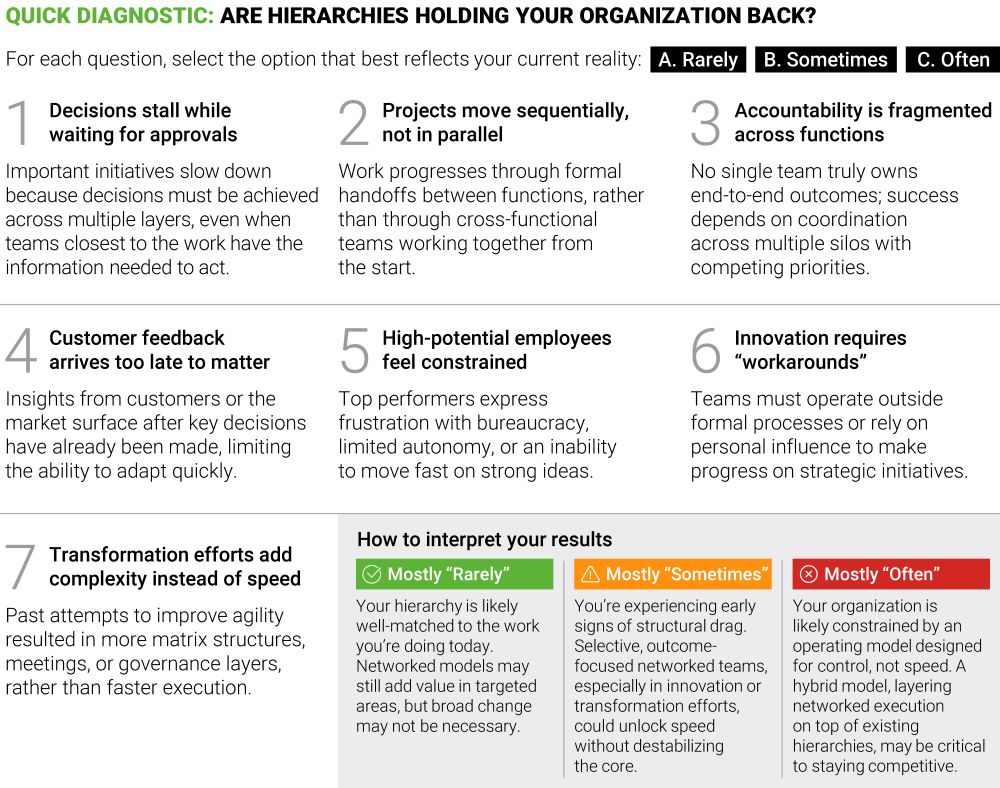
To help leaders assess whether their organization may be constrained by overly rigid structures, or ready for a more networked way of working, we’ve developed a short diagnostic to highlight where traditional hierarchies may be limiting execution, and where networked models could add value.
The content of this article is intended to provide a general guide to the subject matter. Specialist advice should be sought about your specific circumstances.
[View Source]