

Azhic Basirov looks at Aim’s performance in light of recent market upheaval.
Recent turmoil in financial markets around the world has led to increasing uncertainty. There have been a series of headline-grabbing events. In particular, emerging problems in the US sub-prime mortgage market, the collapse of sizeable hedge funds and difficulty in raising debt by private equity consortia, have caused widespread volatility in credit and stock markets.
What’s most worrying is that the extent of losses linked to the sub-prime mortgage market is not completely known. It may be that supposedly very safe, highly rated, complex debt products are backed further down the leverage line by sub-prime mortgage debt. It is this degree of uncertainty, as opposed to risk, that has got the market worried.
More recently, the problems in the banking sector have reinforced fears that a quickfire sale of assets could perpetuate the vicious cycle of collateral losses.
A Balanced Outlook
Of course, nobody can tell the future and it is not known whether recent events foreshadow a more disruptive movement in financial markets or represent a gradual easing of pressure that will allow credit spreads to return to more realistic levels. Despite the worrying signs, there does not appear to be a fundamental challenge to the macroeconomic outlook or corporate earnings expectations. Corporate debt in aggregate has been falling, balance sheets are becoming healthier, and, although the cost of raising debt is increasing, it remains relatively affordable. Indeed, activity in the key world economies has remained buoyant, riding on the back of record world economic growth.
The Impact On Aim
Against this background of uncertainty, the number of admissions to Aim fell to 174 for the year to the end of July, compared with 269 for the comparable period in 2006. At the same time, the capital raised by Aim-listed companies has increased by 24.5% to £11.7bn for the same period, reflecting the fact that while investors have become more selective, larger sums have been raised in secondary issues.
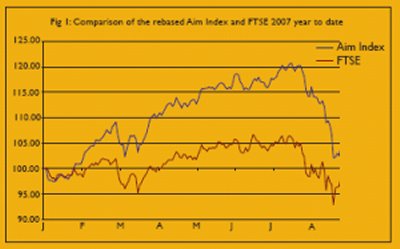
The Aim Index outperformed the FTSE for the year to August (Figure 1). However, the turbulent weeks during August saw a more dramatic decrease in the Aim Index compared to the FTSE. As is often the case in times of uncertainty and market volatility, investors have moved towards safe, non-speculative investments.
The Future
The outlook for Aim remains favourable as world economies continue to grow. As an established premier market for growth companies, Aim continues to attract those seeking to raise growth capital both domestically and, increasingly, internationally. As well as establishing itself as an ideal exchange for the junior oil and gas companies, Aim has attracted a variety of property and other funds in the past 18 months or so. Approximately 48% of funds raised on Aim in 2006 were used for these types of vehicles.
While Aim will continue to provide growth capital for deserving propositions, it cannot be entirely sheltered from the flux of equity markets and investor attitudes to smaller companies in times of turmoil or downturn in stock markets. The coming months will be instructive for gauging the direction of the markets in general – and Aim in particular.
The content of this article is intended to provide a general guide to the subject matter. Specialist advice should be sought about your specific circumstances.