

© Bloomberg 2008. Originally published by Bloomberg Finance L.P. Reprinted by permission
There has been much activity and discussion about Islamic capital markets in the financial press in the past few years. It is common to read about Islamic bonds on a daily basis. In fact Dow Jones and Citigroup actually launched an Islamic bond index called the "Dow Jones Citigroup Sukuk Index." Sukuk (Islamic capital market instruments) have been the topic of choice at numerous finance conferences throughout Europe, the Middle East, the Asia Pacific and now in the United States. One of the key principles of Islamic finance is the prohibition on charging interest (or 'Riba') on money.
Conventional capital market instruments such as bonds, commercial paper and medium term notes all have a fundamental interest and principal component. So how can it work? Aren't Islamic capital market instruments a contradiction in terms? Can we structure to get around such a fundamental rule?
The Initial Deals Used Islamic Leasing As The Solution
A well-established Islamic financing technique, known as the Ijara (Islamic compliant lease), which has been considered acceptable by Islamic scholars for other financing transactions, overcame this problem in the initial deals that came to the market.
The Ijara (which is a word derived from the term 'rental' in Arabic) is a structure that utilises an asset's rental stream to produce a return to the owner of the asset. Economically, an Ijara financing works and operates like an amortising or bullet repayment loan in many respects; however, Shariah scholars have become comfortable with the arrangement being a sale and an Islamic compliant lease of an asset, as opposed to a loan under which principal and interest are payable. The traditional Ijara structure has been in use for some time before Islamic capital market instruments started to appear on the scene.
How can the Ijara structure be used and adopted for an issue of instruments that have similar economic qualities to standard bonds? What if the party seeking the finance does not wish to own an asset but needs financing for other purposes?
Using Leasing In A Capital Markets Context "The Deal That Started It All"
An example of successfully adopting the Ijara structure for a truly global capital market issue was the Malaysian government's issue of Sukuk Trust Certificates in August 2002. The structure used was simple and clean in order to appeal to the broadest possible base of Islamic investors. A special purpose vehicle (SPV) was incorporated in Labuan called the 'Malaysian Global Sukuk Inc.' (MGS).
MGS (owned by a Malaysian state entity), issued Sukuk to investors. MGS used the funds raised from investors to purchase a number of parcels of land from another Malaysian state entity. MGS then leased those parcels of land to the Federation of Malaysia. At the expiry of the term of the lease, the Malaysian government has agreed to purchase the parcels of land from MGS at the face value of the initial issue amount of the Sukuk.
Pursuant to a declaration of Trust, the land parcels are held by MGS in favour of the Sukuk holders. All returns made on the land parcels are conveyed to the Sukuk holders (including lease payments and the final repurchase proceeds). The cash flow produced is similar to any bond. The lease payments are like coupons and the repurchase proceeds paid at the end of the term are like the principal.
The MGS issue was rated by Standard and Poor's and Moody's. The instruments were listed on the Luxembourg Stock Exchange. The lease payments are determined based on a spread over LIBOR. The Islamic scholars have been comfortable with the use of LIBOR as a lease pricing reference mechanism and not as a means of calculating interest.
Can You Trade Debt Above And Below Par Value?
As trading in debt above or below par would obviously breach the Islamic finance principle of not charging interest, and the ability to trade freely in capital market instruments is critical if you would like to create liquidity, there is a potential further problem. However, since the Ijara Sukuk represent an interest in the underlying assets and not debts, they can be traded above or below par freely without breaching any Islamic principles.
Has The Leasing Structure Been The Answer? Can We Achieve The Convenience And Economics Of Conventional Capital Markets Using Leasing?
Islamic scholars have broadly accepted the Ijara structure. However, the structure suffers from some major commercial disadvantages, namely:
- Not all issuers have an appropriate underlying asset available for such a transaction;
- The asset is locked up for the term of the transaction; the owner cannot simply sell it;
- Even if an issuer does have the underlying asset, depending on the jurisdiction, there could be adverse taxation costs associated with introducing the asset into the structure;
- Not all assets can be used for leasing purposes;
- There could be ongoing Shariah audits in connection with the asset. This can be time consuming and costly for the issuer; and
- The structure is not easily usable for a programme structures.
The Sukuk Al Musharaka Generation Of Structures
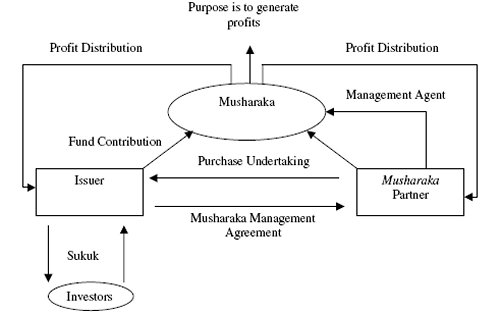
Another structure that gained popularity in the market was the "Sukuk Al Musharaka." This structure involves an SPV Issuer entering into a joint venture "Musharaka" agreement with the finance seeking party (Musharaka Party). The purpose of the Musharaka is to generate profits.
The parties' respective interests in the Musharaka are represented by contractual "Units" held by each party. The Issuer will make a funding contribution to the Musharaka from funds it raises from the Sukuk issue. The Musharaka Party will make an in-kind contribution to the Musharaka (usually including some tangible assets).
The Issuer and the Musharaka Party also enter into a Purchase Undertaking pursuant to which the Issuer can require the Musharaka Party to purchase a set amount of Units on set dates during the term of the Sukuk. The Issuer will receive profit distributions from the Musharaka and proceeds from sales of the Units to the Musharaka Party. The amounts received are distributed to the Sukuk holders in accordance with a set formula.
This structure is viable when the Musharaka Party can use its in-kind contribution for a profit generating venture. The structure is shown diagrammatically below:
The structure does provide some advantages (especially if the Issuer does not have all of the necessary tangible assets to achieve an Ijara Sukuk issue on day one). However, it does still have the following disadvantages: (i) it requires tangible assets; (ii) the assets are locked up in the structure for the term of the Sukuk; (iii) a profit generating venture/project needs to exist; (iv) the structure is relatively document intensive compared to a conventional bond issue; and (v) there have been some Shariah debates about the purchase undertaking.
Other Structures
To overcome the limitations of the current Sukuk structures, innovative structures are being developed by various institutions worldwide. The alternative structures being contemplated are based upon other wellknown Islamic financing structures (such as Mudarabah, Istisna, Musawama, Murabahah, Salam). The biggest challenge that these potential structures face is producing an instrument that can be traded freely in the secondary market without breaching the fundamental principle of not trading in debt above or below par. The Ijara structure has been the most effective in solving this issue as the instruments produced represent an interest in an underlying asset that can be traded. Other structures being contemplated to solve the tradability issue are extremely complex and document intensive. The Mudarabah (a form of Islamic partnership) structure is beginning to make an entrance in the Sukuk market as another viable structure.
Scholars have recently expressed a preference for structures that are moving towards asset securitisation. One good example of such a structure was the groundbreaking Sukuk programme for Gulf Finance House B.S.C (c). Sukuk Programmes: The New Wave
Arranging institutions and issuers usually have the following criteria for potential Sukuk programmes:
1. It must be a programme that enables the issuer to issue Sukuks quickly and efficiently when market conditions are right (just like an Euro Medium Term Note Programme enables an issuer to take advantage of good market conditions at the right time in the Euro market);
2. Issues under the programme are not overly document intensive;
3. The programme has a very flexible architecture that enables the issuer to use a variety of Shariah-compliant asset classes for any issue of Sukuk and also enables the issuer to substitute assets backing the issue efficiently; and
4. The structure has broad Shariah acceptance. The structural architecture of the recent Gulf Finance House B.S.C (c) (GFH) Sukuk programme has been summarised below.
The Asset Side Of The Structure
The programme enables GFH Sukuk Limited, a Cayman Islands special purpose vehicle (Issuer), to issue Sukuk trust certificates in series from time to time. On the occasion of each issuance of Sukuk, the Issuer will apply the proceeds of the issue to acquire from GFH a beneficial interest in certain Shariah-compliant assets pursuant to a master purchase agreement and a supplemental purchase agreement. Those assets must consist of a pool of Shariah-compliant income-generating assets, interests or contracts, which may include, inter alia, ijara, real estate, murabaha contracts, istisna contracts, shares, and/or other Shariah compliant assets. The composition of the pool of assets for each series must be approved by the GFH Shariah board.
In order to manage those assets, the Issuer has appointed GFH as the managing agent to manage the Sukuk assets of each series on its behalf pursuant to a management agreement. Profits and returns received in respect of the Sukuk assets of each series will be applied to pay periodic distribution amounts in respect of such Series of Sukuk on the relevant periodic distribution dates. Any amount corresponding to the principal amounts received in respect of the Sukuk assets of each Series of Sukuk will be reinvested by the Issuer in, inter alia, acquiring additional Sukuk assets (as the master purchase agreement and master purchase trust deed contemplate and allow for) which will form part of the Sukuk assets of the relevant series.
GFH has further agreed, in the management agreement, to make a Shariah-compliant liquidity facility available to the Issuer to cover any liquidity shortfalls and any costs and expenses incurred by the Issuer in having an interest in the relevant Sukuk assets. No interest is payable in respect of any advances made pursuant to this liquidity facility. The liquidity facility is repaid from Sukuk asset proceeds.
The terms of the master purchase agreement and the master purchase trust deed also enable the Issuer to replenish the pool of assets from time to time as and when necessary and allow for substitution of assets (if certain Shariah tests are met).
GFH has undertaken to acquire the Sukuk assets of the relevant series of Sukuk on the relevant maturity date or, as the case may be, on the relevant dissolution date arising from the occurrence of specified dissolution events pursuant to a purchase undertaking deed poll made by GFH in favour of the Issuer. Pursuant to a sale undertaking deed poll, the Issuer has also undertaken to sell the relevant Sukuk assets to GFH (at GFH's option) in certain early dissolution circumstances only. The purchase price payable by GFH for such assets will be an amount equal to the sum of: (a) the aggregate nominal amount of the relevant series of Sukuk, (b) the amount of accrued but unpaid Periodic Distribution Amounts on such date and (c) any outstanding amounts due to GFH under the liquidity facility.
The Funding Side Of The Structure
Pursuant to a master trust deed which is supplemented, on the occasion of the issue of each Series, by a supplemental trust deed in respect of the relevant Series, the Issuer will declare a trust over the relevant Sukuk assets. Each such trust will be declared for the benefit of the relevant certificate holders of the relevant Series.
The Issuer will only act upon the instructions of the certificate holders in carrying out the activities of the trust. To facilitate the giving of such instructions by the certificate holders, it is a term of the Sukuk that a Transaction Administrator is appointed pursuant to a transaction administration deed between the Issuer and the Transaction Administrator to act as agent for the Certificate holders and be solely entitled to provide instructions to the Issuer on their behalf. The structure has been summarised diagrammatically below:

The Key Advantages Of The GFH Programme Structure
The key advantages of the GFH Sukuk programme structure are:
- The flexibility it provides to GFH by allowing the bank to inject different kinds and classes of Shariah-compliant assets into the structure (including Shariah-compliant shares);
- The structure allows for extraction and substitution of assets in a Shariahcompliant manner;
- The programme structure enables GFH to go to the market very quickly compared to having to structure, implement and list one time Sukuk issues;
- Due to the modular master/supplemental structure of the documentation, going to the market is not a document intensive process compared to one-off Sukuk issues; and
- The GFH programme structure has some similarities to asset securitisation structures. Prominent Shariah scholars have recently expressed a preference for these types of structures rather than Musharaka based or Mudarabah based structures.
The Bright Future Of The Sukuk Market
Given the recent growth and potential of this market and the attraction of this market to Islamic and non-Islamic institutions and corporates as a potential source of funds and liquidity, it is only a matter of time before more refined structures are developed that do not suffer from some of the commercial disadvantages of current structures. The Sukuk programmes coming to the market are a good example of innovation in the Islamic finance market that is overcoming limitations of earlier structures.
The content of this article is intended to provide a general guide to the subject matter. Specialist advice should be sought about your specific circumstances.
