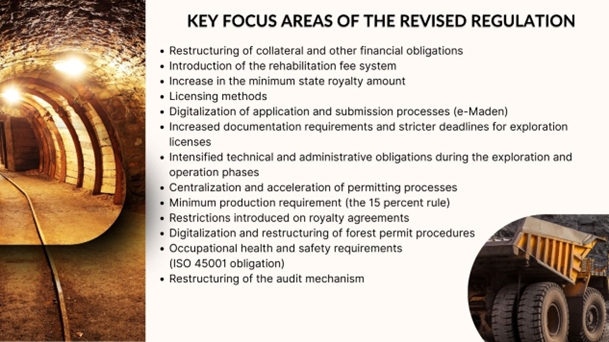
On October 2025, the Ministry of Energy and Natural Resources ("Ministry") introduced a series of significant amendments to the mining framework through the Regulation Amending the Mining Regulation1. These changes form a continuation of the broader legislative reform that began with the extensive revisions to the Mining Act in July 2025. The latest amendments place strong emphasis on digitalization, increased financial obligations, stricter production standards, and a rehabilitation-oriented environmental approach. Collectively, these shifts mark a substantial redefinition of the operational rules governing the mining sector. In this article, we examine the key changes introduced by the amendment and explore their potential implications for industry stakeholders.
Restructuring of the Collateral System and Financial Obligations
One of the most significant changes introduced by the Mining Regulation is the redesign of the collateral and payment system. The former "environmental compliance fee" has been replaced with a new "rehabilitation fee". This update reflects a clearer and more focused approach to environmental responsibilities in mining activities. Also, under the new system, companies must pay the rehabilitation fee by the end of January. If the payment is not made on time, the regulation provides an additional period until June with late interest. If the payment is still not completed, the mining license may be cancelled. This approach increases the financial and operational importance of complying with regulatory obligations.
Another important change concerns the distribution of the operating license fee. Under the new system, 70 percent of the operating license fee will be transferred to the general budget as revenue and 30 percent will be recorded as income of the General Directorate. Under the previous system, 50 percent went to the general budget, 30 percent was held as collateral for environmental compliance work and 20 percent was allocated to the General Directorate. The new allocation model significantly increases the state revenue generated from mining activities and at the same time increases the financial burden on license holders.
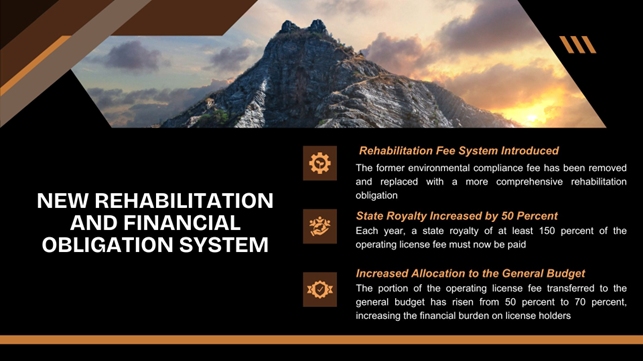
An other significant increases in financial obligations is the new minimum state royalty requirement. Under the new regulation, the rule has been revised to provide that mining licenses with an operating permit must pay each year a state royalty of at least fifty percent more than the operating license fee. This change represents a substantial increase in financial obligations for the sector and is expected to have a direct impact especially on small scale operators. In addition, the removal of the chromium exemption in the state royalty calculation and the updates made to all relevant provisions in line with the benchmark of fifty percent more than the operating license fee indicate that the system has been redesigned in a uniform and consistent manner.
Licensing: Tender or first come first serve?
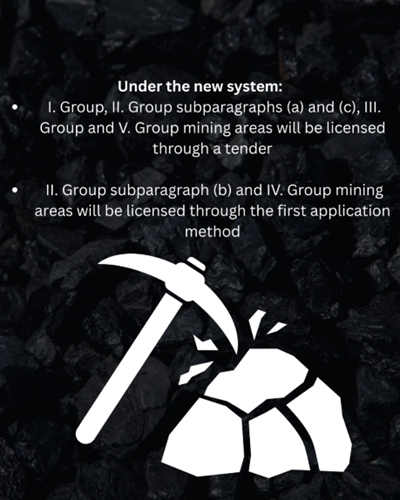
The recent amendments introduce an important change in the approach to determining how mining areas will be licensed. In particular, the scope of areas that may be allocated through the first application method without a tender has been expanded. Under the new system:
- Group I, Group II subparagraphs (a) and (c), Group III and Group V mining areas will be licensed through a tender
- Group II subparagraph (b) and Group IV mining areas will be licensed through the first application method
In addition, if the General Directorate of Mining and Petroleum Affairs (Maden Petrol İşleri Genel Müdürlüğü – "MAPEG") considers it necessary based on technical grounds such as the history of the site, information on neighbouring licenses, or a reserve or discovery report, Group II subparagraph (b) and Group IV areas may also be licensed through the tender method.
Furthermore, pursuant to the amendment, if a site is deemed suitable for licensing through the tender method but permission is not granted for all or part of the area and the successful bidder does not request the license under these conditions, the tender will be cancelled, and the tender fee will be refunded.
The new regulation also clarifies the application process. After an application is submitted, the decision on whether the site will be licensed through the first application method or through a tender will be made with the approval of the Minister based on MAPEG's recommendation and will then be notified to the applicant. Sites that are decided to be licensed through a tender will be designated as tender areas. This amendment removes uncertainty regarding which method will apply to each site and provides greater predictability for the sector.
Applications will be submitted through the electronic system e-Maden2 after the payment of the minimum operating license fee. Tender requests will also be submitted through the system in the same manner by paying the minimum operating license fee and by specifying access details or map sheet and coordinates as well as the mineral group, all within the limitations set out in the Mining Law. With these changes, we expect that the use of digital tools will accelerate application processes and enhance transparency.
Application Documents and Deadlines: More Comprehensive and More Strict
Companies seeking to obtain an exploration license are now required to submit a much more extensive set of documents. Among the documents that must be submitted within two months are the first application undertaking and its supporting documents, as well as an indefinite and unconditional letter of guarantee or other proof demonstrating compliance with the investment guarantee requirement. The minimum investment guarantee amount will be announced each year by MAPEG based on the relevant mineral groups and subgroups. In addition, for legal entities, a partnership confirmation document that includes information on shareholding structure has become mandatory.
Stricter Oversight in the Exploration and Operation Phases
During the exploration period, the rate of progress in planned activities has become much more critical. If less than 50 percent of the investment program is completed for two consecutive years, the submitted guarantee will be forfeited, and the license will be cancelled. This rule aims to prevent license holders from leaving their sites inactive.
There is also a significant change regarding reserve reporting. A three-dimensional reserve report is now mandatory. In addition, drilling data must be entered digitally into the e-Maden system. These requirements are designed to strengthen transparency and improve data quality in the sector.
It is also understood that by requiring the upload of photographs, coordinates and technical data for drilling wells into the e-Maden system, the regulation aims to improve the accuracy and traceability of exploration data.
Operating License: MAPEG Will Now Handle Many Permits
The amendments made major changes in the permitting process. Permit applications for areas subject to special protections such as specially protected environmental zones, national parks, wetlands, wildlife protection and development areas, cultural and tourism protection and development zones, tourism centres and registered heritage sites will now be submitted by MAPEG, with the exception of forest areas.
The license holder will only be required to prepare the project and submit it to MAPEG. If the relevant authorities do not respond within three months, an additional one month will be granted, and if there is still no response at the end of this period, the permit will be deemed to have been granted. While this amendment aims to centralize and accelerate permitting processes and significantly reduce bureaucracy, it should be noted that it also carries certain inherent risks.
One of the most notable new requirements relating to the operating license is the 15 percent production condition. In order for a request to extend the license period to be accepted, the license holder must have completed production amounting to at least 15 percent of the total production declared in the current operating plan as of the application date. It is also stated that this minimum production requirement may be met by calculating the average production of all licenses held by the same license holder that relate to the same mineral and have an operating permit. This rule encourages active production and aims to prevent licensed areas from remaining idle.
Restrictions Introduced on Royalty Agreements
The amendments also introduce significant limitations regarding royalty agreements. Except for Group IV subparagraph (c) licenses and licenses held by public institutions and their affiliates, it is no longer permitted to enter into more than one royalty agreement for a single license. This change substantially restricts the operational flexibility of license holders. In addition, royalty agreements that do not specify coordinate information will not be registered in the official records.
Mining Activities in Forest Areas: A New Permit Process
The amendments also introduce a new requirement for conducting mining activities in State forests. Before a license is issued, an application for a permit must be submitted to the Ministry of Agriculture and Forestry through the e-Government system. While the permitting process has been digitalized, it has also been accelerated. If the relevant authority does not provide a response containing its final opinion within three months, a second notice will be sent granting an additional one month. If no final opinion is provided by the end of this period or if a positive opinion is issued, the applicant will be required to complete the remaining obligations set out in the legislation, after which the license will be issued.
In addition, for mining exploration and operation activities in State forests, a free of charge permit valid for twenty-four months will be granted within three months for necessary facilities such as roads, energy supply, water, communication and other infrastructure. Upon request, this period may be extended for an additional twelve months. These changes are expected to facilitate the integration of mineral resources into the economy.
In addition, the regulation now explicitly provides that permits issued by the Ministry of Agriculture and Forestry will also be deemed to constitute a positive opinion for the purposes of the Environmental Impact Assessment process. This provision significantly simplifies the initial stage of the EIA procedure for activities carried out in forest areas.
Another important development is the ability of MAPEG to transfer permits granted in State forests to third parties. Under the new rules, if the free of charge permit is not transferred, operated or caused to be operated within a period of thirty-six months, the permit will automatically become invalid.
Occupational Health and Safety: ISO 45001 Requirement
The amendments also introduce an important step in the area of occupational health and safety. Companies are now required to obtain the ISO 45001 Occupational Health and Safety Management System Certificate within six months after the operating permit is issued. This requirement is intended to reduce workplace accidents and promote safer working conditions in the mining sector. Considering the country's track record in this area, it can be said that this change is particularly significant.
Audits and Transparency
Audits will no longer be carried out by a three-person team including mining and geological engineers. Instead, they will be conducted by an engineering committee composed of at least two mining or geological engineers. License holders will be required to submit all financial documents for inspection. This amendment aims to enhance transparency in the sector and strengthen the effectiveness of audits.
Conclusion: A New Era for the Sector
With the comprehensive amendments to the Mining Regulation, it can be argued that a new era has begun for Turkey's mining industry. Through increased digitalization, higher financial obligations, a rehabilitation oriented environmental approach and stricter production requirements, the rules governing the sector are being rewritten. These changes are expected on one hand to encourage the entry of strong and serious market players, and on the other hand to place greater emphasis on environmental responsibility and occupational safety. While financial and operational obligations for license holders are increasing, the state is strengthening both its revenue base and its supervisory capabilities.
Indeed, it is critically important for sector stakeholders to adapt to these new regulations and update their strategies accordingly. Although representatives of the mining industry generally view the amendments positively, they note that the separate collection of rehabilitation fees and expanded reporting requirements may create additional costs, particularly for small scale operators3.
On the other hand, the expansion of licensing through the first application method and the narrower application of the tender procedure, together with the procedural simplifications introduced for obtaining permits, may make market entry easier while potentially weakening the preventive oversight intended through permit-based controls, particularly in relation to environmental matters. For this reason, it is essential that the sector be closely monitored by supervisory authorities as well as all relevant stakeholders, including environmental organizations.
Footnotes
1. https://www.resmigazete.gov.tr/eskiler/2025/10/20251030-1.htm, Last accessed: 10.12.2025.
2. https://www.turkiye.gov.tr/migem-e-maden, Last accessed: 10.12.2025.
3. https://madenplatformu.com/maden-yonetmeligi-degisti-2025/, Last accessed: 10.12.2025.
The content of this article is intended to provide a general guide to the subject matter. Specialist advice should be sought about your specific circumstances.