
- within Litigation and Mediation & Arbitration topic(s)
- in European Union
- in European Union
- within Immigration, Criminal Law and Corporate/Commercial Law topic(s)
In the ancient Kingdom of Buganda, there is a saying that the fruits of labour are eaten only by those who live long enough (“ziriibwa muwangaazi”). This is not to be confused with the fruits of labour being eaten by the victor (“ziriibwa muwanguzi”).
In our last article, we showed how counsel and the courts pay too little attention to pre-judgment interest rate awards. Anchoring on the traditional wisdom of the Baganda, we demonstrate below how the resultant paltry interest rate awards imperil a judgment creditor and contribute to unnecessary litigation and case backlog.
Here is the scenario. A large company (“BigCo”) breaches its contract with a startup (“StartCo”). After two years of unsuccessful negotiations, during which creditors, tax authorities and other liabilities continue to mount, StartCo sues BigCo. After three years of a protracted court battle, StartCo wins. The court awards StartCo interest on the award against BigCo at the prescribed statutory rate of interest of 6% per annum (applicable to awards in Ugandan Shillings) from the date of judgment until payment in full. The judge signs off the order, satisfied that justice has been done.
But, has justice really been done? The startup, StartCo is now drowning in debt and is struggling to meet its obligations. The landlord and disgruntled employees have since joined the queue of creditors, alongside tax authorities and the pension fund. With inflation at 3% and lending rates hovering between 15–23%, is a 6% interest award meaningful?
BigCo, a large organisation makes a 30% return on equity, so there is little incentive to pay out to StartCo. BigCo can afford to carry this debt through appeals to the highest court and still come out ahead. Reputational risk is hardly a threat to encourage early payment.
Let us examine the economics. Assuming what BigCo faces in costs and interest on an award of UGX 1,000,000,000 to StartCo at 6%, against what BigCo earns on its 30% return on equity. All interest calculations below apply simple interest rather than compound interest, to keep the comparison straightforward:

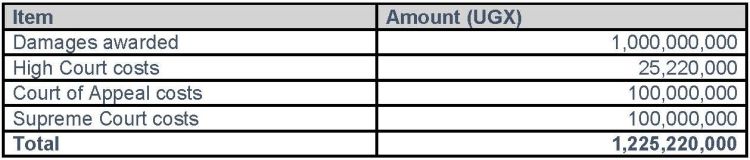
Interest over 7 Years

If BigCo drags out the litigation, it stands to make, say, UGX 2,000,000,000 gross, therefore has zero incentive to honour the judgment and much more to gain by pursuing any arguable ground of appeal. It can use the decretal award to generate enough money to pay whatever is finally determined as due, including legal fees, and may even secure the bonus of winning on appeal. Why, then, should it settle?
Now this scenario would be turned on its head if the courts awarded interest, pre-judgment and post-judgment, that fully recognised the time value of money or the coerced loan theory. If the court awarded StartCo interest at, say, a commercial rate of 23% from the date BigCo breached the contract until the date of payment, that would wipe the smile off BigCo’s face completely.
Higher interest compared with ROI
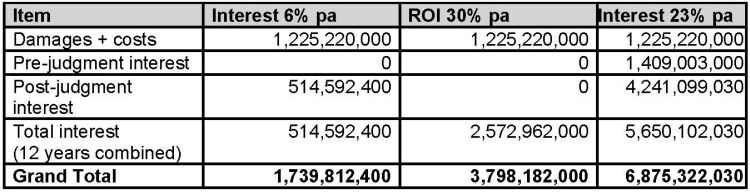
As the table above shows, awarding interest at a commercial rate of 23%, accruing for five years pre-judgment and continuing through a seven-year appeals process, takes BigCo’s total exposure to almost double what it could earn from its 30% return on equity over the same period.
Suddenly, delay no longer pays: BigCo's high-performing asset, once a source of profit, would now cost it more than it earns, eliminating the incentive to run out the appeals clock. BigCo may still choose to appeal on the merits, but it can no longer count on litigation delay itself to turn a profit.
The examples of Kenya and South Africa below show that revising the statutory rate upward to a more commercially realistic level is neither novel nor exceptional. Both jurisdictions have already done so, and Uganda has a ready template to follow.
Lessons from Kenya
Kenya, too, retains a prescribed statutory interest rate of 6%, but its courts have progressively raised the applicable rate to 12%, and more recently to 14%, bringing it much closer to prevailing commercial interest rates of around 18%.
Lessons from South Africa
In 1975, South Africa passed the Prescribed Rate of Interest Act. Under this law, interest on judgment debt is fixed at the inter-bank lending rate plus 3.5%, a formulation that keeps the applicable rate aligned with prevailing economic conditions.
Best advice for a plaintiff
For a plaintiff seeking to recover a true time value of money award in Uganda today, without waiting for a change in the prescribed rate, several practical steps can strengthen the case:
- Plead specifically for interest at a commercial rate running from the date of breach until payment in full, supported by specific and cogent evidence for the higher rate.
- Support the claimed commercial rate with concrete evidence rather than assertion. This should include prevailing commercial lending rates published by Bank of Uganda over the relevant period, expert or economist evidence quantifying the true time value of money lost during the delay.
- Frame submissions around the coerced loan theory: by withholding payment, the defendant has, in effect, obtained an interest-free loan from the claimant, and continues to benefit from the use of funds that rightfully belong to the claimant. Submissions should draw the court’s attention to what the defendant would have had to pay to borrow the equivalent sum commercially, and contrast that with the modest statutory rate, to demonstrate the windfall the defendant enjoys absent a commercial award.
Conclusion
This is the daily reality of judgment creditors across Uganda who win in court only to find that victory delivers little more than a slower route to the same financial distress they sought to escape. The tables demonstrate the scale of the problem in monetary terms, showing that a judgment awarded at the prescribed statutory rate can leave a well-resourced defendant meaningfully better off delaying payment than settling it, while a commercial rate of 23% removes that incentive altogether. Kenya and South Africa confirm that this is a solvable problem, not an immutable feature of judgment enforcement, and that Ugandan courts and lawmakers have a workable precedent to draw on.
Until that reform takes hold, StartCo is juggling its creditors and trying as best it can to expedite the appeals and the seemingly endless applications by BigCo. It is a desperate race against time, a race for survival.
As the wise Baganda say, the fruits of labour are eaten by the survivor, if the survivor can find a place of repose (“ziriibwa muwangaazi n’alabye obugyo”).
The content of this article is intended to provide a general guide to the subject matter. Specialist advice should be sought about your specific circumstances.
[View Source]