
- within Government and Public Sector topic(s)
- with readers working within the Technology industries
Overview
On August 14, 2026, the Treasury Department (Treasury) and the Internal Revenue Service (IRS) issued Notice 2026-50 providing additional interim guidance related to the section 45Q credit to extend and expand the existing safe harbor provided under Notice 2026-1. The safe harbor preserves reporting requirements for the section 45Q credit for taxpayers that report under Subpart RR of the Environmental Protection Agency’s (EPA) Greenhouse Gas Reporting Program (GHGRP) until further guidance is issued.
Notice 2026-50 provides meaningful additional certainty for existing projects that have entered the Subpart RR framework. It expands the safe harbor originally provided in Notice 2026-1 in three key ways:
- Extending the Subpart RR reporting safe harbor to qualified enhanced oil and natural gas recovery (EOR) projects,
- Permitting taxpayers to rely on the safe harbor for recapture, and
- Replacing the prior calendar-year 2025 sunset with a transition period tied to future Treasury guidance related to measurement, reporting, and verification requirements under section 45Q for secure geological storage.
This relief remains conditional, however, and it does not itself establish a replacement process for EPA approval of new monitoring, reporting, and verification (MRV) plans. Treasury and the IRS requested comments on possible long-term alternatives to Subpart RR, including ISO 27914:2026 or other methodologies. Comments are due October 30, 2026.
Background
Last year, the EPA proposed eliminating most GHGRP requirements, including Subpart RR, for reporting years after 2024. To date, the EPA has not issued a final rule to eliminate the GHGRP. On February 27, 2026, the EPA extended the deadline for Subpart RR reporting year 2025 to October 30, 2026.
Notice 2026-1 provides that, if the EPA’s electronic Greenhouse Gas Reporting Tool (e-GGRT) is unavailable for reporting year 2025 by June 10, 2026, taxpayers can rely on the safe harbor provided in that notice to satisfy the section 45Q substantiation and reporting requirements by preparing an annual report under Subpart RR as in effect on December 31, 2025 and obtaining a certification from an independent engineer or geologist that the annual report complies with Subpart RR as in effect on December 31, 2025.
However, Notice 2026-1 did not apply to taxpayers using qualified carbon oxide as a tertiary injectant in a qualified EOR project and did not address the section 45Q’s recapture requirements.
Why the Guidance Was Needed
Section 45Q(f)(2) directs Treasury, in consultation with the EPA, the Department of Energy, and the Department of the Interior, to establish adequate security measures for geological storage so that qualified carbon oxide does not escape into the atmosphere. The current Treasury regulations implement that mandate principally by incorporating Subpart RR. Under these regulations, dedicated geological storage projects must comply with applicable Subpart RR requirements and qualified EOR projects may use either Subpart RR or CSA/ANSI ISO 27916:2019.
Subpart RR requires a site-specific EPA-approved MRV plan, annual mass-balance reporting, monitoring and containment assurance, and electronic submission through e-GGRT. The EPA’s GHGRP repeal proposal would remove those reporting obligations.
Notice 2026-1 provided interim relief for 2025 dedicated storage, but it did not cover EOR projects, did not expressly resolve recapture calculations, and did not provide a transition period beyond 2025.
How the Expanded Safe Harbor Works
1. Trigger: e-GGRT unavailability
The safe harbor applies for a reporting year only if the EPA does not launch e-GGRT for that year by March 31 of the immediately following calendar year. If the EPA launches e-GGRT by that date, the safe harbor does not apply for that reporting year.
2. Eligible storage and projects
The safe harbor now applies to the Subpart RR requirements incorporated into Treasury Regulations §§ 1.45Q-3(b)(1)(ii), 1.45Q-3(b)(2)(ii), and 1.45Q-2(h)(5)(iii). This includes:
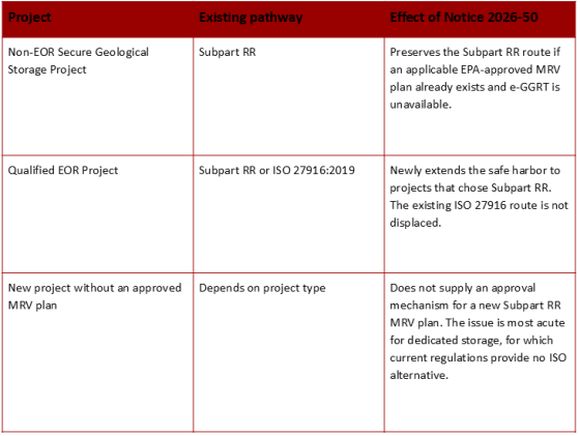
- Non-EOR secure geological storage projects, including storage associated with Class VI wells;
- Qualified EOR projects that elected the Subpart RR pathway rather than ISO 27916:2019; and
- Certain oil reservoirs that permanently ceased production, operate under a Class VI permit, and otherwise satisfy the conditions in Treasury Regulation § 1.45Q-2(h)(5).
For every project relying on the safe harbor, the taxpayer must have received an EPA-approved MRV plan that applies to the dates of storage. Storage operations must comply with Subpart RR as it existed on December 31, 2025.
3. Independent certification replaces electronic submission
Instead of submitting the annual Subpart RR report through e-GGRT, the taxpayer must prepare a report containing all information and documentation that Subpart RR, as in effect on December 31, 2025, would have required, including mass-balance calculations and monitoring and containment assurance.
The report must be submitted to a qualified independent engineer or geologist who is registered or certified in a state. The independent engineer or geologist l must certify, under penalties of perjury, that the capture and disposal comply with Subpart RR as of December 31, 2025, and that the annual report is accurate and complete. The certification must include an affidavit of independence from the taxpayer and, where a Section 45Q(f)(3)(B) election has been made, from both the electing taxpayer and the credit claimant.
4. Recapture is expressly covered
Notice 2026-50 confirms that the same independently certified annual report may be used to determine the amount of qualified carbon oxide securely stored and the quantity, if any, that leaked into the atmosphere for purposes of Treasury Regulation § 1.45Q-5. This resolves an ambiguity in Notice 2026-1 and provides a common measurement framework for current-year credit claims and recapture exposure.
5. Timing and records
The required annual report, documentation, and certification must be completed by the time the taxpayer—or any credit claimant following a section 45Q(f)(3)(B) election—timely files the relevant return, including extensions, amendments, or an administrative adjustment request. The taxpayer must retain the materials in its books and records under section 6001.
Duration of the Relief
The revised safe harbor applies to secure geological storage occurring on or after January 1, 2025, and through December 31 of the calendar year in which Treasury and IRS publish further interim guidance or proposed regulations addressing section 45Q MRV requirements. Thus, publication of successor guidance during a calendar year does not terminate the safe harbor immediately; the transition continues through year-end. The notice nevertheless remains interim guidance rather than a permanent replacement for Subpart RR.
Important Unresolved Issue: New MRV Plans
The safe harbor requires that the taxpayer have received an EPA-approved MRV plan applicable to the dates of storage. It preserves the reporting and verification pathway for a project already admitted to the Subpart RR regime, but it does not authorize Treasury, a state Underground Injection Control (UIC) agency, or a private verifier to approve a new MRV plan. If the EPA finalizes the GHGRP repeal and discontinues its Subpart RR approval function, a new dedicated storage project may still be able to obtain a Class VI permit—whether from the EPA or a state with UIC primacy—yet lack a recognized means under the current section 45Q regulations to establish secure geological storage.
Class VI permitting and Subpart RR approval serve different legal functions. A Class VI permit authorizes underground injection and protects underground sources of drinking water; state primacy transfers that permitting authority but does not transfer the EPA’s separate Subpart RR MRV approval role. Qualified EOR projects retain the alternative ISO 27916:2019 pathway, but that standard does not apply to non-EOR secure geological storage projects.
Summary: What the Safe Harbor Means for Different Project Types
The Path Toward a Permanent MRV Framework
Treasury and IRS request comments on the standard that should replace Subpart RR if the EPA finalizes its proposal, including if ISO 27914:2026 is an appropriate alternative.
Comments on Notice 2026-50 are due on October 30, 2026.
The content of this article is intended to provide a general guide to the subject matter. Specialist advice should be sought about your specific circumstances.
[View Source]