

- within Tax topic(s)
- in India
- with readers working within the Insurance and Metals & Mining industries
- within Energy and Natural Resources, Environment, Litigation and Mediation & Arbitration topic(s)
Switzerland remains excellently positioned from a tax perspective. Yet the global minimum tax is eroding one of its most important locational advantages. Rather than lapsing into tax-policy fatalism, the country should build on its proven strengths and finally implement long-overdue reforms.
Where does Switzerland stand internationally on tax?
In its report on the postulate filed by National Councillor Beat Walti, the Federal Council gives Swiss tax policy a fundamentally good report card. The federally structured tax system, the broad revenue base and the internationally moderate tax burden have all proven their worth. At the same time, it identifies an urgent need for action, particularly in corporate taxation. That is the right diagnosis. The right political conclusions now need to be drawn from it quickly.
The starting position is better than Switzerland’s tendency toward self-criticism might sometimes suggest. The fiscal quota is around 27% of GDP. The OECD average is around 34%. The burden on employment income and corporate profits is also below the level of many industrialised countries. Some caution is warranted in the comparison: mandatory health-insurance premiums and occupational-pension contributions are not counted as part of Switzerland’s fiscal quota. But even taking this caveat into account, the burden remains comparatively moderate.
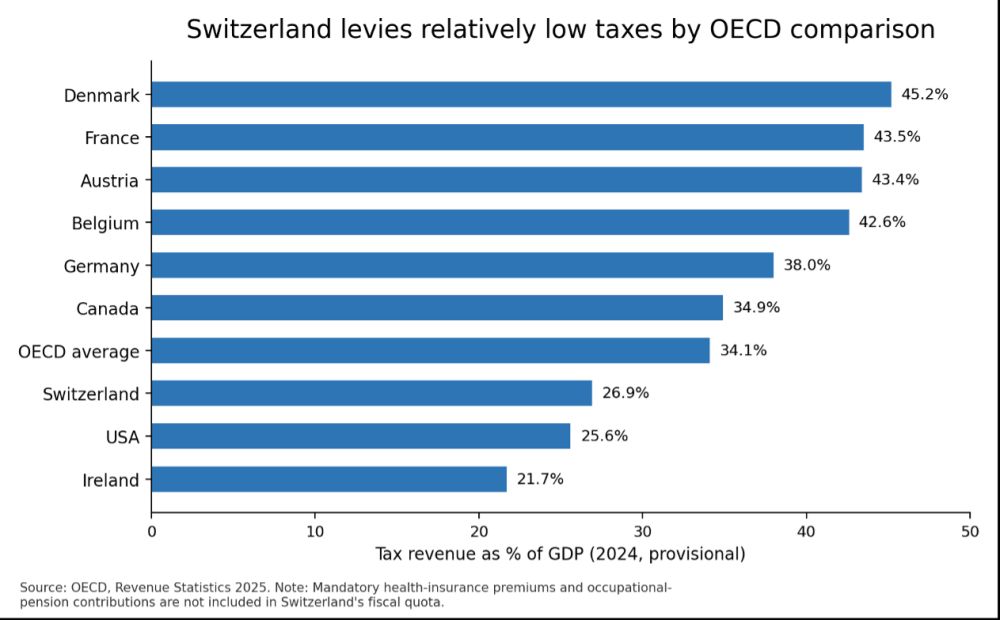
This is not a statistical footnote, but an expression of a successful understanding of the state’s role. Where the state claims a smaller share of economic value creation, businesses and individuals generally retain more resources for investment, innovation, consumption and personal responsibility. At the same time, a moderate fiscal quota forces the state to use its resources efficiently.
What are the real strengths of the Swiss tax system?
Switzerland’s strengths lie not only in the level of its taxes. Predictability, legal certainty and a comparatively accessible administration are just as important. Private individuals can generally file their tax returns electronically themselves. Companies have direct access to the cantonal tax authorities and can clarify complex matters in advance through binding tax rulings.
Because of its three levels of government and numerous deductions, the Swiss tax system is certainly not simple in every respect. But compared with the barely manageable rulebooks of large countries, it is practical, reliable and close to the citizen. This administrative quality is a distinct locational advantage in its own right.
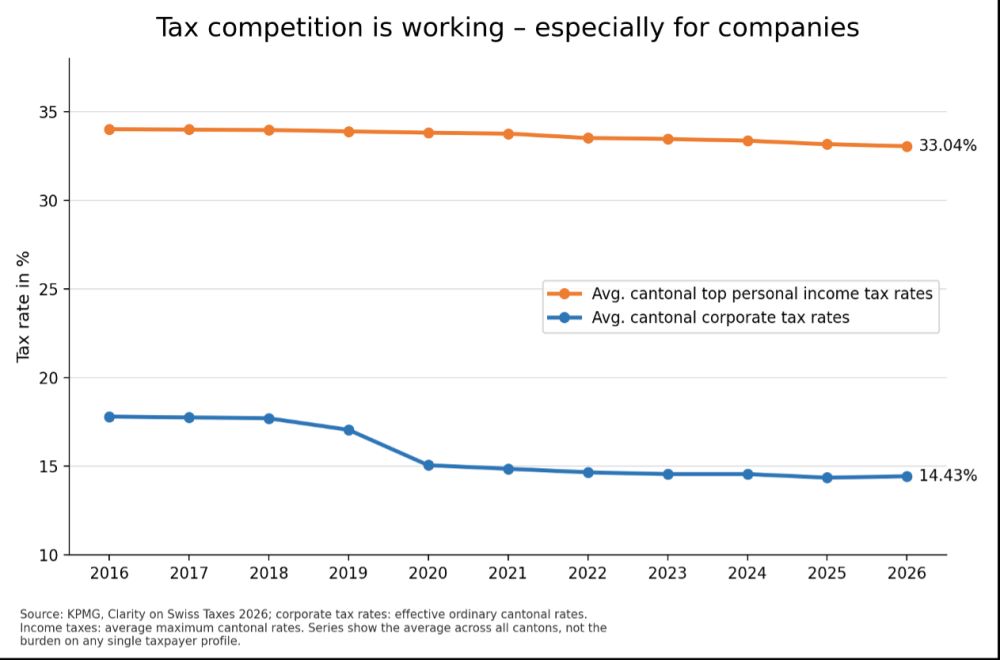
A second strength is tax competition. Around 40% of fiscal revenue is generated by the cantons and municipalities. Cantons set their own rates and must show taxpayers what services they provide in return for their money. This competition is politically intended. It disciplines spending policy, encourages a variety of solutions and prevents a single tax-policy mistake from spreading across the entire country.
This is especially evident in corporate taxation. The average cantonal corporate tax rate fell from 17.8% in 2016 to 14.43% in 2026. The decline in maximum personal income tax rates was smaller, but competition is having an effect there too. In 2026, the tax burden on high incomes ranges from 21.9% in Zug to over 43% in Geneva. In ordinary corporate taxation, Lucerne, at 11.66%, has now edged ahead of Zug at 11.71%.
Zug nonetheless remains a model. Not because of a single tax rate alone, but because of the overall package of short administrative distances, an entrepreneurial administration, legal certainty, international orientation and targeted innovation support. Since 2026 the canton has been supporting substance-based innovation and sustainability projects, responding early to the new world of minimum taxation. Other cantons would do well to take a leaf out of its book.
How can the tax base be secured over the long term?
Securing state revenue over the long term must not be confused with the highest possible tax rates. What matters is a broad and growing tax base. Companies that invest, create jobs and generate profits pay corporate tax. Their employees pay income tax, draw fewer state benefits and generate further revenue through their consumption.
It would be irresponsible to assume that every tax cut automatically leads to higher state revenue. But it is equally wrong to make the purely static assumption that a one-percentage-point cut inevitably leads to a corresponding shortfall in revenue. Taxes change behaviour. They influence work effort, business formation, financing decisions, investment and choice of location. These responses are especially pronounced among mobile companies and highly qualified workers.
Switzerland’s smart strategy is therefore: attractive rates on as broad a base as possible, rather than high rates on a shrinking base. This is how locational attractiveness and sound public finances can be combined.
What does the global minimum tax actually mean for Switzerland?
The global OECD/G20 minimum tax does not fundamentally call this model into question, but it does limit the room for manoeuvre. It applies to internationally active corporate groups with worldwide revenue of at least €750 million. The large majority of Swiss companies, in particular the SMEs that form the backbone of our economy – are not covered by it. For them, cantonal tax competition remains fully relevant.
Switzerland introduced the national top-up tax in 2024 and the international income inclusion rule (primary top-up tax) in 2025. The Federal Council has, for now, refrained from introducing the secondary top-up tax (UTPR), because it would bring considerable legal uncertainty and only limited revenue potential. That is sensible. Insofar as the groups concerned are taxed up to 15% anyway, this tax substrate should not be ceded to foreign finance ministers.
But this must not turn into voluntary Swiss over-compliance. The minimum tax should be implemented narrowly, precisely targeted and with as little administrative burden as possible. It must not be extended to SMEs, nor serve as a pretext for general tax increases. And Switzerland must continually review whether its implementation still serves its own interests, given international special rules and the fragmented participation of major states.
Minimum taxation does not end tax competition. It changes its tools. The Federal Council’s report rightly points to various options for action. Switzerland’s tax base should be better aligned with the international GloBE rules, so that companies are not over-taxed by the interplay of two different systems. At the same time, substance-based instruments should be expanded to promote investment, research, qualified jobs and genuine value creation in Switzerland.
Qualified tax credits and other internationally recognised support instruments for research and development are particularly worth considering. These must not degenerate into a subsidy bureaucracy with politically selected winners. They must be rules-based, transparent and predictable for businesses. What matters is that support is tied to real economic substance in Switzerland: to personnel, investment, innovation and entrepreneurial risk.
Switzerland has excellent conditions for this. It is home to global corporations such as Novartis and Roche, numerous international headquarters and central group functions. Google has built one of its most important development sites outside the US in Zurich. Such companies do not come for the sake of a single percentage point. They come because of the interplay of taxes, universities, skilled workers, infrastructure, legal certainty, quality of life and political stability. It is precisely this overall package that must continue to be improved.
What reforms are needed now and where does this leave Switzerland?
The changed international environment should also be used to push through reforms that are long overdue.
First, the issuance stamp duty on equity capital should be abolished. It generally taxes the raising of new equity capital at 1%, once the exemption threshold of CHF 1 million is exceeded, and brings the federal government an average of around CHF 240 million a year. It disadvantages equity capital relative to debt capital, makes recapitalisations harder and often hits start-ups before they have even generated profits. Under the minimum tax, it is also not treated as a creditable tax. The Federal Council’s report correctly concludes that cosmetic adjustments would achieve little and that abolition is the appropriate reform option.
Second, the cantons’ obligation to levy a capital tax should be reconsidered. A tax on equity capital falls due even in loss-making years, burdens young companies, and, combined with the minimum tax, leads to arbitrary over- and under-taxation. The report therefore explicitly proposes removing the obligation to levy this tax from the Tax Harmonisation Act. The decision could then again be left to the cantons.
Third, a fresh approach is needed to withholding tax. The current rate of 35% disadvantages the Swiss debt-capital market and prompts companies to issue bonds through foreign entities. Switching to the paying-agent principle could preserve the safeguarding purpose for domestic taxpayers while relieving foreign investors of the deduction. This would be more tax-neutral and would bring financing, value creation and jobs back to Switzerland.
Fourth, income taxes should be geared more strongly toward incentives to work. A flattening of the progression, fewer deductions and lower marginal tax rates need to be seriously examined. A flat tax must not, however, be introduced mechanically: the revenue-neutral model examined by the Federal Council would place a greater burden on unmarried individuals with taxable income up to around CHF 135,000. Any reform must therefore be designed so that work and entrepreneurship become more attractive without turning the middle class into the ones footing the bill.
Despite the financial crisis, the pandemic, geopolitical tensions, a strong franc and growing international regulation, Switzerland has held its own remarkably well. It owes this not to some grand master plan, but to its ability to respond pragmatically to change, to distribute responsibility in a decentralised way, and to create good conditions for private initiative.
This is exactly the path it must continue on. The OECD minimum tax is no reason to give up tax-policy competition. It is an incentive to pursue it more intelligently.
Switzerland should not gold-plate the minimum tax, but limit it to what is necessary. It should design its tax base to be internationally compatible, promote innovation and genuine value creation, dismantle harmful capital taxes, and leave the cantons as much room for manoeuvre as possible. Above all, it must not lose sight of the goal: a simpler, more predictable and internationally robust tax system with as moderate a burden as possible.
Switzerland is today one of the most attractive business locations in the world. The task is not to repair a failed model. It is to resolutely continue developing a successful one.
The content of this article is intended to provide a general guide to the subject matter. Specialist advice should be sought about your specific circumstances.
[View Source]