

Introduction
Digital advertising has become central to brand visibility and market engagement across sectors. Increased reliance on social media, influencer marketing, programmatic advertising, and datadriven targeting has, however, expanded regulatory exposure for advertisers operating in or targeting the Nigerian market. Legislative and regulatory developments, most notably the Advertising Regulatory Council of Nigeria Act 2022 ("ARCON Act") and the Nigeria Data Protection Act 2023 ("NDPA"), have materially reshaped the compliance landscape.
This article examines the current regulatory framework governing digital advertising in Nigeria, highlights recurring areas of compliance risk, and outlines practical considerations for managing enforcement exposure in an increasingly regulated environment.
Regulatory Framework Governing Digital Advertising in Nigeria
Digital advertising in Nigeria operates within a multi-layered regulatory environment that combines sector-specific advertising controls, consumer protection oversight, and data protection regulation. The framework, as outlined below, defines the compliance obligations applicable to brands, agencies, influencers, and digital platforms operating in or targeting the Nigerian market.
- Advertising in the ARCON era: The Advertising Regulatory Council of Nigeria ("ARCON") establishes a broad, technology-neutral regulatory framework governing all advertising and marketing communications directed at the Nigerian market. Unlike its predecessor, the Advertising Practitioners Council of Nigeria Act 1988 ("APCON Act"), the ARCON Act extends regulatory oversight beyond practitioners to advertisers, brand owners, digital platforms, influencers, and content creators, etc. It also provides that advertisements directed at the Nigerian market require prior approval from ARCON's Standards Panel, and failure to obtain such approval is an offence1 . Advertising is defined under the ARCON Act broadly to cover any act or activity, whether direct or indirect, intentional or not, connected to the creation, development, production, or dissemination of an advertisement, brand, or marketing idea. It is also pertinent to note that under the ARCON Act, any person or entity seeking to practise advertising or marketing communications in Nigeria must register with the ARCON2 .
ARCON is responsible for ensuring that advertisements are legal, honest, decent, mindful of the Nigerian culture, and free from misinformation or disinformation3 . The ARCON Act applies regardless of the medium used and extends to foreign advertisers whose campaigns target or are accessible within Nigeria. Accordingly, every social media and foreign advertisement requires prior approval and must comply with the provisions of the ARCON Act. The Nigerian Code of Advertising 2023 ("NCA 2023"), further operationalises ARCON's mandate and sets statutory compliance standards. Additionally, ARCON's August 2022 notice and January 2023 policy emphasise the promotion of local indigenous content.
While implementing and enforcing compliance remains challenging in practice due to the nature of the internet and global digital campaigns, the ARCON Act remains Nigeria's primary legal framework governing all advertising activities until it is reviewed. ARCON has shown a strong enforcement stance, resulting in real penalties. Companies are now being sanctioned for social media posts that are considered advertisements. The message is clear: even a routine social media post promoting a product may now constitute a regulatory offence. - Safeguarding Consumers through Truthful Advertising: The Federal Competition and Consumer Protection Act 2018 ("FCCPA") complements ARCON's oversight by prohibiting false, misleading, or deceptive representations in advertising. Under the FCCPA, advertisements that exaggerate product attributes, omit or conceal material terms, or otherwise create false impressions capable of influencing consumer decisions may trigger investigation and enforcement by the Federal Competition and Consumer Protection Commission ("FCCPC"). Such enforcement may arise through consumer complaints, market surveillance, or regulatory review of marketing practices, as the FCCPC exercises concurrent jurisdiction over deceptive advertising and unfair marketing practices. Influencer marketing presents particular sensitivity in this regard because endorsements may appear as independent opinions, and undisclosed commercial relationships can mislead consumers about the nature of the promotion.
The FCCPA also prescribes marketing standards relating to pricing and product representations, and requires disclosure of paid partnerships or other material connections, with liability for non-compliance extending to both brands and influencers / endorsers. - Data Protection and Targeted Advertising: Modern advertising models frequently rely on cookies, audience analytics, and targeted marketing tools, which typically involve the processing of personal data. Where such processing occurs, the Nigeria Data Protection Act 2023 ("NDPA") applies. Notably, the NDPA grants data subjects the right to object, at any time, to the processing of their personal data for direct marketing purposes, including profiling related to such marketing. Once an objection is made, the personal data must no longer be processed for that purpose 4 .
In March 2025, the Nigeria Data Protection Commission issued the Nigeria Data Protection Act (General Application and Implementation Directive) 2025, clarifying that direct marketing constitutes personal data processing that requires consent (the "Directive"). While the NDPA and the Directive do not regulate advertising content or displace ARCON's vetting regime, they heighten compliance exposure for advertisers deploying personalised or analytics-driven campaigns, including foreign entities, targeting Nigerian consumers. - Brand Identity and Sector-Specific Compliance: Digital advertising engages intellectual property rights, sector-specific regulation, and platform governance requirements. From an intellectual property perspective, the unauthorised use of images, music, video clips, slogans, logos, or brand identifiers in advertising content may infringe existing copyright or trademark rights. Conversely, advertisers, brand owners, content creators, and influencers should proactively protect their own intellectual property by registering their distinctive trademarks and securing copyright protection over original content, thereby strengthening enforcement rights and mitigating infringement risks.
Advertisements relating to regulated products or sectors may also require sector-specific approvals before publication. For instance, advertisements relating to food, pharmaceuticals, and other regulated consumables may require prior clearance from the National Agency for Food and Drug Administration and Control ("NAFDAC"). Non-compliance may trigger parallel sanctions beyond ARCON oversight.
Furthermore, advertisers must comply with the advertising policies and community standards of social media platforms and other digital intermediaries through which advertising content is distributed. While compliance with platform rules does not replace statutory obligations under Nigerian law, failure to meet such requirements may result in content removal, account suspension, or advertising restrictions, thereby creating both operational and reputational risk.
Managing Compliance Risks for Digital Campaigns
Effective risk management requires early, structured, and sustained legal input throughout the lifecycle of a digital campaign. Regulatory considerations should be integrated at the planning stage, rather than treated as a post-launch validation exercise. This is particularly critical where campaigns involve influencer partnerships, comparative or performance-based claims, behavioural targeting, cross-border dissemination, or products operating within regulated sectors. In practical terms, organisations should adopt a compliance-by-design approach.
Practical Checklist for Managing Compliance Risks
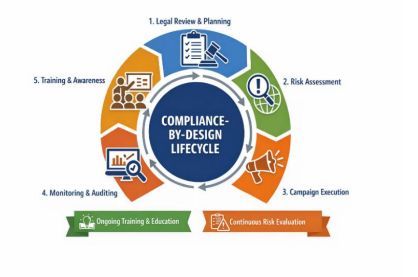
- . Integrate legal review early – embed compliance in planning, not just postlaunch. Formalise internal reviews through documented approval workflows.
- Document claims and evidence – ensure all marketing statements are supported by credible and verifiable evidence.
- Contractual clarity with collaborators – bind advertising agencies, influencers, and other digital collaborators to clear regulatory obligations.
- Ongoing risk monitoring and assessment – continuously identify and address potential compliance gaps.
- Training and awareness – equip staff, marketing teams, and external collaborators with knowledge of laws, standards, and internal compliance protocols.
At the same time, digital marketers must proactively ensure compliance within their personal campaigns and when acting on behalf of larger brands or corporate clients. Regulatory responsibility is no longer confined to corporate entities alone; individuals operating within the digital ecosystem are increasingly subjected to scrutiny. Proactive compliance also involves risk assessment and ongoing training. Before launching campaigns, organisations should identify potential regulatory risks and assess the likelihood and impact of non-compliance. Awareness and accountability should be embedded across the campaign lifecycle.
As regulatory enforcement becomes more coordinated and visible, compliance should not be viewed merely as a defensive shield against sanctions. Rather, proactive compliance operates as a strategic asset, strengthening brand integrity, avoiding penalties, enhancing consumer trust, mitigating reputational risk, and supporting sustainable market positioning.
Conclusion
Nigeria's advertising regulatory framework has evolved to reflect the realities of a digital and datadriven economy. Regulatory oversight now extends far beyond traditional media, encompassing online platforms, influencers, and cross-border digital activity. In this environment, businesses that deliberately integrate advertising compliance and data protection considerations into their digital strategy, supported by risk assessment and staff training, will be better positioned not only to mitigate regulatory risk but also to preserve brand equity, strengthen consumer confidence, and maintain competitive visibility in an increasingly regulated marketplace.
Footnotes
1. Section 54, ARCON Act
2. Section 21(1), ARCON Act
3. Section 2(2), ARCON Act
4. Section 34 (3)(4), NDPA
The content of this article is intended to provide a general guide to the subject matter. Specialist advice should be sought about your specific circumstances.
